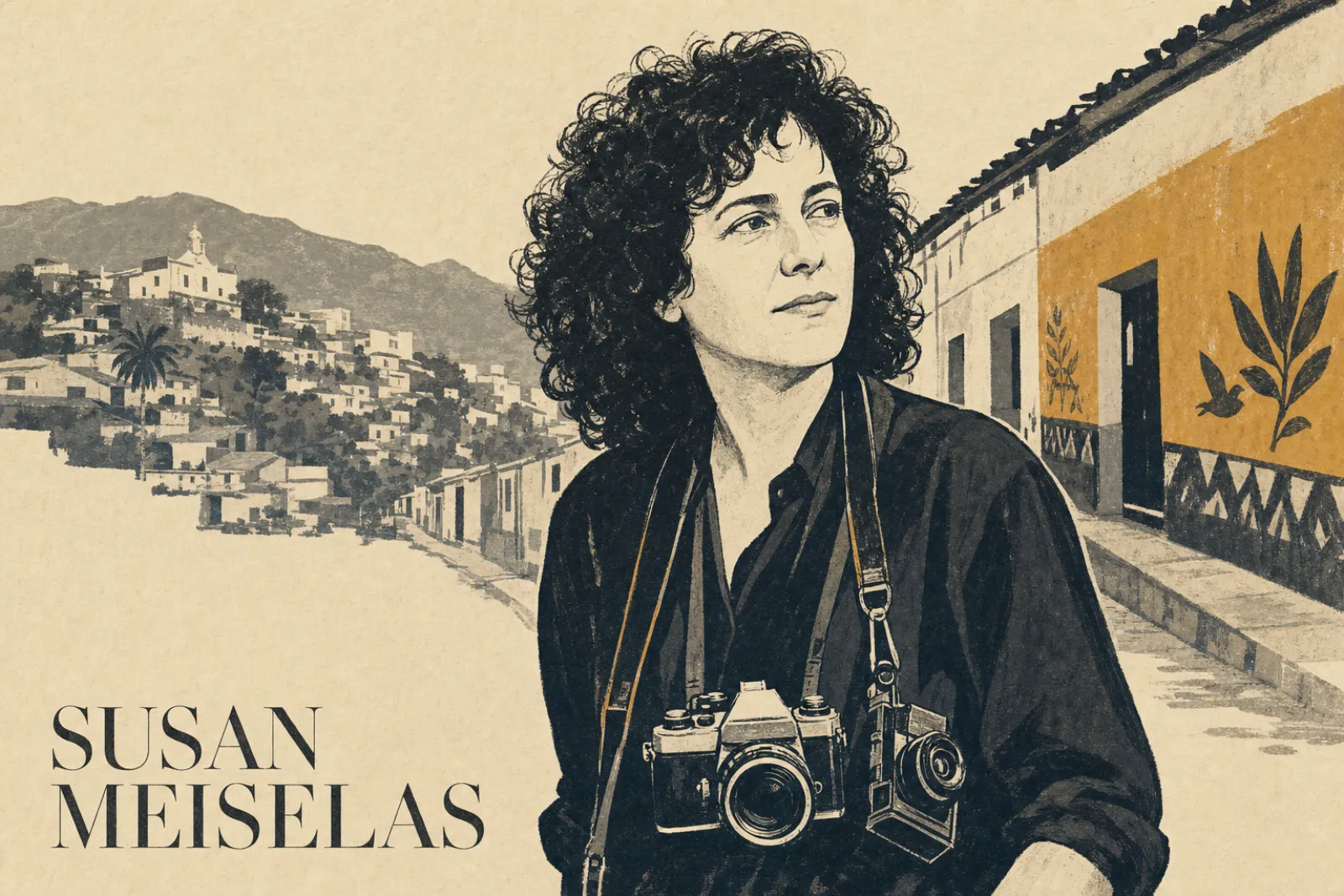
Susan Meiselas is an American documentary photographer, born in Baltimore, Maryland, in 1948, and a member of Magnum Photos. Her subjects have included women working in carnival strip shows in New England, the insurrection in Nicaragua in 1978 and 1979, and the history of the Kurds. She is known for the Nicaragua photograph called Molotov Man, and for a way of working that keeps returning pictures to the people in them.
Meiselas came to photography through teaching, not through newspapers. She studied at Sarah Lawrence College and took a master’s degree in visual education at Harvard University, where she studied with Barbara Norfleet. She worked as an assistant film editor on Frederick Wiseman’s documentary Basic Training. She joined Magnum in 1976 and became a full member in 1980, in the same agency as Gilles Peress, who questioned the conventions of the news picture from a different direction. Her long stays with her subjects place her near Mary Ellen Mark in the documentary tradition, but Meiselas went further in handing part of the story to the people photographed.
Classrooms, a boarding house and the carnival
From 1972 to 1974 Meiselas ran photography workshops in New York City public schools, and she worked on rural photography programmes for the state arts commissions of South Carolina and Mississippi. Her early book Learn to See (1975) came out of that teaching.
During the summers of the early 1970s, while she was still teaching, she followed the women who worked in strip shows at country fairs in New England, including fairs in the Vermont towns of Essex Junction, Woodstock, Tunbridge and Barton. She photographed them and the life of the carnival around them, and she recorded interviews with her subjects. The book Carnival Strippers (1976) was built from both, and a later edition carried the recordings themselves on a disc. The work was shown at the Whitney Museum of American Art, which also republished the book in 2003.
The subject is adult, but the lesson is general. Meiselas did not let the photograph speak alone. The people in the pictures describe their own lives in their own terms, and the reader weighs that against what the camera shows. It is an early and clear example of what a photo essay can do that a single frame cannot.
How do you write the words that go with a documentary picture? How to write photo captions covers what a caption must answer and how editorial captions differ.
Nicaragua, June 1978 to July 1979
In 1978 Meiselas went to Nicaragua, where a popular insurrection was building against the Somoza government. She stayed through the fall of the regime in July 1979. She photographed the insurrection in colour, and the work brought her international recognition.
The best known of them shows a Sandinista fighter, later identified as Pablo Arauz, about to throw a petrol bomb made from a soft drink bottle while holding a rifle in his other hand. It was taken in Estelí on 16 July 1979, in the last days of the regime. The image did not stay in her control. It was reproduced in Nicaragua on things as different as the cover of a church publication and a box of matches, and it became a symbol of the revolution.
The book Nicaragua, June 1978 to July 1979 (1981) set her photographs with historical documents and the testimony of Nicaraguans. She received the Robert Capa Gold Medal. In 1981 she was in El Salvador, where she photographed the aftermath of the El Mozote massacre, working with Raymond Bonner and Alma Guillermoprieto. She then edited El Salvador: Work of Thirty Photographers (1983) and, later, Chile from Within, a collection of work by photographers living under the Pinochet regime.
Curious how news photography differs from other documentary work? Photojournalism covers its history and the ethics that hold it together.
Going back, and building archives
Meiselas returned to Nicaragua repeatedly. For the film Pictures from a Revolution (1991), made with Richard P. Rogers and Alfred Guzzetti, she looked for the people in her photographs, ten years on. In 2004, for the twenty fifth anniversary of the revolution, she brought 19 of the photographs back as mural sized prints and hung them at the places where they had been made. The project was called Reframing History, and the reactions of passers by were filmed.
In the early 1990s she began a long project on Kurdistan, supported by a MacArthur Fellowship awarded in 1992. Her own photographs were only one part of it. She gathered family snapshots, studio portraits, maps, documents and the pictures made by earlier travellers and officials, and assembled them into Kurdistan: In the Shadow of History (1997) and the online archive akaKURDISTAN (1998). Later books include Pandora’s Box (2001), Encounters with the Dani (2003) and A Room of Their Own, made in workshops with women in a refuge in the Black Country, England, in 2015 and 2016. She became president of the Magnum Foundation when it was founded in 2007. Her honours include the Hasselblad Award in 1994 and the Deutsche Börse Photography Foundation Prize in 2019.
How Meiselas makes a documentary picture carry more than one voice
The teachable part of her work is less about the lens than about what happens before and after the shutter.
- Time. Carnival Strippers took three summers. Nicaragua took more than a year, and then decades of return visits. Long documentary projects change what people let you see.
- More than the fighting. Her Nicaragua pictures include a funeral procession, travellers being searched on a road, graffiti on a burned house and a rural main street, as well as fighters waiting for an attack. The viewer is given the whole situation, not one hero.
- Colour as information. In the Nicaragua pictures colour is not decoration. It describes the place and the events. Colour in photography explains how colour directs attention and sets mood.
- Words and sound beside the image. Interviews, testimony and documents sit on the page with the photographs. The picture is treated as evidence that needs context.
- Following the picture afterwards. She tracked where Molotov Man went, who used it and what it came to mean, and made that part of the work.
- Giving pictures back. The murals of 2004 and the Kurdish archive both return images to the communities they came from. This is a practical answer to questions about consent and the ethics of photographing people.
Her books are built with the same care. Order, pairing and the placing of text decide what the reader understands. Photo sequencing covers how to edit and order a body of work.
Photographs and projects to look for
- Carnival Strippers (photographed in the early 1970s, published 1976). Photographs of women working in travelling shows at Vermont fairs, made over several summers. Look at the pictures first, then at the interview material that goes with them, and notice how the words shift your first reading.
- Prince Street Girls (begun in the mid 1970s). A group of girls from Little Italy in New York, among them JoJo, Carol and Lisa, photographed around Prince and Mott Streets over several years as they grew from childhood into adolescence. Notice how a series about the same few people gains meaning with each added year.
- Molotov Man (Estelí, Nicaragua, 16 July 1979). The figure is caught as he is about to throw, a bottle in one hand and a rifle in the other. Note the details that fix the moment: the bottle, the rifle, the beret, the crucifix. A study in timing and gesture.
- Traditional mask used in the popular insurrection (Monimbo, Nicaragua, 1978). A traditional mask, put to a new use during the uprising. One object carries both local custom and the politics of the moment, and the picture says both at once.
- Cuesta del Plomo (Nicaragua). A hillside outside Managua that was used as a place to leave the bodies of people killed under the Somoza government, with human remains visible. It is described here only in general terms. The lesson is that a landscape can be evidence, and that plain description is sometimes the strongest choice.
- Kurdistan: In the Shadow of History (1997). A book in which most of the pictures are not by the author. Look at how found photographs, captions and documents are laid out so that a people’s history is told through many hands.
Thinking about making a book of your own project? Photo book design covers planning, format and layout.
Try this: one portrait, their words
Allow 20 minutes. Choose someone at work or at a hobby: a relative cooking, a neighbour in a garden, a friend at a bench.
- Ask permission and explain that you will show them the result.
- Make no more than twelve frames. Include the place and the tools, as in an environmental portrait.
- Then put the camera down and ask one question: “What should people know about what you are doing here?” Write the answer down word for word, or record it on your phone.
- Show them the frames and let them choose the one they think is truest. Note whether it is the one you would have chosen.
- Put their chosen picture and their sentence together. Give them a copy.
Questions people ask about Susan Meiselas
What is Susan Meiselas best known for?
She is best known for her colour photographs of the Nicaraguan insurrection of 1978 and 1979, above all the picture called Molotov Man, and for the earlier book Carnival Strippers. She joined Magnum Photos in 1976.
Who is the man in Molotov Man?
He was identified as Pablo Arauz, a Sandinista fighter known as Bareta. Meiselas photographed him in Estelí in July 1979 as he threw a petrol bomb at one of the last National Guard positions. She found and interviewed him years later.
What is the book Nicaragua, June 1978 to July 1979?
It is her book of colour photographs of the insurrection against the Somoza government, published in 1981. The title gives the dates the pictures cover. Her coverage of Nicaragua earned her the Robert Capa Gold Medal in 1979.
What was Reframing History?
In 2004, twenty five years after the revolution, Meiselas returned to Nicaragua with 19 mural sized prints of her photographs and installed them at the sites where they were taken. People passing by were filmed as they responded to pictures of their own streets and their own past.
Meiselas is one of the photographers in the A to Z of photographers, and she is quoted on the photography quotes page.