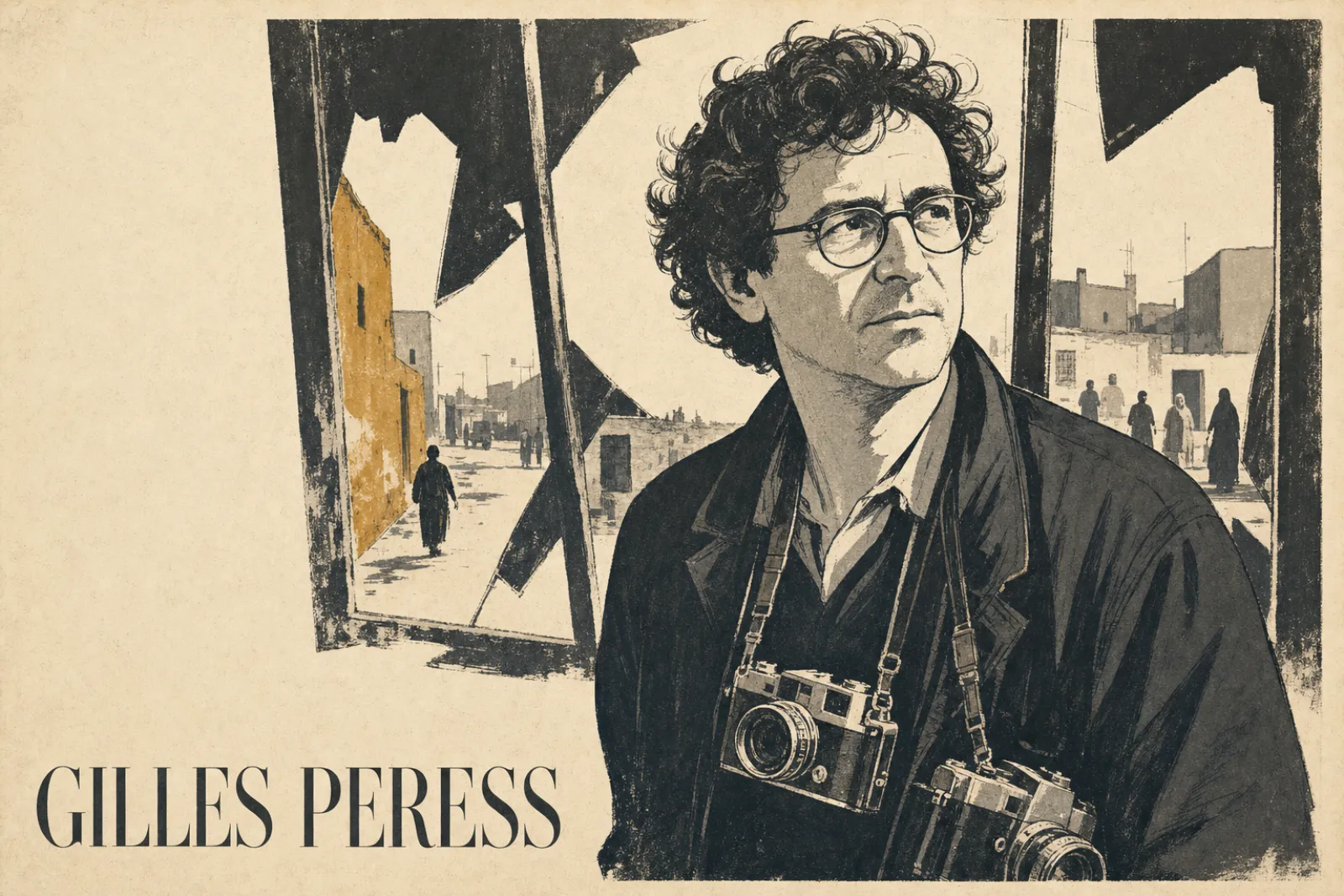
Gilles Peress is a French photographer, born in Neuilly-sur-Seine in 1946, who joined Magnum Photos in the early 1970s. He photographed the conflict in Northern Ireland, the Iranian revolution, the war in Bosnia and the genocide in Rwanda. He is known for dense, fractured frames and for books, beginning with Telex Iran, that refuse to reduce a conflict to one clear picture and one clear caption.
Peress did not train as a photographer. He studied political science and philosophy in Paris, at the Institut d’Études Politiques from 1966 to 1968 and then at the University of Vincennes. He came out of those years convinced that political language failed to describe what was actually happening to people, and he turned to the camera as another way to find out. He made his first series in 1970. At Magnum he worked in the same agency as Susan Meiselas, who was also rethinking what a news photograph owed its subjects. His honours tie him to an older line of committed reportage: he received the grant named for W. Eugene Smith and an award named for Ernst Haas. His pictures look like neither man’s.
Derry, 30 January 1972
Peress was 25 and new to the profession when he photographed a march in Derry, Northern Ireland, against internment without trial. British paratroopers opened fire and thirteen people were shot dead. The day became known as Bloody Sunday. One of his photographs shows the crowd at the bottom of William Street about a minute before the shooting began. Others show one of the victims, Patrick Doherty, moments before and after he died.
He kept returning to the north of Ireland over roughly two decades. His work appeared in magazines such as the Sunday Times of London and The New York Times Magazine. Much of the Northern Ireland material dates from the 1980s, and it waited some thirty years for its final form as a book.
What separates news photography from other kinds of picture making? Photojournalism covers its history and the rules of credibility it runs on.
Tehran by telex
Peress went to Iran during the seizure of the American embassy in Tehran and its hostages. He stayed five weeks over the winter of 1979 to 1980. Pictures from that trip show the embassy in Tehran, a demonstration in a stadium in Tabriz and the courtyard of the main mosque in Qom.
The book that followed, Telex Iran: In the Name of Revolution, was published in 1984. It is not a conventional news account of the embassy crisis. It is a personal document of what one photographer saw, met and felt in those weeks, and it is regarded as a landmark among photobooks. It belongs to a self questioning kind of documentary photography, in which the photographer’s own position is part of the subject.
The pictures themselves are crowded. Posters, faces and slogans pile up in a single frame. A viewer who does not know the city shares the photographer’s own position: an outsider surrounded by signs.
Hate Thy Brother: Bosnia, Rwanda and the graves
Peress grouped his later work under the title Hate Thy Brother, a cycle of documentary narratives about intolerance and the return of nationalism. In 1993 he photographed the war in Bosnia. Farewell to Bosnia was published in 1994. In 1994 he photographed the aftermath of the genocide in Rwanda and the refugee camps across its borders, at Benaco in Tanzania and Goma in what was then Zaire. That work became The Silence, which received an Infinity Award from the International Center of Photography in 1996. The Graves: Srebrenica and Vukovar followed in 1998.
These books deal with mass killing, and they are hard to look at. They are described here only in general terms. What matters for a student of photography is the stance. Peress photographed in these places as someone gathering evidence. He later taught human rights and photography at Bard College and was a senior research fellow at the Human Rights Center of the University of California, Berkeley.
At Magnum he served three times as vice president and twice as president. His awards include a Guggenheim Fellowship, the W. Eugene Smith grant in 1984 and the Dr. Erich Salomon Prize. His prints are held by the Museum of Modern Art, the Metropolitan Museum of Art and the Whitney Museum of American Art in New York.
How a Peress photograph and a Peress book are put together
- Close, and from inside. Many of the Northern Ireland pictures are made on street corners, where two streets run away from the camera in a V. The shape recurs as a figure for a divided city.
- Several things at once. Many frames hold people and events at more than one distance, with signs, posters or buildings behind them. Little is cleared away to isolate a subject. Layering foreground, midground and background explains the structure.
- Meaning from collision. Printed images share the frame with living faces, and in the books celebration sits beside mourning. The work relies on juxtaposition, and the viewer is left to work out the connection.
- One continuous account. Pictures from different days and years are made to sit together as a single narrative. Working in black and white is one way to give a long project that kind of unity.
- Everyday life kept in. Celebrations, marches and funerals are given as much room as riots, and the same kinds of scene come back again and again. Faces and ordinary human moments matter more than spectacle.
- The book as the real work. Whatever You Say, Say Nothing arranges Northern Ireland pictures from the 1980s into 22 semi fictional days in place of a dated chronicle. Page design sets the pace: full page pictures, grids of small frames that speed things up, and single images surrounded by white that slow them down.
The last point is the one most easily borrowed. The order of pictures, and the size at which each is shown, changes what a set of photographs says. Photo sequencing covers editing, pairing and pacing.
Wondering whether a picture needs words at all? How to write photo captions sets out what a documentary caption is expected to answer, a convention his books lean on far less than a news page does.
Photographs and books to look for
- Bottom of William Street, Bloody Sunday, Derry (1972). A crowd photographed about a minute before the paratroopers fired. Nothing violent is in the frame. The tension comes from how the crowd is arranged and from what the title tells you is about to happen.
- Posters in front of the U.S. Embassy, Tehran (1979). From the Telex Iran work. Look at how much of the frame is given to printed images, and ask what the subject of the picture is.
- Telex Iran: In the Name of Revolution (1984). Read it as a whole. Notice how it reads as one person’s five weeks of encounters, not as a summary of the crisis.
- Farewell to Bosnia (1994). It followed his work in Bosnia in 1993. His pictures from that year include Bosnian Muslim refugees at Travnik and the evacuation of Jews from Sarajevo: people uprooted and in transit.
- The Silence (Rwanda, 1994). A book about the aftermath of genocide, including the massacre site at Nyarubuye and the refugee camps. It is not suitable for every reader. Look at how the title tells you to read the pictures.
- Whatever You Say, Say Nothing (2021). Two volumes and about 1,000 pages, published by Steidl with a companion volume, Annals of the North. Follow one of the 22 days from start to finish and watch how repetition, not climax, carries the meaning.
Thinking of turning a long project into a book? Photo book design covers planning, format and layout.
Try this: three layers, no clean background
Allow 20 minutes in a busy public place: a market, a station entrance or a street corner where two streets meet.
- Use the widest setting on your phone or a wide angle lens, and switch to black and white if your camera allows it.
- Stand at the corner so that the two streets run away from you in a V.
- The constraint: every frame must hold three things at three distances. Something within arm’s reach that the edge of the frame cuts, something happening four or five metres away, and writing or pictures on a wall behind.
- Make 24 frames without moving more than a few steps. Do not wait for the scene to simplify.
- Choose six and lay them out twice: once as a grid of six small pictures, once as one large picture alone. Notice how the same material reads differently.
Photograph public scenes, not individuals in distress, and follow the usual courtesies of street photography.
Questions people ask about Gilles Peress
What is Gilles Peress known for?
He is known for long projects on conflict: Northern Ireland from 1972 onward, Iran in 1979, Bosnia in 1993 and Rwanda in 1994. His books Telex Iran, Farewell to Bosnia, The Silence and Whatever You Say, Say Nothing are studied as much for their structure as for their single images.
Did Gilles Peress photograph Bloody Sunday?
Yes. He was in Derry on 30 January 1972 photographing a march against internment without trial when British soldiers shot thirteen people dead. His pictures from that day are held in museum collections, including the Whitney Museum of American Art.
What is Telex Iran?
It is a book published in 1984, made from five weeks of photographing in Iran over the winter of 1979 to 1980, during the seizure of the American embassy in Tehran. It is a personal account of what he saw, not a conventional news report.
How is Whatever You Say, Say Nothing organised?
The book is described as documentary fiction. Peress arranged photographs made over many years into 22 semi fictional days, to show how each day in a long conflict repeats others like it. The companion volume, Annals of the North, supplies essays, documents and context.
Peress is one of the photographers in the A to Z of photographers, and he is quoted on the photography quotes page.