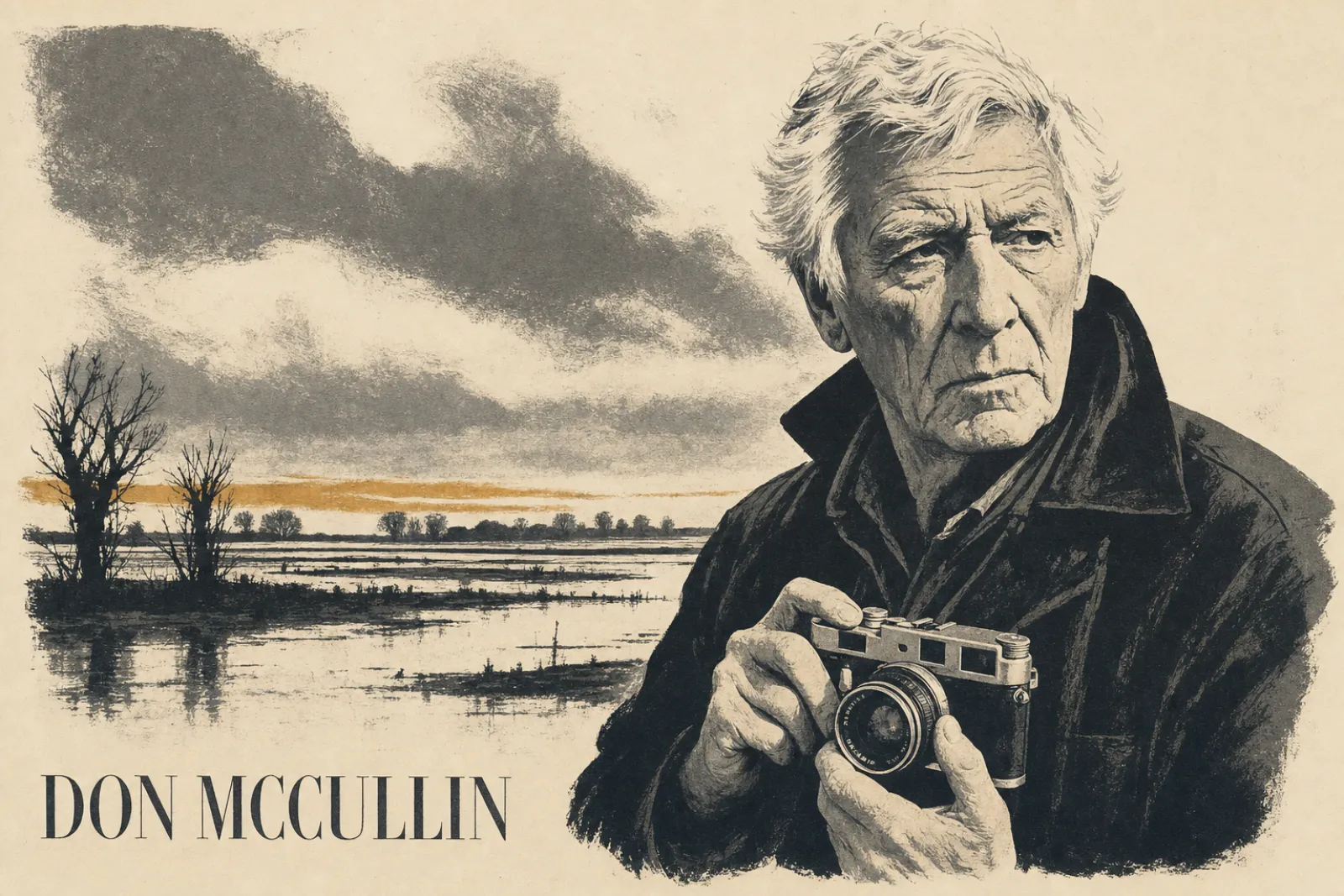
Don McCullin (born 1935) is a British photojournalist who covered wars, famines and poverty for The Observer and The Sunday Times Magazine from the late 1950s to the 1980s. He worked in Cyprus, the Congo, Vietnam, Biafra, Cambodia, Bangladesh, Northern Ireland and Lebanon, and in the poorest streets of Britain. He is known for dark, direct black and white pictures of people caught in conflict, above all a shell-shocked American marine photographed at Hue in 1968.
McCullin had no formal training in photojournalism. He learned to process film during National Service in the Royal Air Force and taught himself the rest on the streets where he grew up. His work belongs to the age of the weekly picture magazine, when one photographer could be given many pages and weeks in the field. Lee Miller had reported the Second World War for a British magazine a generation earlier. James Nachtwey carried the same kind of close reporting into the wars of the 1980s and 1990s.
Finsbury Park, a Rolleicord and The Guvnors
McCullin was born in St Pancras, London, on 9 October 1935 and grew up in Finsbury Park, a poor district in the north of the city. During the Blitz he was evacuated to Somerset. He won a scholarship to Hammersmith School of Arts and Crafts but left at 15, after his father died, to earn a wage.
Called up for National Service, he was posted with the RAF as a photographer’s assistant and spent much of his time in the darkroom. In Nairobi he bought his first camera, a Rolleicord twin lens reflex. Back in London he pawned it, and his mother redeemed it.
In 1958 he photographed a local gang, The Guvnors, posing in their suits in the shell of a bombed house. After the gang was linked to the killing of a policeman, he took the picture to The Observer, which published it. In 1961 he travelled to Berlin to photograph the building of the Wall. Those pictures won a British Press Award and a contract with the paper.
Wondering how people make a start in news photography? Photojournalism as a career looks at the work and the routes into it.
Eighteen years at The Sunday Times Magazine
In 1964 The Observer sent McCullin to the civil war in Cyprus, his first experience of live conflict. His picture of a Turkish Cypriot woman mourning her husband was named World Press Photo of the Year. The same year he went to the Congo for the German magazine Quick.
From 1966 to 1984 he worked for The Sunday Times Magazine. He went to Vietnam many times, and in 1968 spent eleven days with American marines during the battle for Hue. That year a Nikon F camera he was carrying stopped a bullet. He photographed starving children in Biafra in 1968 and 1969. In 1970 he was badly wounded by a mortar in Cambodia. In 1971 he covered the war and the refugee camps in Bangladesh and the street fighting in Northern Ireland. He went to Beirut in 1976 and again in 1982, when he photographed the aftermath of the killings in the Sabra and Shatila camps.
Between wars he photographed Britain. He spent time with homeless men and women in Aldgate and Whitechapel in the East End of London, and he worked in Bradford and other northern towns as their industries closed. These pictures use the same method as the war work: get near, stay, and look people in the face.
In 1982 he was refused a place with the British forces going to the Falklands. He left the magazine in 1984. Later assignments included the Kurdish refugees leaving Iraq in 1991 and, in 2000, the effects of AIDS in Africa for Christian Aid.
Asking where the line sits when the people in front of the camera are in distress? Photography etiquette and ethics sets out the questions to weigh.
Somerset, still lifes and the Roman frontier
From the 1980s McCullin turned more and more to quiet subjects. He made still lifes, arranging bronzes he had collected with flowers and plants from the garden. He photographed the fields and woods of Somerset, and travelled to Scotland, Northumberland and Hadrian’s Wall. He returned often to India, which he first visited in 1966.
His book Southern Frontiers, published in 2010, is a study of the ruined buildings on the southern borders of the Roman Empire. His landscapes are as dark as the war pictures, and have been compared to battlefields. He was made a Commander of the Order of the British Empire in 1993 and was knighted in 2017. Tate Britain held a retrospective in 2019.
What makes a McCullin picture hit so hard
He stood close and at eye level. Most of the well known pictures were made within a few steps of the subject, with the camera at the height of the person’s face. There is no telephoto distance to hide behind. The person fills the picture, which is the plainest use of filling the frame.
He waited for the look. Many of his subjects stare straight into the lens, or straight past it. He made five frames of the marine at Hue on 35mm film and has said every negative was the same, because the man never moved or blinked. The skill was recognising that the picture was already there and not interrupting it.
He composed even under fire. Figures are placed against clear backgrounds, heads are kept clean of clutter, and the frame is held level. The order in the picture is what lets a viewer keep looking at a subject that would otherwise make them turn away. The core ideas are covered under photography composition.
He printed dark. McCullin made his own gelatin silver prints in his darkroom, going back to a negative again and again. Skies are burned down, blacks are deep and faces are lifted out of the gloom. See dodging and burning for the technique and black and white printing for how tone is controlled on paper.
He used bad weather as light. The landscapes are full of low cloud, bare trees and wet ground. Flat grey light turns into drama once the print is pushed toward contrast. The same days most people leave the camera at home are covered in photography in bad weather.
His titles are captions. A McCullin title states who, where and when, and nothing else. The facts anchor the picture to an event, so it cannot drift into being only a striking image.
Want to see how a monochrome picture is planned from the start? Black and white photography covers what to look for and how to edit it.
Photographs to look for
- The Guvnors in their Sunday Suits, Finsbury Park, London, 1958. Members of a north London gang pose in their suits in the shell of a bombed house. Notice how the ruin frames the group and places them in their own district.
- Near Checkpoint Charlie, Berlin, 1961. One of the pictures he paid his own way to make while the Wall was going up. The set is about watching and waiting at a new border.
- Shell-shocked US Marine, The Battle of Hue, 1968. A marine stares past the camera, his eyes fixed on one place. McCullin knelt in front of him to make it, and the eyes hold everything.
- Bradford, Yorkshire, 1978. A picture from his work in the industrial north of England. Look at how much the setting tells about the people who live in it.
- Consett, County Durham, 1976. A steel town in the north east of England. It shows how he treated an industrial landscape with the same weight as a battlefield.
- Woods near My House, Somerset, about 1991. Trees and ground printed very dark. Compare the sky here with the skies in his pictures of Vietnam.
Drawn to the late landscapes more than the reportage? Landscape photography covers light, technique and composition outdoors.
Try this: five frames, one face
This takes 15 minutes and one willing person. The aim is to practise staying close and still.
- Ask someone to sit by a window or in a doorway, with a plain dark background behind them. Set the camera or phone to black and white.
- Stand about one metre away with the lens at the height of their eyes. Do not zoom.
- Ask them to look past you at something far off and to stay as they are. Say nothing more.
- Make exactly five frames over two minutes. Do not check the screen between them.
- Afterward, darken the background and the edges and lift the face slightly. Pick the frame where the eyes are strongest.
Questions people ask about Don McCullin
What is Don McCullin’s most famous photograph?
Shell-shocked US Marine, The Battle of Hue, made in Vietnam in 1968 during the Tet offensive. Prints are held in the ARTIST ROOMS collection shared by Tate and the National Galleries of Scotland.
Did a camera really save Don McCullin’s life?
In 1968 a Nikon F he was carrying stopped a bullet that was meant for him. Two years later, in Cambodia, he was seriously wounded by a mortar.
Which newspapers did Don McCullin work for?
His first pictures were published by The Observer, which put him under contract after his Berlin photographs of 1961. From 1966 to 1984 he worked for The Sunday Times Magazine, where most of his war reportage appeared.
Does Don McCullin print his own photographs?
Yes. Every photograph in his 2019 Tate Britain retrospective was a gelatin silver print he had made himself in his darkroom.
Don McCullin is one of many photographers in the A to Z of photographers.