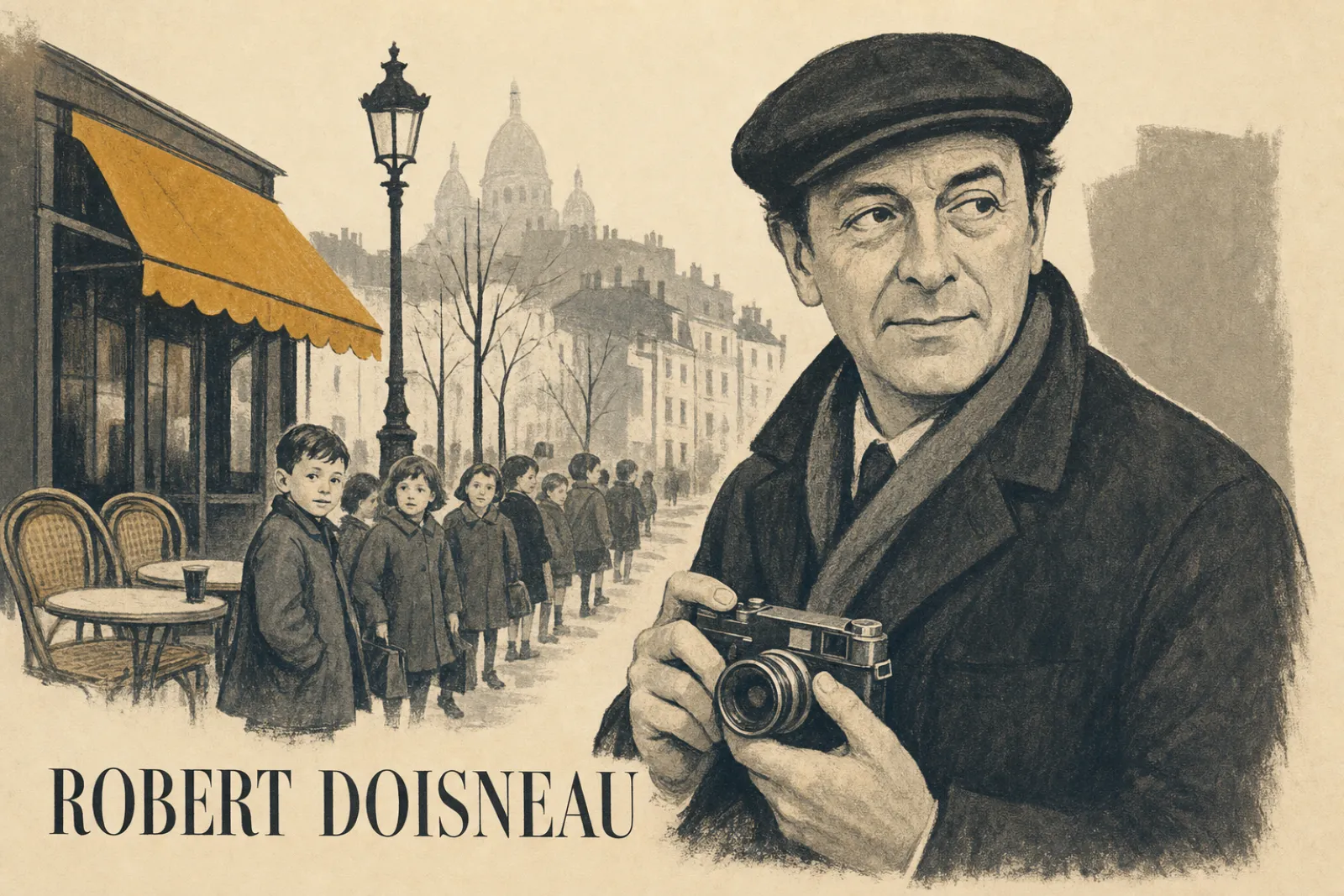
Robert Doisneau (1912 to 1994) was a French photographer who spent his working life in Paris and the suburbs on its southern edge. He photographed children, cafes, weddings, workers and passers-by in black and white, with humor and affection. He is best known for Le Baiser de l’hôtel de ville, a 1950 picture of a couple kissing on a busy Paris street, made for Life magazine.
Doisneau belongs to the French humanist photographers, a loose group that turned its cameras on ordinary daily life in streets and bistros between about 1930 and 1960. The same group includes Henri Cartier-Bresson and Brassaï. His acknowledged influences were Eugène Atget, André Kertész and Cartier-Bresson. Cartier-Bresson invited him to join Magnum Photos. Doisneau declined and stayed with the Rapho agency in Paris for the rest of his career.
An engraver who ended up at the Renault factory
Doisneau was born on 14 April 1912 in Gentilly, just south of Paris. From 1925 to 1929 he studied at the École Estienne, a school for the book trades, and left with a diploma in engraving and lithography. He took up photography as an amateur at sixteen. His first subjects were cobblestones. People came later, first children and then adults.
His first job was lettering at the Atelier Ullmann, a studio that produced graphics for the pharmaceutical trade, where he moved from drawing letters to working with the camera. In 1931 he became camera assistant to the modernist photographer André Vigneau. In 1932 he sold his first picture story to the newspaper L’Excelsior.
From 1934 to 1939 he was an industrial and advertising photographer at the Renault car works at Billancourt. The job ended when he was dismissed for being late too often. In the same year he met Charles Rado, founder of the Rapho agency, and began working for himself.
The war interrupted that start. Doisneau served in the French army in 1939 and 1940. During the Occupation he used his training in drawing, lettering and engraving to forge passports and identity papers for the Resistance. A book of the Liberation, Paris délivré par son peuple, appeared about 1944. In 1945 he began working for the magazine Le Point, for which he made portraits of artists, among them Picasso and Braque.
How does this kind of work fit into the wider history? Photography movements and the ideas behind them sets the main schools side by side.
The suburbs, the street and the picture magazines
In 1945 Doisneau met the writer Blaise Cendrars. In 1946 he returned to Rapho, by then run by Raymond Grosset, and he remained with the agency from that point on. In 1947 he met the poet Jacques Prévert and the writer Robert Giraud, who became a long-standing friend, and he won the Kodak Prize.
His first book, La Banlieue de Paris, came out in 1949 with a text by Cendrars. Its subject was the suburbs where he was born and lived, not the monuments of the center. A run of books on Paris and its children followed through the 1950s, including L’Enfant de Paris in 1951 and Instantanés de Paris in 1955.
Magazine work paid for the walking. From the late 1940s into the early 1950s he was under contract to French Vogue, photographing fashion and reportage. It was for Life that he made the kissing pictures in 1950. He joined Le Groupe des XV, a society formed to promote photography as an art, alongside Willy Ronis. In 1951 his work was shown at the Museum of Modern Art in New York with that of Brassaï, Cartier-Bresson, Ronis and Izis. The Niépce Prize followed in 1956.
He traveled less than most of his peers. There was a trip to the United States in 1960, covering New York, Hollywood and Palm Springs, one to Canada in 1966 and a reportage in the Soviet Union in 1967. In 1984 he took part in the French government’s DATAR photographic survey of the country. Later honors included the Grand Prix National de la Photographie in 1983, the Legion of Honour in 1984 and the Balzac Prize in 1986. He died on 1 April 1994, aged 81, leaving about 450,000 photographs. The collection is looked after by the Atelier Robert Doisneau.
How a Doisneau picture is put together
The method has been described as that of a patient passer-by. Doisneau kept a certain distance from the people he photographed and watched for the small story. The pictures are anecdotes: one thing happening, clearly seen, with enough of the surroundings to explain it.
Several choices recur across the work.
- A small territory, visited again and again. He lived in Gentilly, Montrouge and the 13th arrondissement, and that is where much of the work was made. Knowing a place lets a photographer predict where something will happen. That habit is the foundation of street photography.
- Two things in one frame. His pictures often turn on juxtaposition: social classes mingling, an eccentric among the ordinary, something formal beside something ridiculous. The irony comes from the pairing, not from a caption.
- Humor without cruelty. He was known for amusing oddities of behavior, and the joke is seldom at the subject’s expense. Humor in photography depends on timing and on leaving room for the punchline, and his frames do both.
- Children left to themselves. He returned many times to children playing in the city, unsupervised by parents. Good pictures of children usually come from letting the game continue and staying out of it.
- Black and white, in the light that was there. Humanist photography was made with small portable cameras in available light. The look is direct, with nothing lit for effect. See black and white photography for how tone carries a picture when color is removed.
- Themes kept for decades. His archive is filed by subject: bistros, concierges, fairgrounds, weddings, tradesmen, circus, children, the Seine. A picture made in 1934 could sit beside one from 1957 because he kept asking the same questions.
He was also willing to direct. The Kiss was posed with two people he had asked to take part, which complicates any idea that his work is purely candid photography. What he arranged was the couple. The busy street around them was a real one.
He had limits, too. After the Liberation he refused to photograph women whose heads had been shaved as punishment for relationships with Germans. What a photographer declines to shoot is part of the work.
Wondering where the line sits between observing and arranging? Photography etiquette and ethics covers consent and honesty when the subject is other people.
Photographs and books to look for
- Le Baiser de l’hôtel de ville (1950). A couple kiss on a busy street by the Paris city hall. Notice how much of the busy street he kept in the frame. The picture ran in Life on 12 June 1950 as part of a photo-essay on couples kissing in Paris.
- La Banlieue de Paris (1949). His first book, with a text by Blaise Cendrars. Look at how much attention he gives to the unglamorous edge of the city where he grew up.
- L’Aéroplane de Papa (1934). An early picture, from the year he started at Renault. It is evidence that his own work was already under way alongside the factory job.
- La Dernière Valse du 14 Juillet (1949). The title places it at the end of the Bastille Day celebrations. It belongs with his many pictures of dances, fairs and public holidays.
- Giacometti dans son atelier (1957). One of his portraits of artists at work. He also photographed Picasso, Braque, Léger and Cocteau. As the title says, the sculptor is shown in his own studio.
- Palm Springs 1960. Pictures from his 1960 American trip, later published as a book. It is a rare view of Doisneau outside France.
Want to make a set of pictures that reads as a story, as the Life assignment did? How to create a photo essay walks through planning, shooting and ordering one.
Try this: one corner, fifteen minutes
This exercise practises the patient passer-by.
- Pick one spot within walking distance of home where people pass and pause: a cafe terrace, a bus stop, a shop window, a park gate.
- Stand or sit a few meters back. Do not move for fifteen minutes.
- Frame the scene first, with the background settled, and wait for people to enter it.
- Photograph only when two things in the frame say something about each other: a tall person and a small dog, a formal coat beside a child’s scooter, a sign and someone ignoring it.
- Take no more than twelve pictures. Afterwards, choose the one that needs no explanation.
Not sure how to stay with one place without running out of ideas? Working the scene in street photography shows how to get more than one picture from a single spot.
Questions people ask about Robert Doisneau
Was The Kiss by the Hôtel de Ville staged?
Yes. The picture was part of a Life assignment on couples kissing in Paris, and Doisneau asked a young couple he had seen kissing to pose for him in the street. The street was real, but the couple were posing.
Who were the couple in the photograph?
They were Françoise Delbart, later Françoise Bornet, and Jacques Carteaud, both drama students. Their identity was not public until 1992, when another couple claimed to be the subjects and went to court. In 1993 a Paris court rejected that claim. Anyone who photographs people for publication should understand model releases.
Why is the picture so well known?
It first appeared in Life on 12 June 1950 and went on to become an international symbol of young love in Paris. The identity of the couple stayed unknown until 1992. In 2005 the original print that Doisneau had given to Françoise Bornet was sold at auction for 155,000 euros.
Did Robert Doisneau belong to Magnum?
No. Henri Cartier-Bresson invited him to join, and he refused. He worked through the Rapho agency, which he first joined in 1939 and returned to in 1946.
For more photographers and how they worked, see the A to Z of photographers.