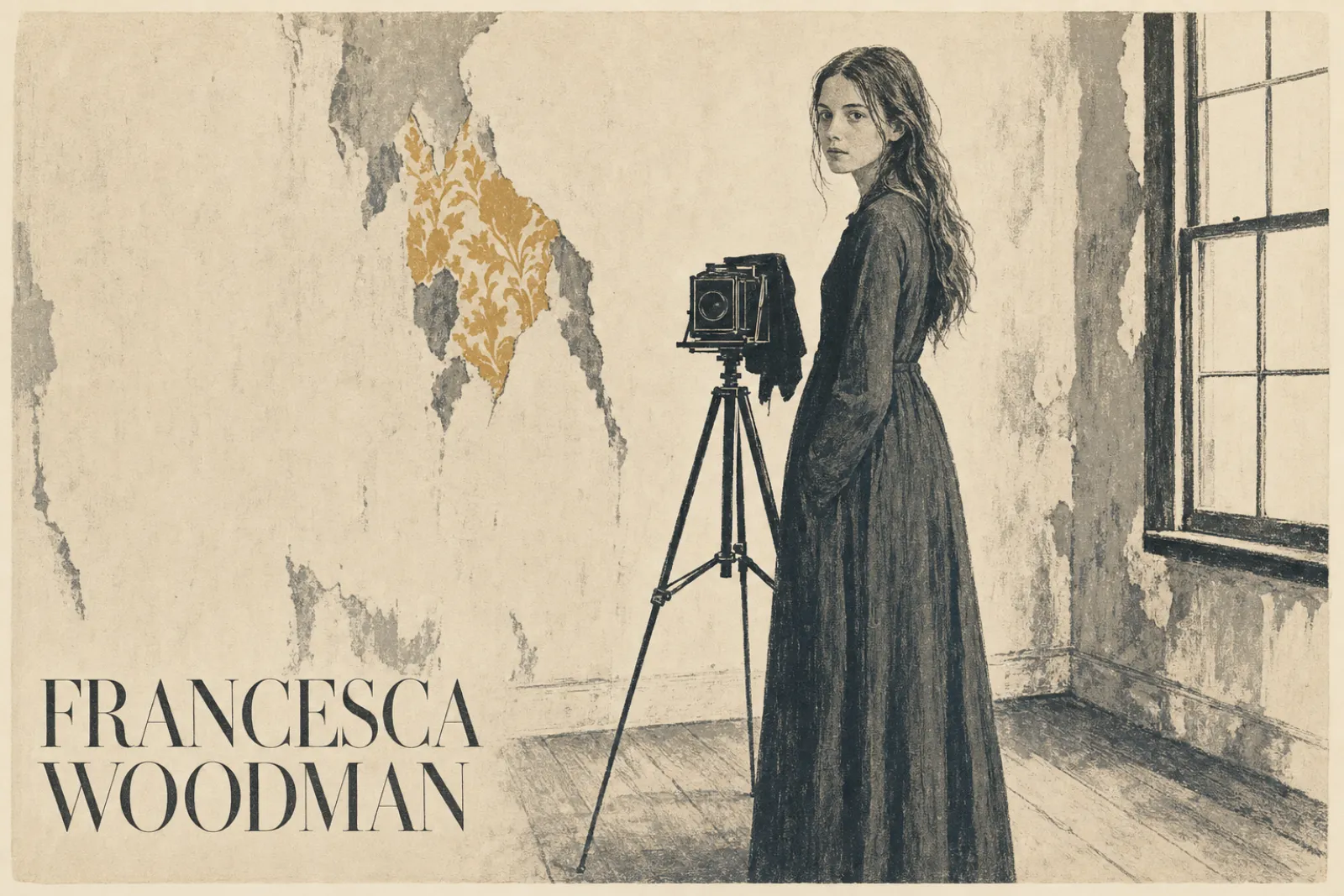
Francesca Woodman (1958 to 1981) was an American photographer who made small, square, black and white pictures, most of them of herself or of other young women, in bare and decaying rooms. She worked in Colorado, in Providence, Rhode Island, in Rome and in New York, in a working life of less than ten years. She is known for long exposures in which the figure blurs and seems to pass into the wall behind it.
Woodman grew up among artists. Her mother, Betty Woodman, was a ceramicist and her father, George Woodman, a painter and photographer. At boarding school she was taught by the photographer Wendy Snyder MacNeil. Her influences included Surrealism and the photographs of Man Ray, and the staged, story-like pictures of Duane Michals. In 2024 the National Portrait Gallery in London paired her work with that of Julia Margaret Cameron, another photographer who used soft focus and dressed-up sitters to make pictures closer to dreams than to records.
Colorado, Italy and a first self-portrait at thirteen
Woodman was born on April 3, 1958, in Denver, Colorado, and grew up in Boulder. Italy was a second home. She attended second grade in Florence, and the family later bought a farmhouse in the countryside near the city, where she spent most summers.
She made her first self-portrait at thirteen. From 1972 she attended Abbot Academy in Massachusetts, which merged with Phillips Academy the following year, and she finished high school in Boulder in 1975. She went on photographing herself for the rest of her life.
Providence and Rome: empty rooms as a studio
From 1975 to 1978 Woodman studied at the Rhode Island School of Design in Providence. Much of her best known work comes from these years. She photographed in run-down houses with cracked plaster, bare boards and peeling wallpaper, using herself as the model. Series from Providence include House, Space2 and Polka Dots.
She spent a year in Rome on the school’s honors programme, from 1977 to 1978. There she became a regular at Libreria Maldoror, a bookshop with a gallery, and had her first solo exhibition there in March 1978. The Angel series was made in Rome in 1977. Back in Providence, she made large photographs for the first time for her thesis exhibition at the school’s Woods-Gerry Gallery, and installed them at the ceiling and the baseboards.
She used a medium format camera that made square negatives 2 1/4 inches on each side. One account, in The New York Review of Books, names it as a Yashica given to her by her father when she was a teenager. Her prints were small, mostly 8 by 10 inches or less, and many are far smaller: a print from the Angel series shown at the Guggenheim Museum measures 7.6 centimetres square. They are made to be looked at closely by one person at a time.
Wondering what a square frame changes? Aspect ratio in photography explains how the shape of the frame affects where a subject can sit.
New York, blueprints and one book
Woodman moved to New York in 1979. In early 1980 she began working with diazotype, the process used for architectural blueprints, to make prints on a completely different scale. Her Caryatid of 1980 is more than two metres tall. These prints belonged to her Temple project, for which friends posed as caryatids, and one of them was shown at the Alternative Museum in New York in 1980. She spent the summer of 1980 as an artist in residence at the MacDowell Colony in New Hampshire.
Her artist’s book Some Disordered Interior Geometries was published in January 1981. It was the only one of her artist’s books of photographs published in her lifetime. Woodman died by suicide in New York on January 19, 1981, aged 22.
The work became widely known after her death. Her first solo museum exhibition opened in 1986 and was shown at Wellesley College and Hunter College. A retrospective was shown at the San Francisco Museum of Modern Art in 2011 and at the Guggenheim Museum in New York in 2012, with more than 120 vintage prints, artist’s books and short videos. She left at least 10,000 negatives and more than 800 prints.
How the figure is made to disappear
The central technique is a slow shutter. The camera stays fixed and the room is recorded sharply. The body moves during the exposure and records as a smear or a pale trace. Walls, floorboards and window frames are solid, and the person is not. Anyone can reproduce the effect once they understand long exposure and how shutter speed records movement.
She worked indoors, in abandoned and derelict rooms, and played with the light she found there. A long exposure needs little light, so a dim room lit by a window is enough. It is a use of natural light for mood, not for flattery.
She hid part of the subject. The face is often obscured. Bodies are pressed against walls or hidden behind peeling wallpaper. Mirrors, old clothes and single pieces of furniture recur as props. The viewer is given less than a portrait usually gives and has to finish the picture.
She used the square with care. A square has no long side to lead the eye, so placement does the work: a figure low in a corner, a doorway dead centre, a large area of empty floor.
She chose black and white at a time when colour film was easy to get. Without colour, the rooms lose their date and the pictures read as tone and texture.
She was model and photographer at once, which is the basic problem of self-portrait photography: setting the frame, starting the exposure and then performing inside it without seeing the result.
Want to try blur on purpose? How to photograph moving subjects compares freezing, blurring and panning, and how to use a tripod properly covers keeping the camera still while the subject moves.
Photographs and series to look for
- House #3, Providence, Rhode Island (1976). One of the numbered pictures in the House series, made in a derelict interior in Providence. Notice how much of the frame is given to the room and how little to the figure.
- House #4, Providence, Rhode Island (1976). From the same series, and shown at the Guggenheim as a print 14.6 centimetres square. Look at how the walls and the room are used as places for the body to hide.
- Space2, Providence (1976). A title written as a mathematical expression, space squared. The print shown at the Guggenheim is under 14 centimetres on each side, so look at how much room the small square is made to hold.
- Angel series, Rome (1977). Made during her year in Italy. The prints are tiny, which changes how they are read. See them at true size if you can, or hold your hand up to judge it.
- Some Disordered Interior Geometries (1981). A 24 page book in which 16 photographs are attached to pages from an Italian geometry exercise book, with her handwriting added. The printed diagrams and the bodies comment on each other.
- Caryatid, New York (1980). A diazotype more than two metres high. A caryatid is a carved female figure used as a column, and the title says how the body is being treated. It shows the same photographer working at the scale of architecture.
Asking how photographs and pages work together? Photo sequencing covers ordering a body of work, and how to make a photography zine walks through making a small book by hand.
Try this: stay still, then move
Allow 20 minutes in a room with one window and a plain wall. Use any camera or phone that lets you set a slow shutter of one to four seconds, on a tripod or a stack of books.
- Turn off the lights and the flash. Frame the wall and part of the window, and crop to a square.
- Set the self-timer. For the first frame, stand against the wall and stay completely still.
- For the next four frames, begin still and then move one thing during the exposure: step sideways, crouch, turn your head, raise an arm.
- Compare the five. Find the frame where the room is sharp and you are only partly there.
Questions people ask about Francesca Woodman
What camera did Francesca Woodman use?
She worked mainly with medium format cameras that made square negatives of 2 1/4 by 2 1/4 inches. One account identifies her camera as a Yashica given to her by her father.
How did she get the blurred, ghost-like figures?
She used long exposures with slow shutter speeds. The camera and room stayed still while the body moved, so the figure blurred against sharp surroundings.
Are all her photographs self-portraits?
Many are, and she began making self-portraits at thirteen. She also photographed friends and other models, and the face is often hidden, so the pictures are less about likeness than about a body in a space.
How much work did she leave?
Her estate holds more than 800 prints and at least 10,000 negatives. By 2006 only about 120 images had been published or exhibited.
For more photographers from every period, see the A to Z of photographers.