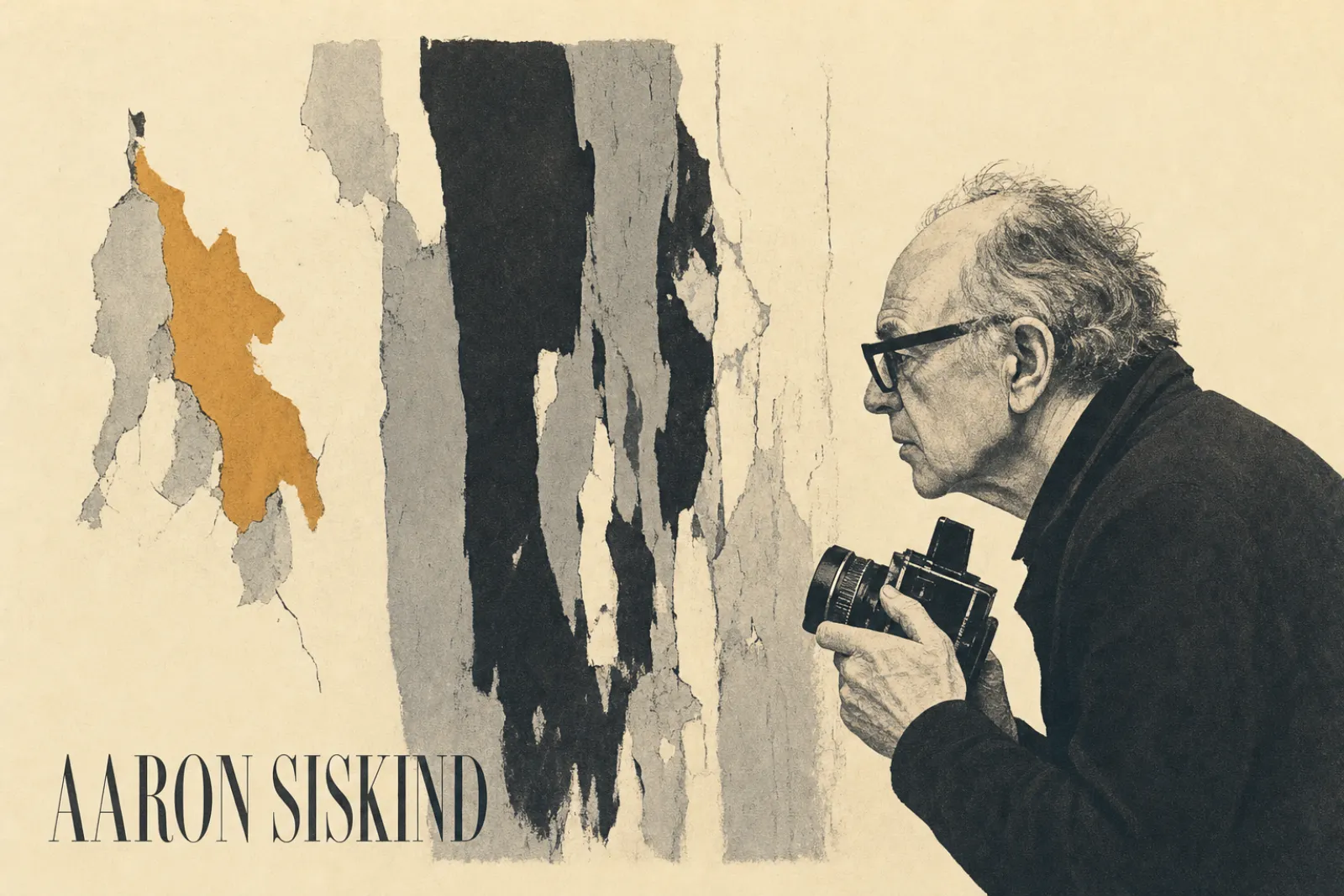
Aaron Siskind (1903 to 1991) was an American photographer and teacher who worked in New York, Chicago and Providence. He began in the 1930s as a documentary photographer of city life, then turned his camera on walls, peeling paint, tar and stone and made flat, close, black and white pictures that read like abstract paintings. He is known for showing that a photograph of a real surface can stand as an abstract image in its own right.
Siskind came to photography late and by accident, and he learned it among the socially minded documentary photographers of the New York Photo League. What he reacted against was the League’s belief that a photograph should be judged by its subject. His closest allies after that were painters, among them Franz Kline, Mark Rothko and Willem de Kooning, and he exhibited alongside them. In photography his long partnership was with Harry Callahan, with whom he taught first in Chicago and later in Providence. His turn away from the literal subject has a parallel in the work of Minor White, who was making close studies of rock, surf and wood as metaphors in the same years.
An English teacher with a wedding present
Siskind was born in New York City on 4 December 1903 and grew up on the Lower East Side. He graduated from City College of New York in 1926 and taught English in the city’s public schools for more than twenty years. Around 1930 he was given a camera as a wedding present and started using it on his honeymoon.
In the early 1930s he joined the Photo League, a group of photographers committed to documentary work with a social purpose. From 1936 to 1940 he ran its Feature Group, which produced photo essays on New York neighbourhoods. The most extensive was Harlem Document, made over about three years: Harlem residents, street life and life at home. The pictures were published as a book in 1981.
How is a long project about one place put together? Documentary photography covers research, access and building a body of work.
Even inside these projects his attention was drifting from the people to the shapes. Tabernacle City, a series photographed in the 1930s, concentrated on buildings and their forms more than on social conditions. It was shown at the Photo League in 1941, members objected, and Siskind left the League.
Gloucester, 1944: the subject becomes the picture plane
The change was clear by 1944 at Gloucester, Massachusetts, where Siskind photographed found details at close range. The camera described them sharply, but the frames were arranged so that the flat pattern mattered more than what the things were.
From there he moved to walls. Through the late 1940s and 1950s he photographed peeling paint, graffiti and chalk marks in New York, Chicago, Arizona and elsewhere, close up and presented as flat surfaces with almost no depth. He titled the prints with a place and a number, such as Chicago 21 or New York 2, which told the viewer nothing about the subject and left only the picture.
Painters understood what he was doing. He showed at the Charles Egan Gallery in New York, where Franz Kline also exhibited, and in 1951 he was the only photographer in the Ninth Street Show, a key exhibition of Abstract Expressionist art. What the painters valued was the way his prints removed pictorial space, so that the image sat on the surface of the paper as a painting sits on canvas.
What turns a photograph of a real object into an abstract picture? Abstract photography goes through the methods, from close-ups to found subjects on city walls.
Twenty years in Chicago, then Providence
Siskind met Harry Callahan at Black Mountain College in North Carolina, and in 1951 Callahan brought him to teach at the Institute of Design in Chicago, the school founded by László Moholy-Nagy as the New Bauhaus. Siskind stayed for twenty years and led the photography programme from 1961 to 1971. From 1952 to 1954 he directed a student project to record the buildings of the architect Louis Sullivan in Chicago, many of them facing demolition.
He kept photographing wherever he travelled: Mexico in 1955, Rome in 1963 and 1967. He received a Guggenheim fellowship in 1966. In 1971 he joined Callahan at the Rhode Island School of Design in Providence and taught there until he retired later in the decade. He went on working in the 1980s, photographing tar repairs on roads in Providence and in Vermont. He died in Providence on 8 February 1991, aged 87.
How a wall becomes a picture
Siskind’s method is narrow and can be learned in an afternoon. Doing it well takes longer.
- Stand square to the surface. The camera faces the wall straight on, so nothing recedes. With no perspective lines, the viewer has no clue to depth and reads the frame as a flat design.
- Cut out the context. No ground, no sky, no edge of the building. To fill the frame with the surface alone removes scale, so a patch of paint the size of a hand can look as large as a cliff.
- Compose with the four edges. Without a subject in the usual sense, the picture is held together by shape and by where each shape meets the border. A dark mark that touches one edge and stops short of another sets up the tension that the whole frame depends on.
- Use light that rakes or light that flattens, and choose. Low side light picks out every blister and crack and gives texture. Even, shadowless light turns the same wall into pure tone. Either can work, but it has to be a decision.
- Think in black and white. With colour gone, a wall is reduced to dark shapes, light shapes and the greys between them. Strong contrast between a few large areas does the work that colour would otherwise do. The guide to black and white photography explains how to judge a scene by tone alone.
- Keep everything sharp. The abstraction comes from framing, not blur. Fine detail tells the viewer the thing was real, and that pull between real surface and invented picture is the point.
- Name it neutrally. A place and a number. A descriptive title would send the viewer back to the object.
Which marks in a frame pull the eye hardest? Visual weight explains why a small dark shape can balance a large pale one.
Photographs and series to look for
- Harlem Document (late 1930s). The Feature Group’s study of Harlem, led by Siskind. Look at how the street and domestic scenes are organised, and compare them with the later work: the same eye for shape is already there, with people still in the frame.
- Gloucester (1944). The turning point. Details are photographed close and sharp and arranged as flat shapes. Notice how little space there is behind anything.
- Peeling Paint, Jerome, Arizona (1949). Peeling paint is the whole picture. There is no building, only the surface, and the eye moves across it the way it moves across a canvas.
- Chicago and New York wall pictures (early 1950s). Prints such as New York 2 (1951) and Chicago 21 (1952) turn graffiti, chalk and peeling paint into arrangements of marks. These are the pictures most often set beside the work of the painters he knew.
- Pleasures and Terrors of Levitation (begun 1953). Divers at Oak Street Beach on Lake Michigan in Chicago, photographed against the sky. Each body is a dark silhouette hanging in mid-leap, with nothing around it to explain where it came from. The figures read like the marks on his walls.
- Homage to Franz Kline (1970s). Kline, a friend of many years, died in 1962. In this series Siskind photographed marks on walls that recall Kline’s paintings, in prints titled by place and number, such as Jalapa 34 (1973).
Try this: nine frames of one wall
Find a weathered surface within a few steps of where you are: a painted door, a rusted gate, a patched road, a wall with old posters. You have fifteen minutes and nine frames.
- Set the camera or phone to black and white so the screen shows tones, not colours.
- Stand square on. Check that the edges of the frame are parallel to any straight lines in the surface.
- Move in until nothing but the surface is visible. No ground, no sky, no door handle, nothing that gives away the size.
- Make three frames from that spot, shifting the camera a little each time so that a different shape touches the border.
- Step closer by half and make three more. Then closer again for the last three.
- Review the nine. Pick the one where you can no longer say what the object was but would still want to look at it. Give it a place name and a number.
Questions people ask about Aaron Siskind
What is Aaron Siskind known for?
He is known for abstract black and white photographs of flat surfaces such as walls, peeling paint and tar, made from the 1940s onwards. He is also known for the Harlem Document of the 1930s and for decades of teaching in Chicago and Providence.
Was Aaron Siskind an Abstract Expressionist?
He was a photographer, but he was close to the Abstract Expressionist painters and exhibited with them. He showed at the Charles Egan Gallery and was the only photographer in the Ninth Street Show of 1951.
Where did Aaron Siskind teach?
He taught at the Institute of Design in Chicago from 1951 to 1971, heading its photography programme for the last ten of those years, and then at the Rhode Island School of Design. Before that he spent more than twenty years teaching English in New York public schools.
What was the Pleasures and Terrors of Levitation series?
It is a group of photographs of divers at Lake Michigan, made in Chicago from 1953. The divers are shown as dark shapes against an empty sky, so the pictures are about the form of a body in the air more than about diving.
Siskind is one of the photographers in the A to Z of photographers, and he is quoted on the photography quotes page.