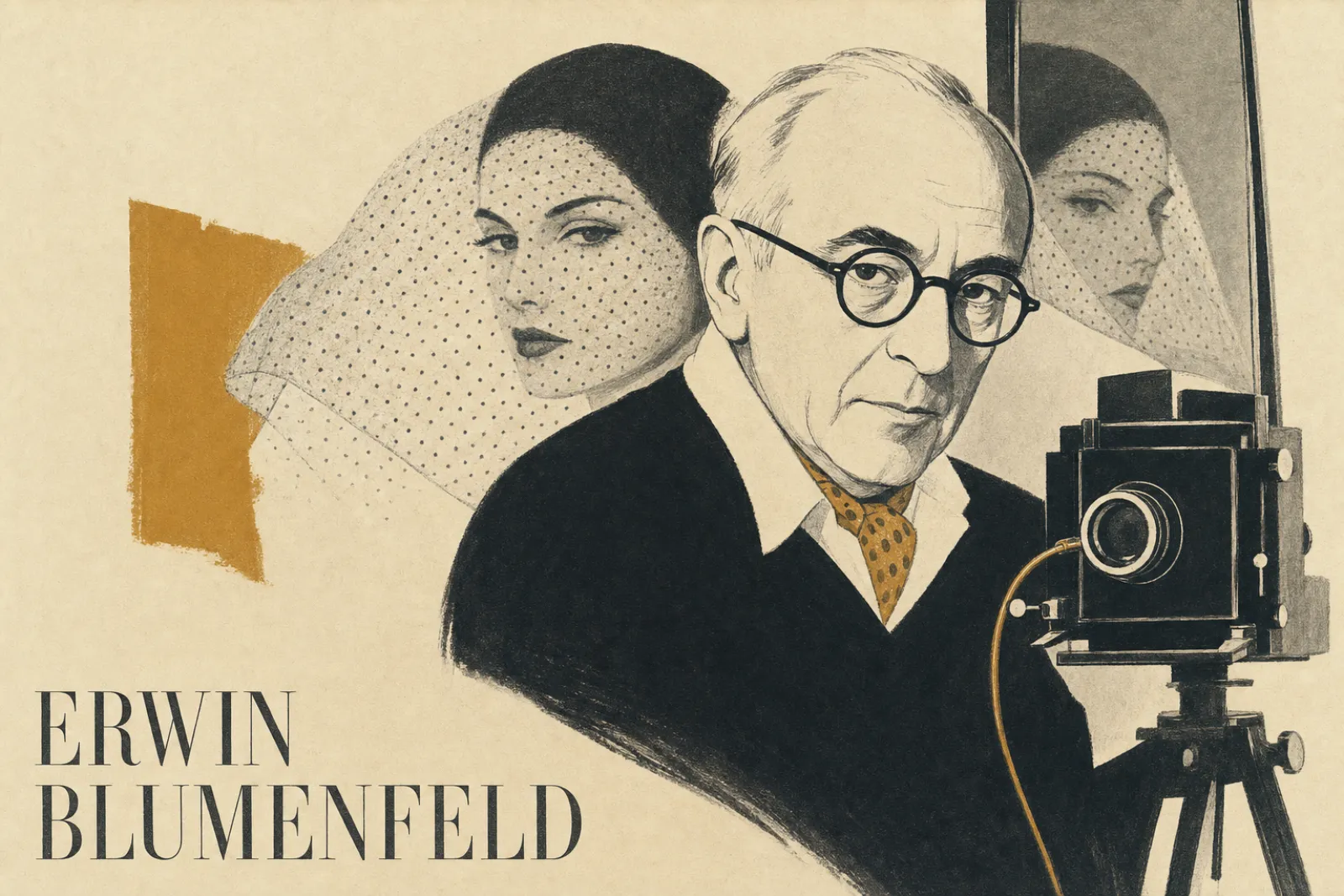
Erwin Blumenfeld was a German photographer, born in Berlin in 1897, who worked in Amsterdam, Paris and New York and died in Rome in 1969. He made portraits, nudes, photomontages and, above all, fashion photographs and magazine covers. He is known for carrying the darkroom experiments of the 1920s and 1930s avant-garde, such as solarisation, multiple exposure and montage, onto the covers of Vogue and Harper’s Bazaar.
Blumenfeld had no formal training in photography. His schooling was Dada. In 1918 he got to know the Dadaist George Grosz, and with his friend Paul Citroen he later named himself a director of a Dutch Dada centre in Amsterdam. He made collages and drawings before he made photographs for a living. When he reached Paris in 1936 he looked hard at the French avant-garde, and the influence of Man Ray shows in his nudes. He reacted against the idea that a fashion picture was a clear record of a dress. For a different answer to the same magazine pages, compare the fashion work of Richard Avedon and Irving Penn.
From a Berlin clothing shop to a handbag store in Amsterdam
Blumenfeld was given a camera as a boy in 1907 and used himself as one of his first subjects. He kept making self portraits for the rest of his life. His father died in 1913, and he left school for an apprenticeship at a women’s clothing store. In 1917 and 1918 he served as an ambulance driver on the Western Front in France. At the end of 1918 he crossed into the Netherlands.
In Amsterdam he married Lena Citroen in 1921, and they had three children. In the early 1920s he opened the Fox Leather Company, a shop selling ladies’ handbags. He photographed customers there and printed in a darkroom at the back of the shop. In 1932 he began an intense period of photographic work and hung his portraits of women in the shop window. The contact sheets and enlargements from these years show how much of the picture was decided in the lab: very tight framing, high contrast and dramatic light.
In 1933 he answered Hitler’s rise to power with a photomontage that combined a negative of a skull with a portrait of Hitler in a single print. It became one of his best known images and was later used in Allied propaganda. The handbag shop went out of business in 1935, and he opened a photographic studio.
Wondering what a home darkroom actually involves? Darkroom basics covers the space, the equipment and the processing steps.
Paris, the Eiffel Tower and the internment camps
Blumenfeld moved to Paris in 1936 and rented a studio in the rue Delambre in Montparnasse. His first Paris pictures were portraits, including the painters Henri Matisse and Georges Rouault. In 1937 he made his first beauty cover, for the magazine Votre Beauté. In 1938 the British photographer Cecil Beaton visited the studio and helped him to a contract with French Vogue.
For the May 1939 issue of French Vogue he photographed the model Lisa Fonssagrives on the ironwork of the Eiffel Tower, high above the city. That summer he travelled to New York and came home with a contract as Paris fashion correspondent for Harper’s Bazaar. The war ended that work within a year. As a German Jew in France he was interned in a series of camps, including Montbard, Loriol, Le Vernet and Catus. In 1941 he escaped with his family, by way of Casablanca, to New York.
New York: colour covers for Vogue
In New York Blumenfeld was commissioned at once by Harper’s Bazaar. He first shared a studio with the photographer Martin Munkácsi and from 1943 had his own. In 1944 he signed a contract with the publisher Condé Nast and shot covers for Vogue and its sister magazines until 1955. His pictures also ran in Life, Look and Cosmopolitan, and he became one of the most highly paid fashion photographers of his time. In 1948 the Museum of Modern Art in New York included him in the survey exhibition In and Out of Focus.
The experiments he had made in black and white in the 1930s became experiments in colour. He also made experimental advertising films for the Dayton department store in Minneapolis, his main advertising client. In the 1950s and 1960s he photographed New York, Paris and Berlin on colour slides with a 35mm camera, and he took a Leica to Berlin in 1960 on his first visit since the 1930s. He spent his last years on an autobiography, finished in 1969, the year he died of a heart attack in Rome. It was published in French in 1975 and in English as Eye to I in 1999. His own selection, My One Hundred Best Photos, appeared in 1979.
How a Blumenfeld picture is built
Blumenfeld treated the exposure in the camera as raw material. The finished picture was made afterwards, at the enlarger and in the trays. Five habits explain most of what you see.
- Something between the lens and the subject. He photographed through veils and frosted glass, and broke figures up in mirrors. The viewer has to complete the figure. That is why a picture with so little sharp detail still holds attention. Reflection photography with mirrors and glass starts from the same idea.
- Solarisation. Re-exposing a print or negative to light during development partly reverses the tones and draws a dark line along the edges of shapes. He used it on nudes and portraits to turn skin into something closer to a drawing.
- More than one negative. The Hitler montage is two negatives printed as one. Other pictures combine a positive and a negative of the same image, or sandwich two colour slides together. A double exposure made in camera or in software is the direct descendant.
- Removal. He cropped hard and printed with high contrast so that minor detail fell away. On the 1950 Doe Eye cover the face is cut down to a few features. This is high key taken to its limit.
- Colour as a shape. In the New York covers a block of red or green often does the work a line did in the black and white prints. Colour theory for photographers explains why one strong hue against a pale field reads so fast on a news stand.
The lighting came first, though. The early Amsterdam portraits already use dramatic light and high contrast, and the Paris architectural studies of the Eiffel Tower and Rouen Cathedral are made of strong relief in light and shade. Shadow photography shows how to make the shadow itself the subject.
How is a beauty picture actually lit in a studio? How to light for fashion and beauty goes through the main lights and the rim and hair lights.
Photographs to look for
- The Hitler photomontage (1933). A skull and a portrait printed together so that the bone shows through the face. Notice that the effect depends on how exactly the two images are laid over each other. It is a political cartoon made with an enlarger.
- Wet Veil (about 1937). A nude figure under a wet veil, one of the Paris nudes in which the body becomes a surface for light and shadow. Look at how the fabric stands between the viewer and the figure, and how little is literally visible.
- The Minotaur or The Dictator (about 1937). A calf’s head set on a draped torso. It names no real person. Notice the plain setting and the upright pose, which make an absurd object look like an official portrait.
- Lisa Fonssagrives on the Eiffel Tower (1939). The model is photographed on the structure of the tower itself, far above Paris. The ironwork, the dress and the empty air around the figure do the composing.
- The Red Cross cover for Vogue (15 March 1945). A figure stands behind frosted glass, soft and dark, with a translucent red cross laid over her. Only the hands near the glass are close to sharp. Blur is used to make a graphic sign.
- Doe Eye, Vogue cover (January 1950). The model Jean Patchett’s face is reduced to a minimum of features. Compare it with the original portrait if you can find it, and see how much was taken away in the lab.
Want to push a picture away from description altogether? Abstract photography covers reflections, close detail and movement as ways to do it.
Try this: a portrait through something
Allow 15 minutes. You need one person, one window or lamp, and one translucent thing: a net curtain, a sheet of baking paper, a shower door, a glass of water or a piece of tulle.
- Place your sitter side on to the light, about an arm’s length from it.
- Hold the material between the lens and the face. Make five frames with it touching the lens, five with it halfway, and five with the sitter pressing a hand or cheek against it.
- The constraint: in every frame, only one feature may be clearly readable. Choose an eye, the mouth or a hand, and let everything else dissolve.
- Pick the frame that shows the least and still reads as a person. Convert it to black and white and raise the contrast until the minor detail drops out.
Questions people ask about Erwin Blumenfeld
What is Erwin Blumenfeld best known for?
He is best known for fashion photographs and magazine covers made for Vogue and Harper’s Bazaar between the late 1930s and 1955, and for the January 1950 Vogue cover often called Doe Eye. Outside fashion, his 1933 photomontage of Hitler and a skull is probably his most famous picture.
What techniques did Blumenfeld use?
He used solarisation, multiple exposure, photomontage, combined positive and negative images, and sandwiched colour slides. In the studio he shot through veils and frosted glass and used mirrors to fragment the figure. He regarded the darkroom as the place where the picture was finished.
Was Erwin Blumenfeld part of Dada?
Yes, on its Dutch edge. He knew George Grosz, and in Amsterdam he and Paul Citroen called themselves directors of a Dutch Dada centre and wrote to Francis Picabia in its name. His collages from 1916 to 1933 mix drawing, cut out photographs and printed words.
How did Blumenfeld get from Europe to America?
He was interned in French camps as a German Jew after the outbreak of the Second World War. He obtained a visa for his family, and in 1941 they left France and reached New York by way of Casablanca. He lived and worked in New York for the rest of his life.
Blumenfeld is one of the photographers in the A to Z of photographers, and he is quoted on the photography quotes page.