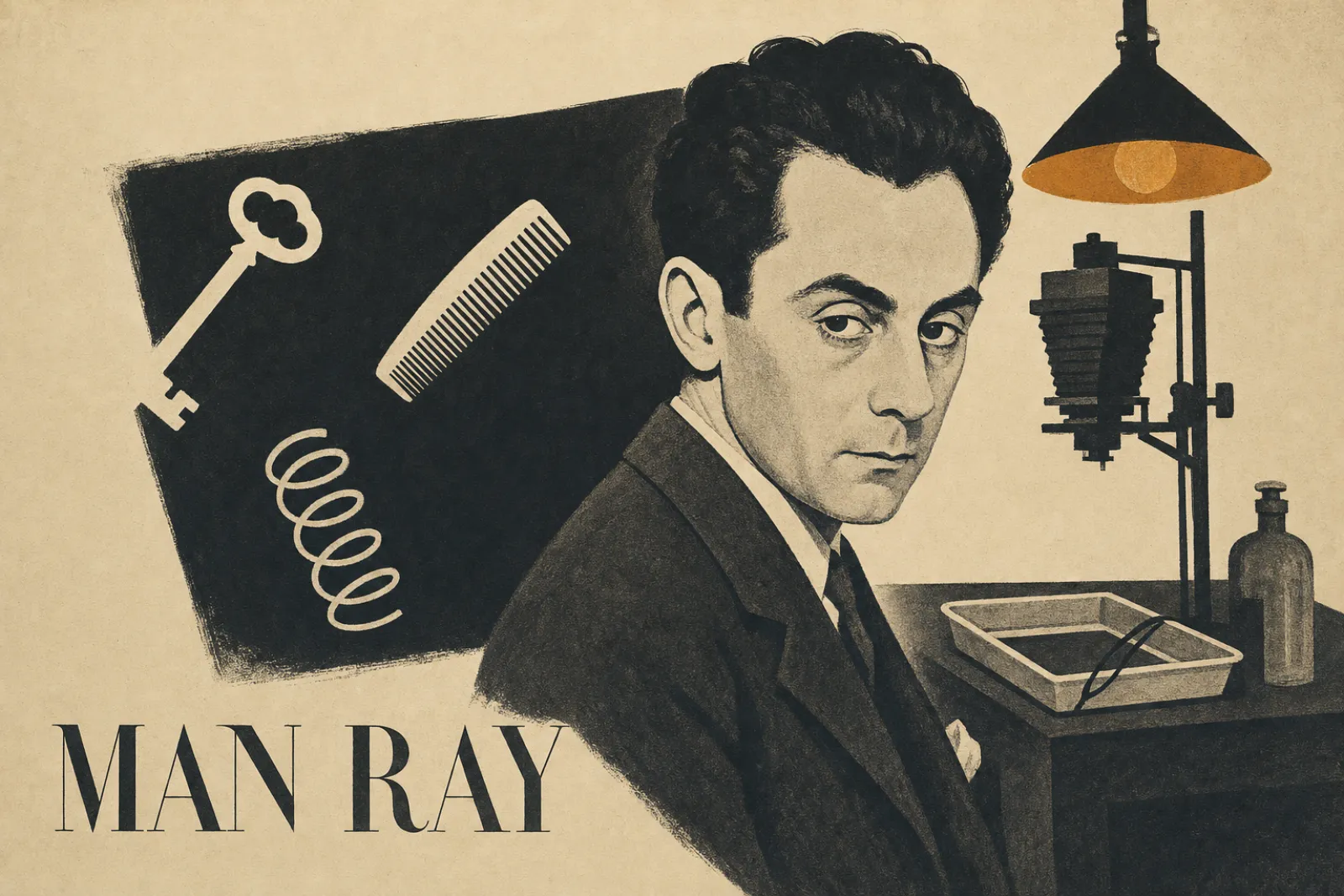
Man Ray was an American artist, born in Philadelphia in 1890, who spent most of his working life in Paris. He painted, built objects and made films, and between the two world wars he was one of the leading portrait and fashion photographers in the city. He is known for the rayograph, a photograph made without a camera, and for pictures such as Le Violon d’Ingres that turned the ideas of Dada and Surrealism into photographs.
He came to photography through painting. In New York he was a regular visitor to the 291 gallery run by Alfred Stieglitz, and in 1915 he met the French artist Marcel Duchamp, who became a lifelong friend and collaborator. In Paris his darkroom assistants included Berenice Abbott and Lee Miller, both of whom became important photographers. He reacted against the idea that a photograph had to be a faithful record of what was in front of the lens.
From Brooklyn painter to New York Dada
Man Ray was born Emmanuel Radnitzky on 27 August 1890, the son of Russian Jewish immigrants. His father was a tailor. The family moved to Williamsburg in Brooklyn, and in 1912 they changed their surname to Ray. He attended Boys’ High School in Brooklyn, where he learned drafting, and in 1912 enrolled in art classes at the Ferrer Centre.
His first solo exhibition, of paintings and drawings, was in 1915. He took up the camera around that time, at first to record his own artworks. With Duchamp and Katherine Dreier he founded the Société Anonyme in 1920, and with Duchamp he published the single issue of New York Dada. His objects from these years include The Gift (1921), a flatiron with metal tacks fixed to its base, which makes a useful thing useless.
What were Dada and Surrealism, and where does photography fit? Photography movements explains the ideas behind each one.
Paris, 1921 to 1940: portraits, fashion and the darkroom
In July 1921 Man Ray moved to Paris and settled in Montparnasse. He worked there as a fashion photographer and as a maker of portraits. His sitters included Pablo Picasso, James Joyce, Gertrude Stein, Jean Cocteau and Salvador Dalí, and his photographs ran in Vogue, Vanity Fair and Harper’s Bazaar. The bookseller Sylvia Beach said that to be photographed by Man Ray or by Abbott meant you rated as somebody.
Soon after he arrived he met Alice Prin, a model known as Kiki de Montparnasse. She was his companion through most of the 1920s and the subject of his best-known pictures. He also made short experimental films, among them Le Retour à la raison (1923) and Emak-Bakia (1926). In 1925 his work was in the first Surrealist exhibition at the Galerie Pierre in Paris, alongside Picasso, Max Ernst and Joan Miró.
Abbott joined his studio as a darkroom assistant in 1923. He wanted someone with no previous knowledge of photography. In 1925 he introduced her to the photographs of Eugène Atget, whose archive she later saved. Lee Miller arrived in 1929 and became his assistant, model and collaborator until she left in 1932.
The Second World War forced him back to the United States. He lived in Los Angeles from 1940 to 1951 and concentrated on painting. There he met the dancer and model Juliet Browner, whom he married in 1946. They returned to Paris in 1951. He published an autobiography, Self Portrait, in 1963, received the Royal Photographic Society’s Progress Medal in 1974, and died in Paris on 18 November 1976.
Curious about the commercial side of his work? Fashion photography covers the techniques and creative direction the field calls for.
Rayographs, solarization and other ways to make a picture
Man Ray treated the darkroom as a place to make pictures, not only to print them. Three methods carry most of the lesson.
- The rayograph. A photogram is made by placing objects directly on light-sensitive paper and switching on a light. Where an object blocks the light the paper stays white. Where light gets through glass or thin material it turns grey. Bare paper goes black. Man Ray came upon the method by accident in the darkroom, when he set a glass funnel, a measuring glass and a thermometer on a wet sheet in the tray and turned on the light. He named the results after himself. He was not the first to make photograms: Christian Schad had made them in 1918. Man Ray’s used combs, paper spirals and drawing curves, arranged so that chance played a part. A selection was published in December 1922 as Champs délicieux, with an introduction by the Dada writer Tristan Tzara. The page on darkroom basics describes the equipment a photogram needs.
- Solarization. If a negative or print is briefly exposed to light part way through development, some of its tones reverse. Dark areas turn light, and a thin line forms along the edges between them. The effect had been found by accident many times before. Man Ray and Lee Miller rediscovered it together after she joined him in 1929 and made it a signature. Miller told of a mouse running over her foot in the dark, which made her switch on the light with film in the developer. It is one of many alternative photographic processes that grew out of accidents.
- Working on the print. For Le Violon d’Ingres he painted two shapes onto a finished print and then photographed the print again. The picture is a photograph of an altered photograph.
The same thinking runs through his straight photographs. He paired things that do not belong together, a face and a mask, a back and a violin, so that each changes how the other is read. This is juxtaposition, and it is the most transferable thing in his work. His self portrait Space Writing, from 1935, has been called the first example of light painting.
Drawn to pictures that are not of anything in particular? Abstract photography looks at how shape, tone and texture can be the whole subject.
Photographs to look for
- Rayographs from Champs délicieux (1922). Cameraless pictures of household and studio objects. Look for the range of greys where glass has bent the light, which stops them reading as flat silhouettes.
- Le Violon d’Ingres (1924). Kiki de Montparnasse seen from behind, wearing a turban, with the two sound holes of a violin painted onto the print across her back. It was first published in the Surrealist magazine Littérature in June 1924. The title is a French expression for a hobby, after the painter Ingres, who played the violin. A print sold at Christie’s in New York in 2022 for 12.4 million dollars, a record for a photograph at auction at the time.
- Noire et Blanche (1926). Kiki rests her head on a table with her eyes closed and holds a dark African mask upright beside her face. It first appeared in French Vogue on 1 May 1926. Compare the two ovals, one pale and one dark.
- Larmes, or Glass Tears (1930 to 1932). An extreme close-up of a woman’s upturned face with glass drops set on her cheeks as tears. The tight crop removes any context and leaves only eyes, lashes and glass.
- Solarized portrait of Lee Miller (around 1930). Made in Paris during the years the two worked on the technique. Look for the reversed tones and the edge lines that the process leaves.
Try this: a rayograph without a darkroom
This takes about 20 minutes. It uses a phone or camera, a window or a bright screen, and a sheet of plain white paper.
- Collect six small objects, at least two of them glass or clear plastic: a drinking glass, a key, a comb, a spring, a leaf, a paper clip.
- Tape the paper flat against a sunlit window, or lay it over a tablet showing a white screen in a dark room.
- Arrange the objects on or against the paper so the light comes through from behind.
- Photograph the paper straight on from the unlit side. You should see shadows only, no surface detail.
- Make ten arrangements. Overlap objects in at least five of them.
- Convert the best frame to black and white, then invert it so the shadows turn white on black.
The constraint is that no object may be recognisable from its surface, only from its outline and the way it passes light.
Questions people ask about Man Ray
What is a rayograph?
A rayograph is Man Ray’s name for a photogram: a picture made by laying objects on photographic paper and exposing it to light, with no camera involved. He began making them in Paris in the early 1920s and published a set as Champs délicieux in 1922.
Was Man Ray his real name?
No. He was born Emmanuel Radnitzky. His family changed its surname to Ray in 1912, and he shortened his first name to Man.
Did Man Ray invent solarization?
No. Tone reversal from extra exposure during development had been noticed long before. Man Ray and Lee Miller rediscovered it after 1929 and were the ones who turned it into a deliberate artistic method.
Where is Man Ray buried?
He is buried in the Montparnasse Cemetery in Paris. His wife Juliet, who died in 1991, was buried in the same tomb.
Man Ray, his assistants and the Surrealists around him are listed in the A to Z of photographers.