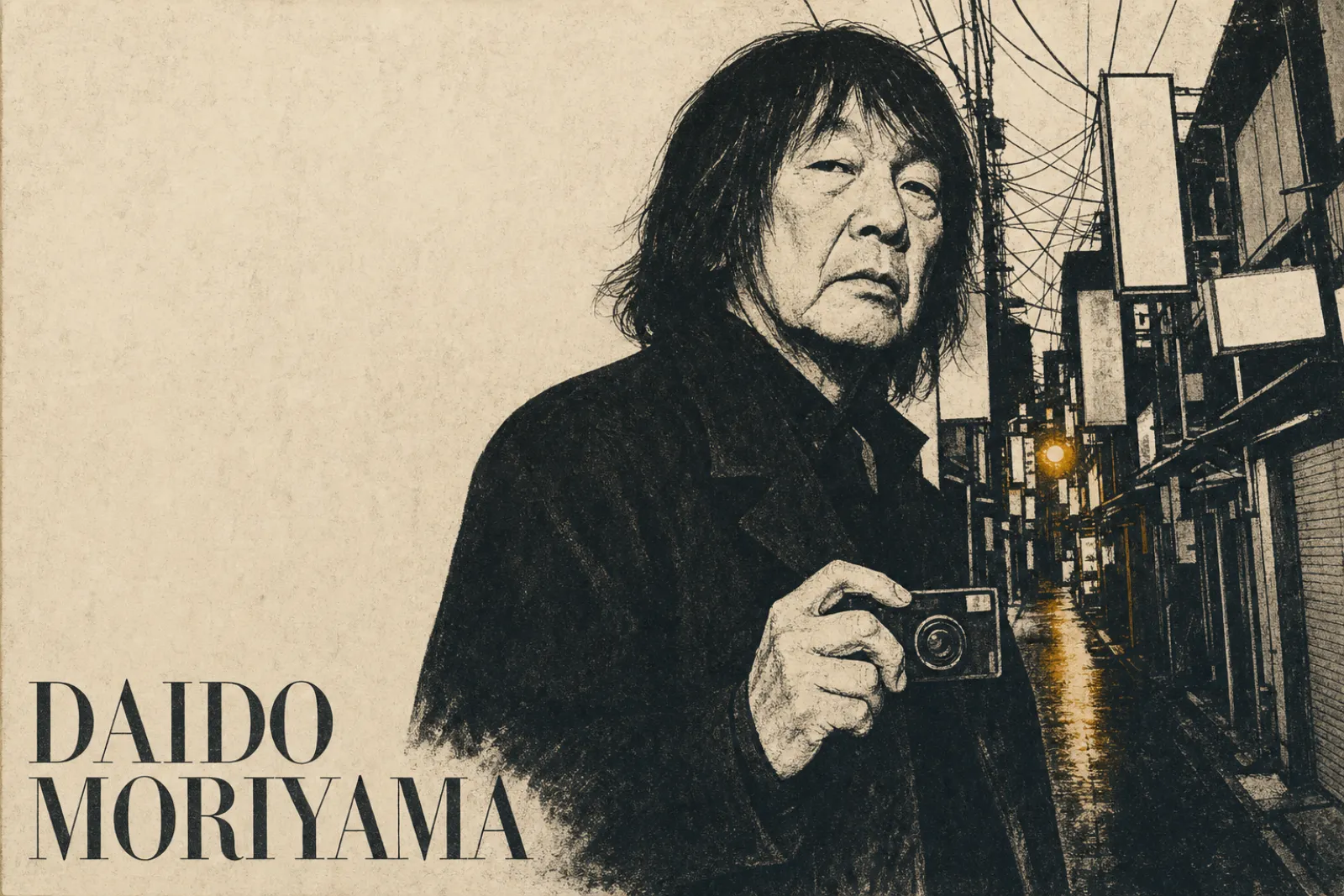
Daido Moriyama is a Japanese photographer, born in Osaka in 1938, who made rough, grainy, high contrast black and white pictures of streets in Tokyo and across Japan from the 1960s onward. He worked with small hand held cameras and published his work mainly as books, more than 150 of them. He is the best known photographer to come out of the magazine Provoke and its blurred, grainy style.
Moriyama learned the craft as an assistant. In Osaka he worked in the studio of Takeji Iwamiya, and in Tokyo he spent three years with Eikoh Hosoe, whom he credited with teaching him the fundamentals of technique. His influences included the photographers William Klein and Shomei Tomatsu and the artist Andy Warhol. The Provoke photographers set themselves against the clear, well made photojournalism that led Japanese photography at the time. For a contrast from the same years, look at the New York street work of Garry Winogrand and Joel Meyerowitz, who was born in the same year as Moriyama and took the street in the opposite direction, toward colour.
From graphic design in Osaka to a first book in Tokyo
Moriyama was born on 10 October 1938 in Ikeda, Osaka. His childhood was spent in several parts of Japan before the family returned to Osaka. He worked in graphic design from his mid teens, then bought an inexpensive Canon 35mm camera from a friend and turned to photography in his early twenties.
In 1961 he moved to Tokyo, hoping to join the photographers’ cooperative Vivo, and became Hosoe’s assistant. When he began working for himself, magazines published his pictures. A series published in 1965 caught the attention of the poet Shuji Terayama, who asked him for images to accompany his theatre and prose works. In 1967 the Japan Photo Critics Association gave Moriyama its New Artist Award.
His first book, Japan: A Photo Theater, came out in 1968. It mixed the tension of city life with pictures of nightlife and of a Tokyo being torn up and rebuilt. It is street photography in the plain sense that it was made on foot in public places, but it has little interest in the single well timed scene. The pictures pile up.
Provoke, Farewell Photography and the stray dog
Provoke was an experimental photography magazine founded in 1968 by Takuma Nakahira, Yutaka Takanashi, Koji Taki and Takahiko Okada. Moriyama joined from the second issue. Its look is described in Japanese as “are, bure, boke”: rough or grainy, blurred, out of focus. Of the photographers linked with the magazine, Moriyama became the most celebrated.
In 1969 the magazine Asahi Camera ran his twelve part series Accident, for which he photographed images already reproduced elsewhere, such as television stills and news wire pictures. Photographing pictures of pictures became a lasting habit.
Two books followed in 1972. Farewell Photography pushed the rough style as far as it would go. It included the leftovers of the process itself: the edges of discarded film, dust, light leaks, sprocket holes and the maker’s lettering on the film. A Hunter, inspired by Kerouac’s On the Road, held many pictures taken from a moving car, with tilted horizons, blurred figures and pieces of road in the frame.
His best known single picture dates from the same period. Stray Dog, Misawa, made in 1971 in a town in Aomori prefecture beside a United States air base, shows a haggard stray dog turning its head toward the camera.
In 1974 his work was included in New Japanese Photography at the Museum of Modern Art in New York. In the same year he helped Shomei Tomatsu set up the Workshop Photography School, and in 1976 he co-founded Image Shop Camp, a gallery given over to photography that put on about 200 exhibitions in eight years.
The retrospective Daido Moriyama: Stray Dog opened at the San Francisco Museum of Modern Art in 1999 and travelled. From 10 October 2012 to 20 January 2013 Tate Modern in London showed him alongside William Klein. He received the Infinity Award for Lifetime Achievement from the International Center of Photography in 2012 and the Hasselblad Award in 2019, an award Josef Koudelka, another photographer born in 1938, had received in 1992. From the late 2000s he worked increasingly with compact digital cameras. His colour work includes the series Tokyo Colour, made from 2008 to 2015.
How the rough pictures are made to work
Start with the camera. Moriyama used a small hand held camera and tended to shoot without looking through the viewfinder. He took a large number of frames of whatever passed him. Not framing with the eye produced tilted horizons and cut off figures, and he kept them.
How do you get anything sharp without looking through the camera? Zone focusing explains presetting distance and aperture so that a known band is in focus.
Then the tone. The pictures are black and white with harsh contrast: few mid greys, deep blacks, bright whites. Grain is not hidden. It is part of the surface, in the way brush marks are part of a painting. Blur from movement, his own or the subject’s, is left in.
Want that texture from a digital file? How to add film grain to digital photos covers what grain is, when it helps and how to apply it.
Then the crop. Many of his pictures were printed in an upright 4:5 shape instead of the longer 3:2 shape of the 35mm negative, and he sometimes cropped his 35mm frames to get it. Changing the aspect ratio after the fact let him tighten a loose, unsighted frame around the one thing that mattered in it. Some prints were composites, built from more than one frame of film.
Then the hour and the place. Bars, signs, back streets and nightlife run through the books. Working after dark with a small camera means high sensitivity film, slow shutter speeds and all the grain and blur that follow. The guide to night street photography covers the same conditions with digital cameras.
Last, the book. Moriyama treated the printed page as the final form, and from the 2000s he preferred to hand the layout and recomposition of his books to someone else, because it freed the pictures from his own memory of taking them. One picture matters less than the run of them. Photo book design looks at sequence and pacing, and shooting on film covers the material he started with.
Nervous about raising a camera at strangers at all? Overcoming your fear in street photography gives a staged way to build up to it.
Photographs and books to look for
- Japan: A Photo Theater (1968). His first book. Notice how nightlife and a city under redevelopment are mixed without explanation, and where blur is used.
- Accident (1969). A twelve part magazine series made by photographing television stills and news pictures. Ask what changes when a camera copies an image instead of a scene.
- Stray Dog, Misawa (1971). A dog turns its head toward the camera. Ask how close the photographer was and at what height, and what the grain and contrast add to so small an event.
- Farewell Photography (1972). The extreme of the style. Look for film edges, dust, light leaks and sprocket holes, things most photographers trim off.
- A Hunter (1972). Pictures taken from a moving car. The tilt, the blur and the pieces of road in the frame tell you how each one was made.
- Tokyo Colour (2008 to 2015). Later work in colour. Compare it with the early books and decide what in the approach survives without black and white.
Try this: fifty frames without looking
Take 15 minutes on one busy block, with a phone or a small camera.
- Set the camera to black and white if it has the option, and to its widest lens.
- Hold it at chest height. Do not look at the screen or through the viewfinder at any point.
- Walk the block once and take fifty frames: signs, feet, windows, people passing, posters, the road. Do not stop to compose.
- At home, raise the contrast until the mid greys thin out. Then pick five frames and crop each to an upright 4:5 shape around the one thing in it that holds your eye.
- Put the five in an order and look at them as a set.
Most frames will fail. The point is to see what kind of picture appears when the eye is taken out of the framing, and how much of the result is decided afterwards in the crop and the order.
Questions people ask about Daido Moriyama
What does “are, bure, boke” mean?
It is a Japanese phrase for rough or grainy, blurred and out of focus. It describes the look linked with Provoke magazine and with Moriyama’s work from the late 1960s and early 1970s.
What camera did Daido Moriyama use?
He started with an inexpensive Canon 35mm camera bought from a friend and became known for working with small hand held cameras. From the late 2000s he worked almost entirely with compact digital cameras.
What was Provoke magazine?
Provoke was an experimental Japanese photography magazine founded in 1968 by Takuma Nakahira, Yutaka Takanashi, Koji Taki and Takahiko Okada. Moriyama joined from its second issue, and he became the most celebrated of the photographers linked with it.
Where was the Stray Dog photograph taken?
In Misawa, in Aomori prefecture in northern Japan, in 1971. The town sits beside a United States air base. The picture gave its name to his 1999 retrospective at the San Francisco Museum of Modern Art.
Moriyama is one of many photographers profiled in the A to Z of photographers.