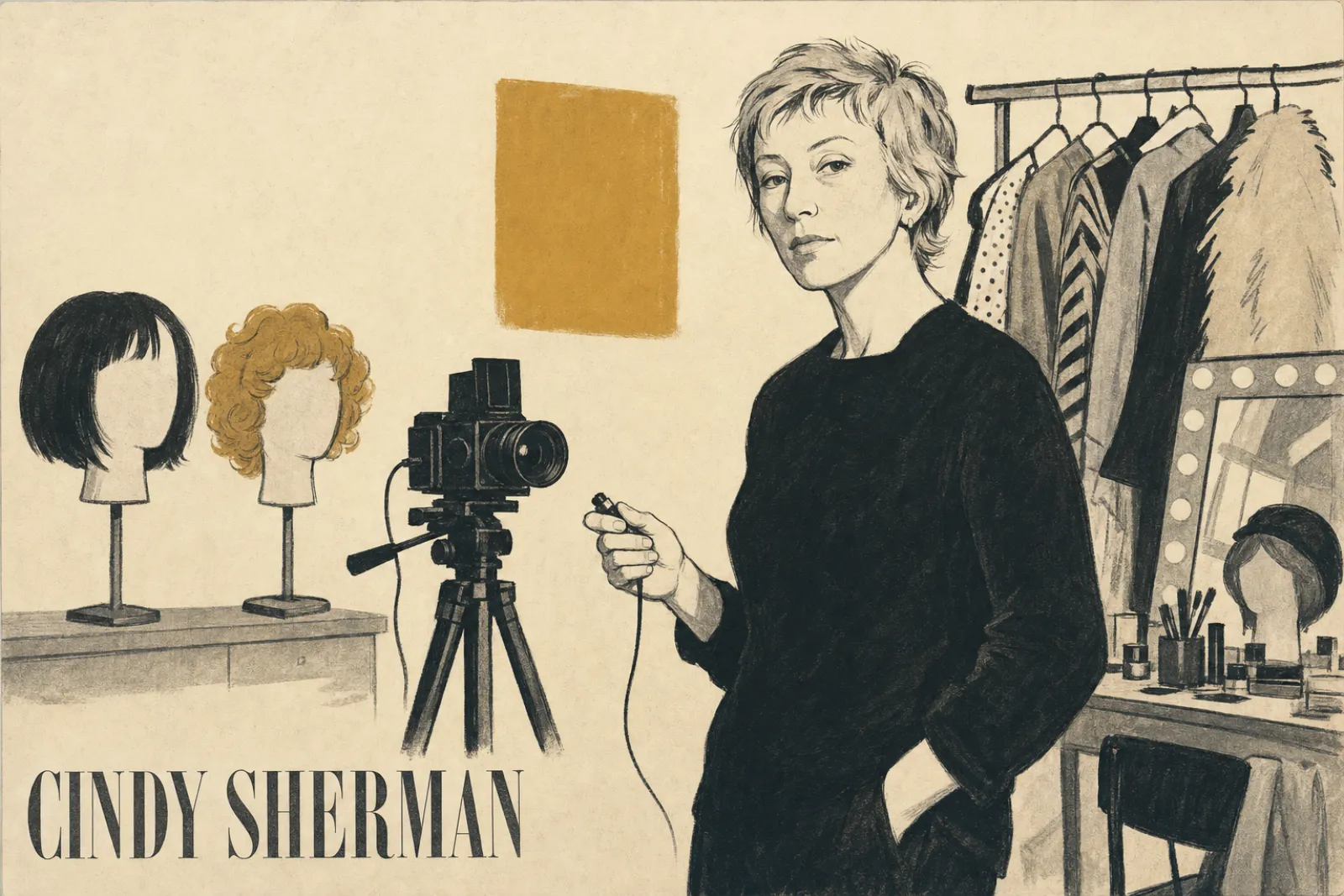
Cindy Sherman (born 1954) is an American artist who built a career from the late 1970s onward on photographs of herself dressed as other people. Working alone in her studio, she was the model, photographer, stylist and makeup artist for every picture. She is known for the Untitled Film Stills, 70 small black-and-white photographs made between 1977 and 1980 that look like publicity shots from films that never existed.
Sherman is grouped with the Pictures Generation, American artists of the 1970s and 1980s who took the images of film, television and advertising as their raw material. Her pictures are not self-portraits in the usual sense. They say nothing about her. They react against the idea that a photograph of a person shows who that person is. Two other photographers make useful comparisons. Francesca Woodman, working in the same years, also put her own body in front of the camera, but to very different, private ends. Gregory Crewdson also staged pictures that borrow the look of cinema, on a far larger scale.
Buffalo, New York and seventy films that were never made
Sherman was born in Glen Ridge, New Jersey, on January 19, 1954. In 1972 she entered the art department at Buffalo State College intending to paint, then switched to photography. She graduated in 1976. While a student, in 1974, she helped found Hallwalls, an artist-run space in Buffalo, with Robert Longo, Charles Clough and others. In 1977 she moved to New York City.
That year she began the Untitled Film Stills. Each one shows a single woman in a moment that seems cut from a story: a young office worker in the city, a housewife at the sink, a woman waiting by a road. The characters are types drawn from 1950s and 1960s Hollywood films, film noir, B movies and European art-house cinema. None copies a real film. Sherman used wigs, makeup and clothes to build each character. She shot them in her apartment, on streets around New York, at a beach house on Long Island and on a trip to Arizona.
The prints are small, black and white and glossy, shown in plain black frames, the format of the stills that film studios sent to newspapers. That choice matters. A viewer who knows what a publicity still looks like accepts the picture as one before noticing that the same woman is in all of them. The Museum of Modern Art in New York bought the series in December 1995 and exhibited it in 1997.
Never photographed yourself on purpose before? The self-portrait photography guide covers gear, focusing without a stand-in and composition.
Color, scale and stranger characters
In 1980 Sherman moved to color and larger prints. In the Rear Screen Projections of that year she posed in front of projected backgrounds, an old film-studio trick. In 1981 the magazine Artforum invited her to make work for its pages. She produced the Centerfolds, twelve wide color photographs, each 2 feet by 4 feet, shaped like a magazine’s double-page spread. Each shows one woman on the floor or in bed, usually lying down and filling the frame, lost in thought or worry. The magazine decided not to run them. They became one of her best-known series.
The work that followed grew less comfortable. The Fairy Tales (1985) and Disasters (1986 to 1989) are dark, theatrical scenes, and in some of them Sherman hardly appears. For the History Portraits (1988 to 1990) she restaged European portrait painting from the 15th to the 19th century with costumes, wigs and obviously false body parts. A group of pictures from 1992 used mannequins and prosthetic limbs in place of her own body to take on the subject of sexuality in images. They are deliberately unpleasant, and they are not suitable for young viewers.
Later series returned to single characters against a background. The Clowns (2003 to 2004) put painted faces against garish, digitally made backdrops. The Society Portraits (2008) showed society matrons, each one a study of makeup, clothes and posture. A photographic mural made in 2010 and 2011 altered her face digitally instead of with makeup and set the figures against decorative backdrops.
Her honors include a MacArthur Fellowship in 1995 and the Hasselblad Award in 1999. The Museum of Modern Art held a retrospective of more than 170 photographs from February 26 to June 11, 2012, which traveled to San Francisco, Minneapolis and Dallas.
How do you carry one idea across dozens of pictures? The page on long-term photography projects covers choosing a subject and keeping it going.
How one person became hundreds of characters
She controlled everything herself. Sherman worked without assistants, apart from a few early frames where someone else pressed the shutter. She was photographer, model, art director, makeup artist, hairdresser and stylist. Working alone removes pressure. She could try a face, look at the result and try again without anyone waiting.
The materials were cheap and ordinary. A camera, wigs, makeup and clothes were enough for most of her career. The page on photography props and accessories lists the sort of simple objects that can do this job. What changes a person in a picture is rarely expensive: a hairline, a pair of glasses, the way a collar sits.
Each picture implies a story and withholds it. The character looks out of the frame, or pauses in a doorway, or holds something. The viewer supplies what happened before and after. This is visual storytelling with the story left out, and it is why the Film Stills hold attention far longer than their size suggests.
The format carries meaning. The small glossy still, the wide centerfold and the large formal portrait each tell the viewer what kind of picture to expect before the subject is even read. Sherman picked the print size and aspect ratio that belonged to the kind of image she was imitating, then put the wrong thing inside it.
The light matches the source. The Film Stills are lit to look like scenes from a film. The History Portraits are lit to look like the oil paintings they restage. In each series the light is part of the costume. Learning a few basic arrangements from a studio lighting setup guide is a good way to see how one face can be made to belong to different kinds of picture.
The seams show. In the History Portraits the prosthetic body parts are plain to see. Sherman did not want a perfect disguise. The visible fakery reminds the viewer that every portrait, painted or photographed, is put together.
Nothing has a title. Every work is called Untitled and given a number. Without a caption, the viewer has to decide who the person is. Sherman said that she wanted people to recognize something of themselves in the pictures and not her.
Is this still portrait photography? The fine art photography page explains how an idea, more than a subject, can drive a body of work.
Works to look for
- Untitled Film Still #21 (1978). One of the best known of the series: a young secretary in a suit and hat on a city street, office buildings behind her, looking off to one side. Notice how the low camera angle and her sideways look suggest that something is about to happen.
- Untitled Film Still #48 (1979). A hitchhiker stands at the side of an Arizona road at sunset with her case behind her, small in a wide view. It is one of the few stills where another person, her father, pressed the shutter. It shows that a character can be made by clothes, posture and place alone.
- Untitled #96 (1981). One of the Centerfolds. A teenage girl in an orange sweater lies on a linoleum floor, holding a scrap of newspaper. The wide frame is filled edge to edge. A print sold at auction in 2011 for 3.89 million dollars, then the highest price paid for a photograph.
- The History Portraits (1988 to 1990). Large color pictures that restage old master portraits. Look at how the wigs and prosthetic body parts are left visible, and compare the lighting and pose with the kind of painting each one imitates.
- The Clowns (2003 to 2004). Bright color, heavy makeup and digital backgrounds. Look at how each clown’s expression fights with the painted smile on top of it.
Try this: three people who are all you
This takes about 20 minutes. Use a phone or camera on a tripod, a shelf or a stack of books, with the self-timer.
- Write down three characters in one line each. Give each a job and a mood, for example: a tired night-shift nurse, a nervous first-time traveler, a retired teacher who has just had good news.
- For each one, change only three things: hair, one item of clothing, and one object to hold. Use what is already in the house.
- Stand in the same spot by a window for all three. Do not look at the lens. Decide what the character is looking at and look at that.
- Take no more than five frames per character, then pick one of each.
Put the three chosen pictures side by side. The exercise has worked if a stranger would guess three different lives. If they look like you in three hats, change the posture next time, not the costume. A posing guide helps here, because shoulders and hands tell more than clothes do.
Questions people ask about Cindy Sherman
Are Cindy Sherman’s photographs self-portraits?
She is the model in most of them, but she did not treat them as self-portraits. Each picture shows an invented character, and the works are left untitled so that the viewer decides who the person is. She said she wanted viewers to recognize something of themselves, not her.
What are the Untitled Film Stills?
They are 70 black-and-white photographs made between 1977 and 1980. In each one Sherman plays a female character of a kind familiar from 1950s and 1960s films, in a scene that looks like a publicity still. The Museum of Modern Art in New York acquired the series in 1995.
Did Cindy Sherman take her own photographs?
Almost always. Museum accounts of her working method describe her as working unassisted in her studio and doing the photography, modeling, makeup, hair, costume and art direction herself. A few of the early Film Stills were taken by someone else at her direction, including one shot by her father.
Cindy Sherman is quoted on the photography quotes page, and the A to Z of photographers leads to others who staged what they photographed.