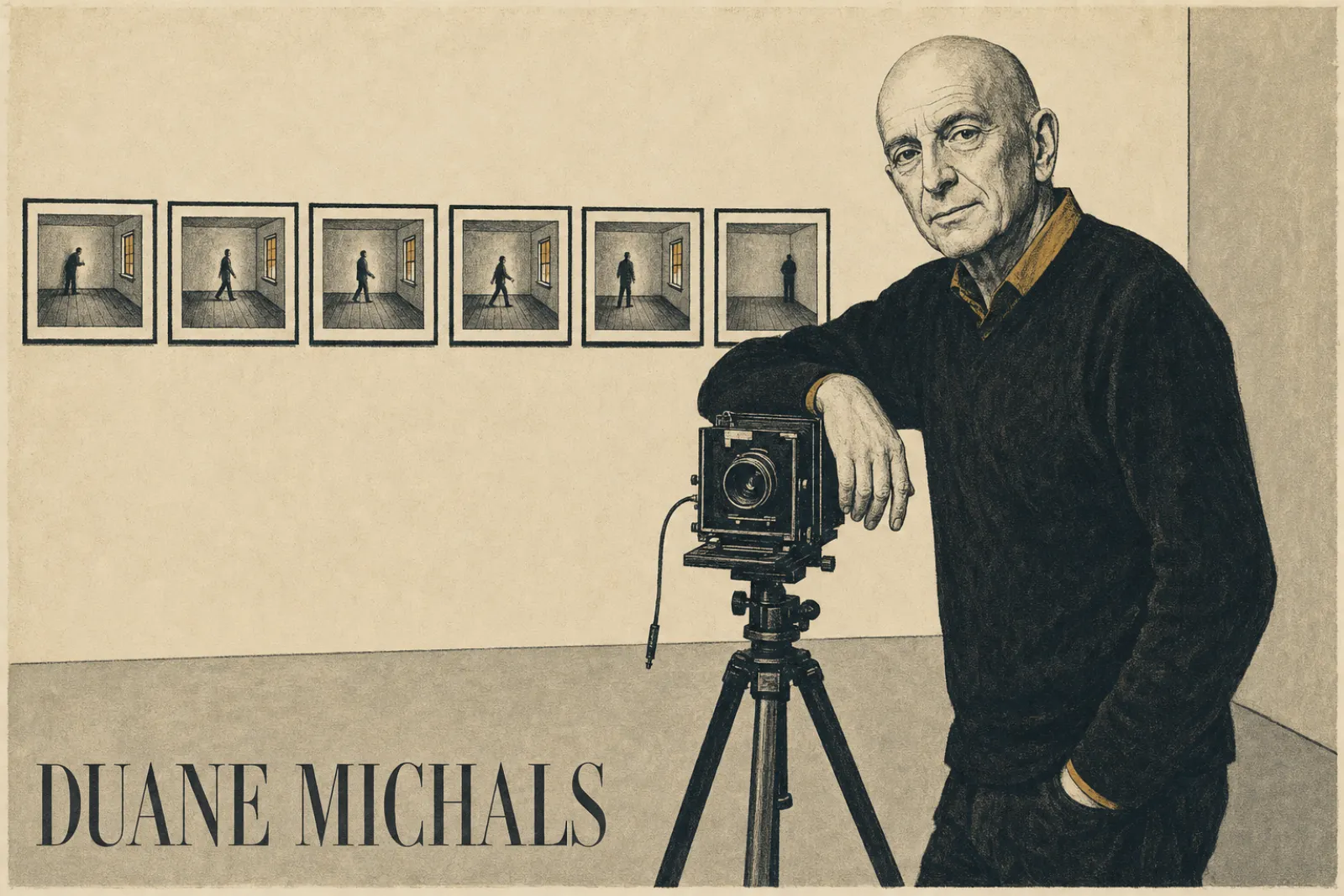
Duane Michals (1932 to 2026) was an American photographer who worked in New York from the late 1950s. At a time when serious photography meant a single picture caught in the street, he staged small stories and told them in rows of photographs. He then began writing by hand on the prints. He is known for those two things: the photo sequence, and the photograph with handwritten text.
Michals never studied photography. He trained as a graphic designer and took his ideas from painters and writers more than from photographers, above all the Surrealist René Magritte, Giorgio de Chirico, Balthus, William Blake, Lewis Carroll and Walt Whitman. An early series of deserted city views followed the example of Eugène Atget. In 1966 he was shown alongside Lee Friedlander, Garry Winogrand and Bruce Davidson in the exhibition “Toward a Social Landscape”, but his direction was the opposite of theirs. They went out to find pictures. He made his up.
From a steel town to a borrowed camera in Russia
Michals was born on February 18, 1932 in McKeesport, Pennsylvania, a steel town near Pittsburgh, into a family of steelworkers. As a teenager he took art classes at the Carnegie Institute in Pittsburgh. He graduated from the University of Denver in 1953, served in the United States Army in Germany, and then moved to New York, where he studied for a time at Parsons School of Design and worked in publishing and design.
In 1958 he travelled to the Soviet Union with a borrowed camera and made simple, direct portraits of people he met. Those pictures were the basis of his first exhibition, at the Underground Gallery in New York in 1963. He supported himself with magazine work for Esquire, Mademoiselle and Vogue, and he kept doing commercial assignments throughout his career. In 1968 the Mexican government hired him to photograph the Olympic Games.
His portraits stand apart from the studio portraits of the day by photographers such as Richard Avedon. Michals photographed René Magritte at the painter’s own house and the artist Joseph Cornell in a darkened room, which is the approach described in the guide to environmental portrait photography.
Sequences: when one picture was not enough
In 1964 Michals photographed New York early in the morning with nobody in it: empty shops, deserted streets, a subway car. The rooms look like stage sets waiting for actors. Within a couple of years he was supplying the actors. He asked people to play parts in short scenes and photographed each scene as a short series of frames, printed small and shown in a row.
The subjects were things a camera cannot see directly: death, desire, memory, dreams, what happens to the spirit. In The Spirit Leaves the Body (1968) the soul is shown departing from a body, an effect made with double exposure. The Museum of Modern Art gave him a solo exhibition in 1970, and the book Sequences carried the work to a wider audience.
How do you plan pictures that only make sense together? How to create a photo story or series covers building a beginning, middle and end.
Writing on the print
During the 1960s Michals began to write by hand on his prints, in the margins around the picture. Sometimes it was a title, sometimes a paragraph, sometimes a poem. The practice offended many photographers, who believed a good picture should need no words. His answer was that photographs fail all the time, and that he would write what the picture could not show.
This Photograph Is My Proof (1967) is among the best known of these works, a single print with a text added in his hand. The title states the idea: the picture is offered as evidence, and it takes the words to say what it is evidence of. Later books paired pictures with his own verse, and The House I Once Called Home (2003) returned to his family home in McKeesport. He went on to publish more than forty books, and in later years he also painted on photographs and made short films. He died in New York on June 9, 2026.
What should the words beside a photograph do? How to write photo captions covers adding what the picture cannot say, without repeating what it can.
How a Michals sequence is built
- He started with an idea, not a location. Each sequence answers a question such as “what does it feel like to be visited by death?” The scene, the actors and the props were chosen to serve it.
- He kept the camera position fixed. In several sequences the frame hardly moves from one picture to the next. Because the room stays the same, the eye goes straight to what has changed.
- He changed one thing per frame. A figure enters, comes closer, touches, leaves. Each picture is a single step. This is the logic of film frames or a comic strip, and the page on visual storytelling covers the same principle.
- He used faults as tools. Blur, mirror images and double exposure were rejected by most photographers of his generation. Michals used them to show ghosts, dreams and the passing of time. He first met double exposure by accident, with the borrowed camera in Russia.
- He ended with a turn. The last frame often changes the meaning of the first. Some sequences are circular and finish where they began.
- He worked plainly. The pictures are small black and white prints of ordinary rooms and ordinary people. The lack of polish keeps attention on the idea.
- He let text and picture disagree. The writing does not describe what is visible. It adds a memory, a doubt or a feeling, so the reader has to hold both at once.
Looking for a first idea to stage? Photography project ideas lists fifty starting points, many of which suit a short series.
Sequences and photographs to look for
- Empty New York (1964). Vacant shops and deserted streets early in the morning. Notice how a room without people still suggests that something is about to happen.
- Magritte with Hat (1965). One of the portraits from his visit to the painter’s house. In these pictures Magritte appears translucent or in fragments, so that the painter seems to turn into one of his own paintings.
- Paradise Regained (1968). Six frames. A clothed couple in a room gradually shed their clothes while the house plants grow, until the room has become a garden.
- Death Comes to the Old Lady (1969). Five frames. A woman in a housedress is visited by a man in a dark suit, and at the end she evaporates from the picture. Her disappearance stands for the event the camera cannot record.
- Chance Meeting (1970). Six frames. Two men meet in passing, and the sequence turns on the attraction between them. Very little happens, and the story is carried by small changes from one frame to the next.
- Things Are Queer (1973). Nine frames. From one picture to the next the objects and the figure change scale, so that nothing is the size it first seemed. The sequence is circular.
Try this: a five frame story from one spot
Allow about 20 minutes. You need a phone or camera, one room and one person. You can be the person if you use a timer.
- Write one sentence that states something invisible, for example “someone is being remembered” or “a decision is made”.
- Put the camera on a shelf, a stack of books or a tripod and do not move it again.
- Take exactly five pictures. Change only one thing between each: a position, a gesture, an object that appears or goes.
- Make the fifth picture alter the meaning of the first.
- Lay the five out in a row. Under one of them, write a single line by hand that tells the viewer something the pictures do not show.
Questions people ask about Duane Michals
What is Duane Michals known for?
He is known for photo sequences, in which a staged story is told across several frames, and for writing by hand on his prints. Both broke with the idea, dominant in the 1960s, that a photograph should be a single unposed moment that speaks for itself.
Why did Duane Michals write on his photographs?
He thought a photograph could show how something looked but not what it meant to the people in it. The handwriting supplies thoughts, memories and doubts that are not visible in the frame.
Was Duane Michals trained as a photographer?
No. He studied art and design at the University of Denver and at Parsons School of Design and described himself as self taught in photography. He began photographing on a trip to the Soviet Union in 1958.
Where can Duane Michals’s work be seen?
The Carnegie Museum of Art in Pittsburgh holds his archive and organised the retrospective “Storyteller” in 2014. The Morgan Library and Museum in New York presented a retrospective in 2019. His prints are in many museum collections, including the Museum of Modern Art.
Michals is one of the names in the A to Z of photographers, and he is quoted on the photography quotes page.