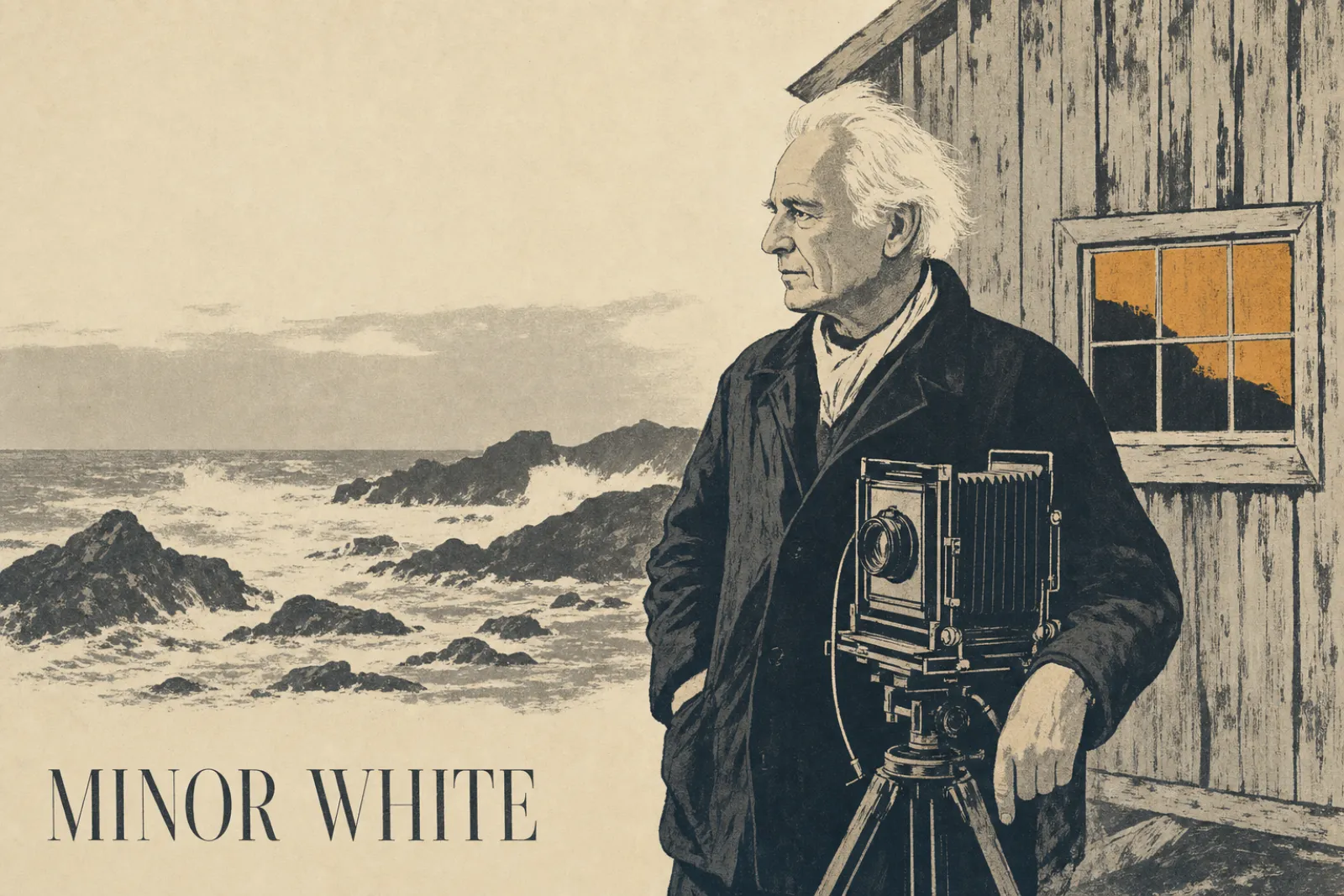
Minor White (1908 to 1976) was an American photographer, teacher and editor who worked in Portland, San Francisco, Rochester and Boston. He made black and white photographs of rock, surf, frost, barns, peeling paint and windows, and arranged them in ordered groups he called sequences. He is known for treating a photograph as a metaphor for a state of mind, and for editing the magazine Aperture from its founding in 1952.
White learned from the leading American photographers of the generation before his. From Alfred Stieglitz, whom he first met in New York in February 1946, he took the idea of the equivalent, a photograph that stands for a feeling, and the practice of showing pictures in sequence. From Ansel Adams he learned the Zone System of exposure and development. Edward Weston, whose Point Lobos he photographed again and again, shaped both his pictures and his thinking. What White added was a spiritual discipline, drawn in later years from Zen and the teachings of Gurdjieff, and a method of teaching people how to look.
Botany, Portland and a 35mm camera
White was born in Minneapolis on 9 July 1908. His grandfather, an amateur photographer, gave him his first camera in 1915. He studied botany and writing at the University of Minnesota and graduated in the early 1930s.
In late 1937 he moved to Portland, Oregon, with a 35mm Argus camera. He lived at the YMCA, taught his first photography class there and joined the Oregon Camera Club. In 1938 he was hired as a photographer by the Oregon Art Project of the Works Progress Administration and recorded the historic buildings of downtown Portland. In 1940 he went to teach at an art centre in La Grande, in eastern Oregon.
Recognition came quickly. In 1941 the Museum of Modern Art in New York accepted three of his photographs for an exhibition and bought all three. In 1942 the Portland Art Museum gave him his first solo exhibition. That April he was drafted into the army. He served in Hawaii, Australia and the Philippines, photographed little and wrote poetry.
How do you photograph a building so that it stands straight and reads clearly? How to photograph architecture and buildings covers viewpoint, light and keeping verticals upright.
San Francisco: the coast, the school and Aperture
After his discharge in 1945 White went to New York, studied art history at Columbia University with Meyer Schapiro and met Beaumont and Nancy Newhall at the Museum of Modern Art. In July 1946 he moved to San Francisco to assist Ansel Adams in the new photography department at the California School of Fine Arts. By the middle of 1947 he was its main teacher and had built a three year course centred on personal expression. He brought in Imogen Cunningham, Lisette Model and Dorothea Lange to teach.
The pictures changed with the place. On the coast south of the city, in San Mateo County and at Point Lobos, he photographed surf, fog banks, cliffs and rock, and in 1947 he made the sequence Song Without Words. From 1949 he also carried a small Zeiss Ikonta camera through San Francisco and over four years made nearly 6,000 photographs of Chinatown, the docks, parades and fairs, a body of street photography quite unlike the work he is known for.
In 1952 White, Adams, Lange, the Newhalls, Barbara Morgan and others founded Aperture, a journal for serious photography. White volunteered as editor and ran it for many years. It became one of the most influential photography publications of its time.
Rochester and MIT: the teacher
In 1953 Beaumont Newhall invited White to George Eastman House in Rochester, New York, as a curatorial assistant. He worked there until 1957 and organised exhibitions. From 1955 he taught at the Rochester Institute of Technology. In Rochester he took up Zen meditation and the ideas of George Gurdjieff, and both entered his teaching. He began working in colour in 1955 and made thousands of 35mm transparencies over the next twenty years. He also travelled across the United States photographing landscape. In August and September 1959 he photographed the Badlands of South Dakota, the Grand Tetons and the California coast.
In 1965 he was invited to help set up a visual arts programme at the Massachusetts Institute of Technology and moved to the Boston area. At MIT he directed four large themed exhibitions: Light7 in 1968, Be-ing without Clothes in 1970, Octave of Prayer in 1972 and Celebrations in 1974. His first monograph, Mirrors, Messages, Manifestations, was published by Aperture in 1969 with 243 photographs and his own texts. He received a Guggenheim Fellowship in 1970.
White died in Boston on 24 June 1976. He left his archive to Princeton University, where the Minor White Archive at the art museum holds more than 26,000 items: prints, negatives, contact sheets, proof cards, journals and teaching notes.
How an equivalent and a sequence are made
White’s ideas can sound mystical. The working methods behind them are concrete.
- Take the subject out of its setting. He moved in on rock, wood, frost and paint until the surroundings were gone and the thing became a form. It is the same step that begins most abstract photography. The picture is still an exact record of what was in front of the lens. It has simply stopped being about that.
- Decide the tones before exposing. White used the Zone System he learned from Adams to place each part of the scene on a chosen tone in the print. The guide to the Zone System explains the scale, and previsualization covers the habit of seeing the finished print before pressing the shutter.
- Slow down. He used small cameras when he needed to, such as the Argus in Portland and the Zeiss Ikonta in San Francisco, but his method depends on long looking before the exposure. A view camera enforces that: large format means a tripod and a long look at the ground glass before any exposure.
- Change what the film sees. For Sequence 10, Rural Cathedrals, in 1955, he photographed the landscape of upstate New York on both ordinary and infrared film. Infrared film darkens blue sky and lightens foliage, which gives a familiar scene an unfamiliar look. The guide to infrared photography describes the effect.
- Edit as carefully as you shoot. A sequence is a fixed order of prints meant to be read from first to last, with each picture altering the next. White made about 100 such groups. He compared them to a cinema of stills. Early sequences carried poems and texts. Later ones dropped the words as the images grew more abstract.
- Look for a long time. He brought meditation into his teaching, and at MIT he required students to draw their subjects as well as photograph them, so that they would spend longer looking.
How do you put pictures in an order that adds up to more than the single frames? Photo sequencing covers the first edit, pairing, pacing and the opening and closing image.
Photographs and sequences to look for
- Sun in Rock, Devil’s Slide (1947). One of the San Mateo County coast pictures, from the same year as the sequence Song Without Words. Others from that coast carry titles such as Fog Bank and Surf. Look at how sea, fog and stone are treated as masses of dark and light.
- Two Barns and Shadow (1955). A barn picture from the year of Sequence 10, Rural Cathedrals, the group of upstate New York landscapes made on ordinary and infrared film. Look at how the shadow works as a shape of its own.
- Windowsill Daydreaming (1958). Made on 17 July 1958 at 72 North Union Street, Rochester. A windowsill with curtains is described almost entirely through light and texture. It is the second picture in the sequence Sound of One Hand, and it shows that an equivalent can be made indoors from very little.
- Sequence 16, Sound of One Hand (1960). The title refers to a Zen riddle. The pictures include work from Rochester and from Pultneyville, New York. Follow how each print prepares the next.
- Sequence 15 (1959). A portfolio of prints from August and September 1959 that sets landscapes such as Badlands, South Dakota and Grand Tetons beside close studies such as Patched Window and Broken Paint Figure. Look at how the large views and the small details are made to belong together.
- Totemic Sequence (1974). Ten photographs in which the last picture is the first one turned upside down. The opening image is titled Power Spot. It is a clear demonstration that order and orientation are part of a photograph’s meaning.
What happens to a picture when it is paired with one or two others? Diptychs and triptychs shows how to pair photographs so they work on each other.
Try this: a five picture sequence from one small place
Allow twenty minutes. Choose an area no bigger than a parking space: a patch of shoreline, a garden wall, a frosted car, a kitchen windowsill.
- Before lifting the camera, stand still and look at the place for two full minutes.
- Set the camera or phone to black and white.
- Make ten photographs, all from within arm’s reach of the subject. Leave out the horizon and anything that shows how big things are.
- Choose five. Lay them out in a row on a screen or as small prints.
- Reorder them until each picture hands a shape or a tone to the one after it. Then swap the first and last and see what changes.
- Write one word for the feeling of the finished row. Do not name the subject.
Questions people ask about Minor White
What did Minor White mean by an equivalent?
He took the term from Alfred Stieglitz. An equivalent is a photograph that works both as a record of the thing in front of the camera and as a symbol of something the photographer felt. White applied the idea to rock, water, frost and other natural forms photographed out of context.
Did Minor White found Aperture?
He was one of a group of founders in 1952, with Ansel Adams, Dorothea Lange, Beaumont and Nancy Newhall, Barbara Morgan and others. White was its first editor.
What is a sequence in Minor White’s work?
A sequence is a set of photographs shown in a fixed order so that the pictures act on one another. He made about 100 of them, and described the form as a cinema of stills.
Where did Minor White teach?
He taught at the California School of Fine Arts in San Francisco from 1946 to 1953, at the Rochester Institute of Technology from 1955, and at the Massachusetts Institute of Technology from 1965. He also ran workshops, some of them residential, in his own home.
White is one of the photographers in the A to Z of photographers, and he is quoted on the photography quotes page.