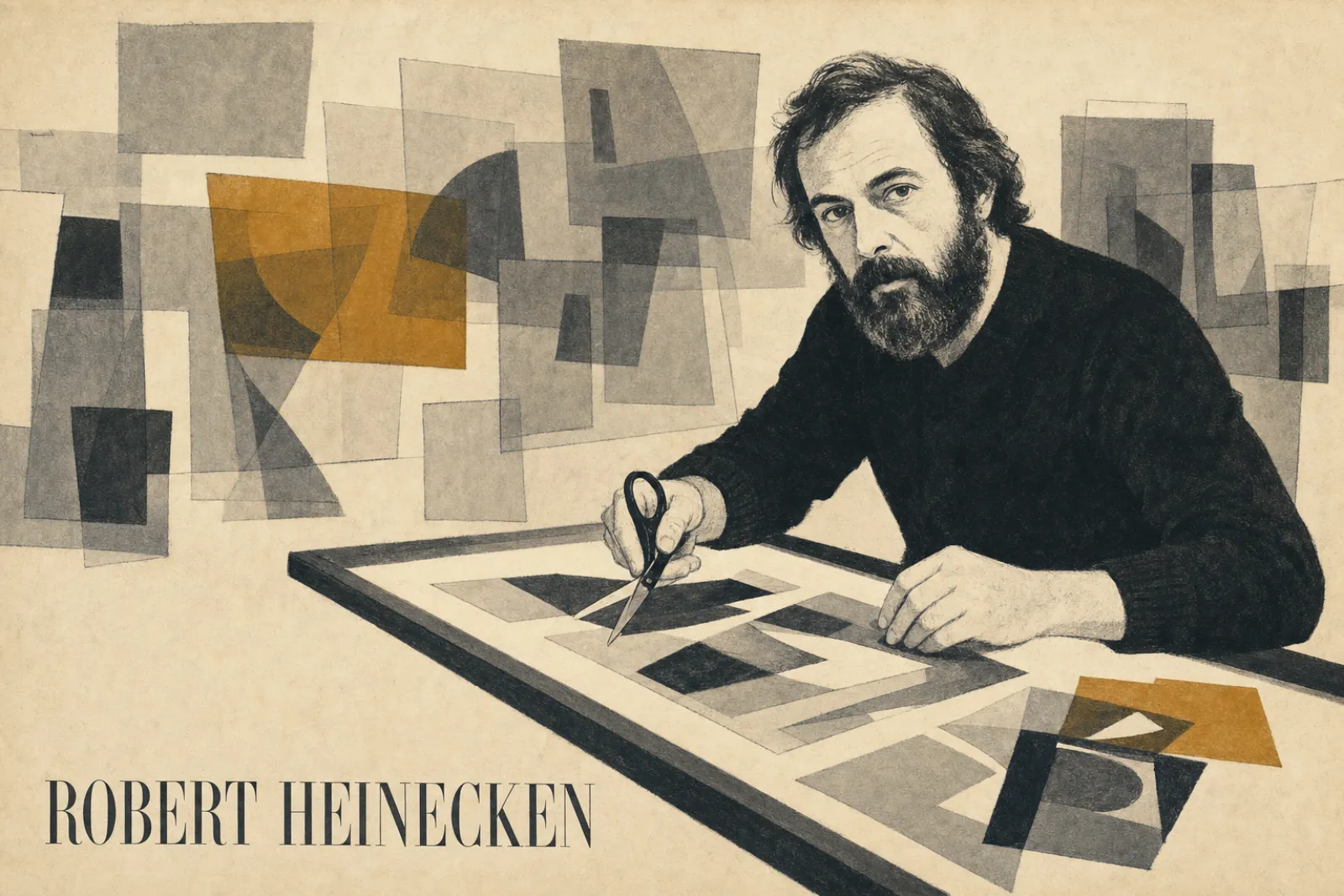
Robert Heinecken (1931 to 2006) was an American artist who worked in Los Angeles from the early 1960s to the 1990s and made photographs almost entirely without a camera. He cut, layered, contact printed and rephotographed pictures that already existed, mostly from magazines and television. He called himself a paraphotographer, and he is known above all for Are You Rea, a set of photograms made by shining light straight through magazine pages.
Heinecken came to photography from printmaking, and it shows. He treated a photograph as raw material to be worked on, in the way a printmaker treats a plate. That put him at odds with the West Coast tradition of the carefully made fine print that ran through Edward Weston and Ansel Adams. His early pictures from the 1960s were high in contrast, blurred, and deliberately under or overexposed. Later writers placed his work beside that of the artists who borrowed from mass media in the late 1970s and 1980s, among them Cindy Sherman, although he had started a decade before them.
From fighter pilot to the photography classroom at UCLA
Heinecken was born in Denver, Colorado, in 1931, the son of a Lutheran minister. The family moved to Southern California in 1942 and he grew up in Riverside. He earned an associate degree in art at a community college there in 1951 and began studies at the University of California, Los Angeles. He then left for military service, trained as a fighter pilot, and was discharged from the Marine Corps in 1957 with the rank of captain.
He went back to UCLA on the GI Bill and took a bachelor’s degree in art in 1959 and a master’s in 1960. His subject was printmaking. Photography entered during his graduate studies. In 1960 the art department hired him as an instructor in drawing, design and printmaking, and within two years he had started a photography curriculum there. He taught at UCLA until 1991.
The teaching mattered as much as the art. His program put experiment ahead of craft rules, and a number of his students went on to careers as artists using photography, including John Divola, Jo Ann Callis and Eileen Cowin. He was also among the founders of the Society for Photographic Education in 1964.
Wondering where this sits among the other schools of photography? Photography movements and the ideas behind them sets out straight photography, Surrealism’s found image and what came after.
Magazines, television and the borrowed picture
Heinecken’s subject was the flood of printed and broadcast pictures that surrounded American life: advertisements, news photographs, fashion spreads, pin ups, television news. He believed these images shaped how people thought about sex, the body, war and what to buy, and he wanted to make that shaping visible. So he used the pictures themselves.
Are You Rea, made between 1964 and 1968, is the clearest example. Hold a magazine page up to a window and the front and the back show at once. Heinecken did the same thing in the darkroom. He laid a single page on photographic paper and exposed it to light, so that both sides printed together as one negative image. No camera and no lens were involved. He looked through more than 2,000 pages from magazines such as Life, Time and Woman’s Day and chose 25 for the finished portfolio. An advertisement on one side collides with an article on the other, and the accident reads as a comment.
In the mid 1960s he also mounted photographs of the body on wooden blocks and puzzle pieces that could be rearranged, so that one work had many possible pictures. In 1969 he began altering whole magazines. He took copies of Time and other periodicals, overprinted or inserted explicit imagery among the ordinary pages, and some of these copies were put back on newsstands for unsuspecting buyers to find.
Television came next. In the 1980s he made what he called videograms, either by photographing the screen or by pressing light sensitive paper against it so the glow of the broadcast exposed the sheet directly. Inaugural Excerpt Videograms, from 1981, was assembled from the television coverage of Ronald Reagan’s inauguration. He also worked with instant film, first with the Polaroid SX-70 camera in the 1970s and early 1980s, and later with the very large 20 by 24 inch Polaroid process.
Some of this work uses pornographic source material, and it was meant to be uncomfortable. The lesson for a photographer does not depend on that material. It is that a picture changes its meaning when it is moved, cropped, paired or layered.
How a Heinecken picture is put together
The methods are simple, and that is part of the point. Almost everything he did can be traced to five choices.
- Contact, not camera. A photogram is made by putting an object straight onto light sensitive paper and exposing it. Heinecken’s object was a printed page. The same contact principle drives the alternative photography processes, and cyanotype is the easiest one to try because it needs only sunlight and water.
- Two pictures in one frame. His magazine photograms are found double exposures. The viewer’s eye tries to separate the two layers and cannot, so it reads them as one statement. The same effect can be planned on purpose with double exposure photography.
- Negative tones. Because the page itself acted as the negative, the print came out reversed, with dark ink turning light. Familiar faces and products become strange, and that strangeness slows the viewer down. High contrast does the rest, stripping an advertisement to shape and gesture.
- Selection as authorship. He made nothing in Are You Rea except the choice: 25 pages out of more than 2,000. Editing was the creative act. That is the same skill used in editing and ordering a body of work.
- Pairs and grids. Lessons in Posing Subjects and many later pieces set small pictures side by side with text, so that meaning comes from comparison. Anyone who has built a diptych or triptych has used the same idea.
He also moved between materials freely. He printed on canvas coated with photographic emulsion and coloured it by hand with pastel chalk, laid film transparencies over magazine page collage, and used silver dye bleach colour paper for his later photograms. All of it began in an ordinary darkroom.
Is this still photography, or something else? Photography theory covers the ideas critics use to answer that, including the photograph as a trace of the real and the question of truth in an edited frame.
Works to look for
- Are You Rea (1964 to 1968). Twenty five photograms from magazine pages. Look at how type from one side cuts across a face from the other, and how hard it is to tell which layer is on top.
- Multiple Solution Puzzle (1965). Sixteen gelatin silver prints mounted on wood. The parts can be rearranged, so the work has no single correct picture. Notice how that changes the viewer from a looker into a player.
- Figure Horizon #1 (1971). Ten canvas panels coated with photographic emulsion. The title joins two subjects, the human figure and the horizon line of a landscape. Look at how the join between one panel and the next becomes part of the picture.
- Lessons in Posing Subjects/Matching Facial Expressions (1981). Fifteen Polaroid prints with printed text. The title borrows the language of an instruction manual. Read the text against the pictures and notice how a caption changes what a pose seems to mean.
- Surrealism on TV (1986). A slideshow of 216 colour slides photographed from television and shown in random order. Because the order changes, the connections a viewer finds between one slide and the next are made by chance.
- Recto/Verso #2 (1988). A silver dye bleach print in colour. The title names the front and back of a page, the idea he had started with more than twenty years earlier.
Want to make a picture that is about an idea, not a place or a person? Fine art photography explains how to develop a concept and build a body of work around it.
Try this: a two sided page on a window
This takes about 15 minutes and needs a phone or camera, a magazine or newspaper, and a bright window.
- Tear out ten single pages that have pictures on both sides. Do not look for good matches. Take them as they come.
- Tape one page flat against the window glass in daylight so both sides show through at once.
- Photograph it square on, filling the frame with the page so no window frame shows. Switch off the flash.
- Repeat for all ten pages. The constraint: you may not move, fold or trim a page to improve the overlap.
- Convert the ten frames to black and white, then invert one to a negative and compare it with the positive.
- Pick the single page where the two sides say something together that neither says alone. Write one line on why.
The exercise trains selection. You made nothing, and one of the ten will still be better than the others.
Prefer to blend the two layers yourself? Abstract photography has a section on multiple exposure and layering with any camera.
Questions people ask about Robert Heinecken
What does paraphotographer mean?
It was Heinecken’s own word for himself. He used it because his work stood beside or beyond the usual idea of photography. He seldom used a camera and built his pictures from existing photographs.
How was Are You Rea made?
Each image is a photogram of a single magazine page. The page was placed in contact with photographic paper and exposed to light, which printed the front and the back together. The series was made between 1964 and 1968 and has 25 images.
Did Robert Heinecken ever use a camera?
Yes, at times. He photographed in the early 1960s, worked with the Polaroid SX-70 in the 1970s and photographed television screens in the 1980s. Most of his best known work, though, was made by contact printing, collage and rephotography.
Where is Robert Heinecken’s archive?
The Robert Heinecken Archive is held at the Center for Creative Photography at the University of Arizona in Tucson. It was formally started in 1981. The Museum of Modern Art in New York surveyed four decades of his work in the 2014 exhibition Robert Heinecken: Object Matter.
Heinecken is one of the photographers in the A to Z of photographers, and he is quoted on the photography quotes page.