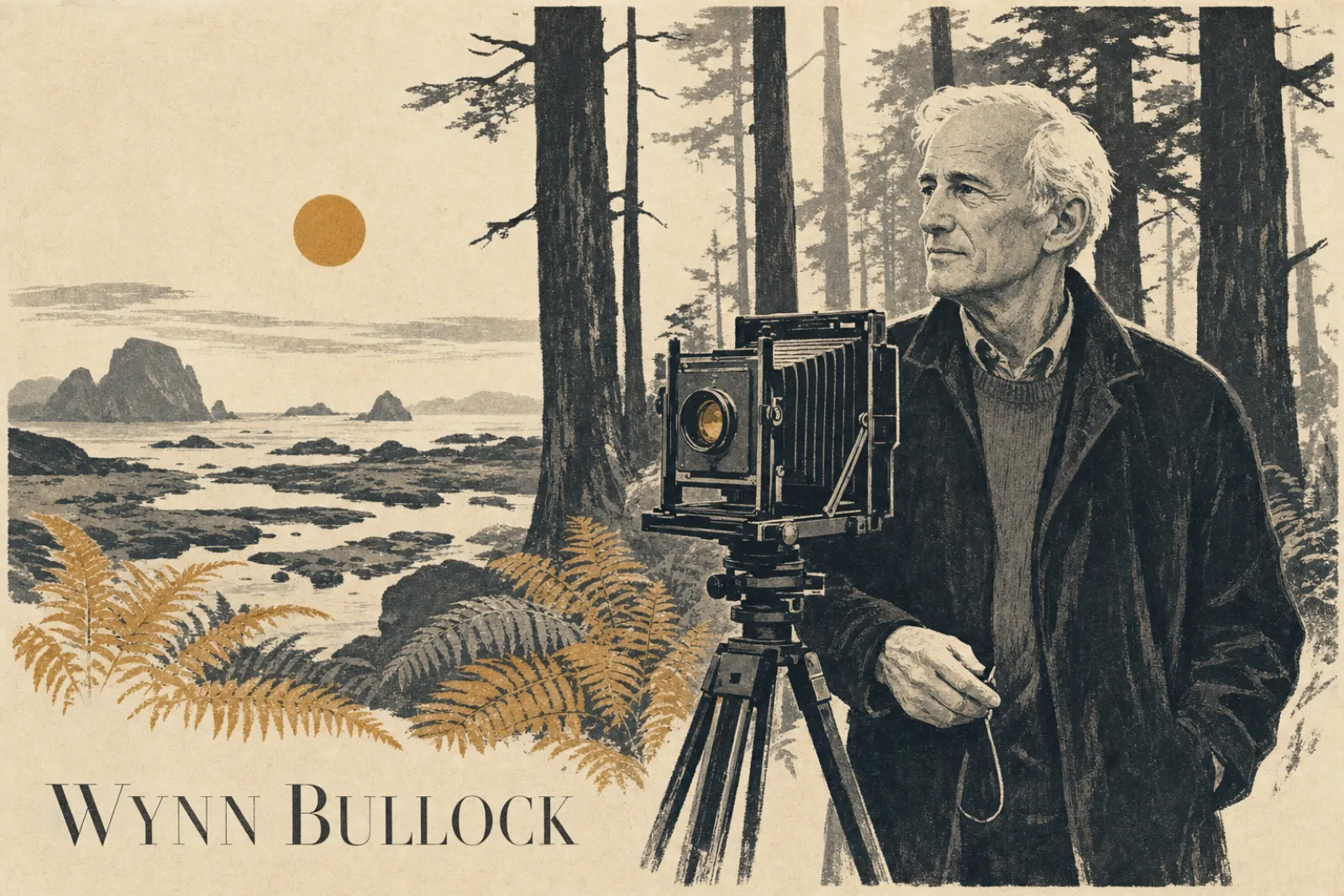
Wynn Bullock (1902 to 1975) was an American photographer who worked on the Monterey coast of California from 1946 until his death. He photographed forests, tide pools, eroded ground and the human figure in black and white, including on 8×10 inch sheet film. He is best known for Child in Forest, made in 1951, and for pictures that try to show time and change as well as surfaces.
Bullock came to photography late and by an unusual road. He had been a professional singer, and his first love in the medium was the experimental work of Man Ray and László Moholy-Nagy, which he saw in Paris in the 1920s. A meeting with Edward Weston in 1948 turned him toward sharp, unmanipulated prints. He then worked near Ansel Adams on the same stretch of coast and taught as a guest at Adams’s Yosemite workshops. He never fully gave up experiment, and that is what separates his pictures from theirs.
A tenor who bought a camera in Paris
Bullock was born in Chicago on April 18, 1902, and raised in South Pasadena, California. After high school he moved to New York to sing. He joined the chorus of Irving Berlin’s Music Box Revue and later toured with the show’s road company. In the middle of the 1920s he lived in Paris and studied voice and gave concerts in France, Germany and Italy.
In Europe he saw paintings by Cézanne and photographs by Man Ray and Moholy-Nagy. He bought his first camera and began taking pictures as an amateur. Back in the United States in the 1930s he completed pre-law courses in West Virginia, and in 1938 he entered law school at the University of Southern California. He left within weeks and enrolled at the Art Center School in Los Angeles, where he studied photography from 1938 to 1940.
His teacher there, Edward Kaminski, encouraged experiment. Bullock worked with solarization, in which a print or negative is exposed to light partway through development so that tones partly reverse, and with bas relief effects. The Los Angeles County Museum showed this early work in a solo exhibition at the start of the 1940s. He kept at the research, and in the late 1940s he was granted patents in the United States, Canada and Great Britain for a process that controlled the line effect of solarization.
Monterey, Weston and the turn to straight photography
During the Second World War Bullock enlisted in the Army and was then released to photograph for the aircraft industry. After the war he made and sold postcard pictures around California. In 1946 he settled in Monterey with his family and took the photographic concession at the Fort Ord military base. He held it until 1959 and kept doing commercial work until 1968. The personal photographs were made around a working life.
The meeting with Edward Weston in 1948 was the turning point. Weston’s prints showed him what a plain, sharp photograph could carry, and Bullock began to work in that manner himself. Through the 1950s he photographed the forests and shoreline near his home, often with members of his family as figures in the scene.
Recognition came in 1955. Edward Steichen chose two of his photographs for The Family of Man at the Museum of Modern Art in New York. When the exhibition travelled to the Corcoran Gallery in Washington, Let There Be Light was voted the most popular picture in it. The other, Child in Forest, became one of the pictures people remembered from the show.
Curious about the kind of camera that makes this possible? Large format photography explains camera movements, the image quality and what you give up to get it.
Colour made from light alone, then a return to black and white
In the early 1960s Bullock stopped making black and white pictures for a time and produced a body of work he called Color Light Abstractions. These were 35mm Kodachrome slides of light itself, with no recognisable subject. He regarded light as a great force at the heart of everything a photographer could study. The colour printing of the day frustrated him, and by the middle of the decade he went back to black and white. His estate began scanning and printing the abstractions in 2008.
The late black and white work was more experimental than what came before. He used very long exposures, photograms, prints made as negatives and prints turned upside down. In 1968 he became a trustee of the Friends of Photography in Carmel and chaired its exhibition committee in its first years. He also taught at the Institute of Design in Chicago and at San Francisco State College. In 1975 his archive was one of the five that founded the Center for Creative Photography at the University of Arizona, beside those of Ansel Adams, Harry Callahan, Aaron Siskind and Frederick Sommer. He died in Monterey on November 16, 1975.
How Bullock made a still picture show time passing
Bullock read widely in physics and philosophy, and he wanted a photograph to show that things are events in time as well as objects in space. That sounds abstract. In practice it came down to a handful of choices that anyone can copy.
- Pair the short lived with the long lived. A small child is set in an old forest. A figure is placed among weathered logs or rock. One element measures the other, and the viewer feels the difference in their lifespans.
- Let the shutter stay open. In his later work he used extremely long exposures. Anything that moves during a long exposure blurs or smooths out while anything fixed stays sharp, so a single frame records a stretch of time. The method is covered in long exposure photography.
- Print for the full scale of tones. His prints run from deep black to bright white with detail held between. Point Lobos Tide Pool came from a soft 8×10 negative that he printed on very hard paper to get that range. He also burned and dodged, but kept the handwork invisible. The digital equivalent is covered in dodging and burning.
- Get close to the surface. Tree trunks, driftwood, rock and eroded earth fill his frames. Light that rakes across a surface and sharp focus make these readable, which is the subject of texture in photography.
- Break the habit of recognition. Printing a tree as a negative, or upside down, stops the viewer from naming it and moving on. The picture has to be looked at as shapes and tones first. That is one of the basic moves of abstract photography.
None of this needs rare equipment. It needs a subject that holds still, a steady camera and patience over the print.
Finding that woodland scenes come out as a tangle? Forest and woodland photography deals with why the woods defeat first attempts and how to isolate and simplify.
Photographs to look for
- Child in Forest (1951). A small child on the floor of a forest. Notice how small the figure is against the trees, and how much of the frame is given to the forest. It was one of his two pictures in The Family of Man.
- Let There Be Light (1954). The picture that visitors to The Family of Man in Washington voted their favourite. Look at where the brightest tone sits in the frame and how much of the picture is left dark around it.
- Point Lobos Tide Pool (1957). A contact print from an 8×10 negative of a pool on the shore. Small forms in the water can read like stars and a galaxy. The scale is impossible to judge, which is the point.
- Erosion (1959). An eroded embankment, worn away so that what lay under the surface shows. It is a picture of a very long stretch of time laid out in one frame. Look at how much of the picture is given to the ground itself.
- Color Light Abstractions (early 1960s). Pictures of coloured light with no recognisable subject. Compare them with the black and white work and the same interest shows: light as the subject, not as the thing that reveals a subject.
- Tree Trunk (1971). A late print presented as a negative and upside down. Try to work out what you are looking at before you read the title.
Want to see in tones before you press the shutter? Black and white photography covers seeing in monochrome and what makes a strong black and white image.
Try this: one old thing, one young thing
This takes 15 to 20 minutes with any camera or phone. Go somewhere with something old in it: a large tree, a stone wall, a rusted gate, a worn doorstep.
- Find something short lived to set against it. A fallen leaf, a flower, a puddle, a child’s toy, your own hand.
- Make six frames only. In every frame both things must be sharp and both must be in the same light. No flash.
- For the first three frames, keep the short lived thing small, under a tenth of the frame.
- For the last three, move in until the old surface fills the frame edge to edge and the small thing sits inside it.
- Convert all six to black and white and pick the one where the difference in age is felt without a caption.
The constraint is the pairing. You are practising the choice of what to put next to what, which was Bullock’s main tool.
Not sure where to stand or what light to wait for outdoors? Landscape photography covers settings, the best light and composition for natural scenes.
Questions people ask about Wynn Bullock
Is it Wynn Bullock or Wynne Bullock?
The correct spelling is Wynn Bullock, with no final e. That is how his name appears at the Center for Creative Photography, which holds his archive, and at the museums that collect his work.
Who is the child in Child in Forest?
She is his daughter Barbara, who was born in 1945. The photograph was made in 1951 and was shown in The Family of Man at the Museum of Modern Art in 1955.
How did Edward Weston influence Wynn Bullock?
The two met in 1948 and became friends. Weston’s prints led Bullock away from darkroom experiments such as solarization and toward straight photography of the natural world, which occupied him through the 1950s.
Where can Wynn Bullock’s photographs be seen?
His archive is at the Center for Creative Photography in Tucson, Arizona. The High Museum of Art in Atlanta holds prints by him, including Child in Forest, and showed more than 100 of his prints in the 2014 exhibition Wynn Bullock: Revelations.
Bullock is one of the photographers in the A to Z of photographers, and he is quoted on the photography quotes page.