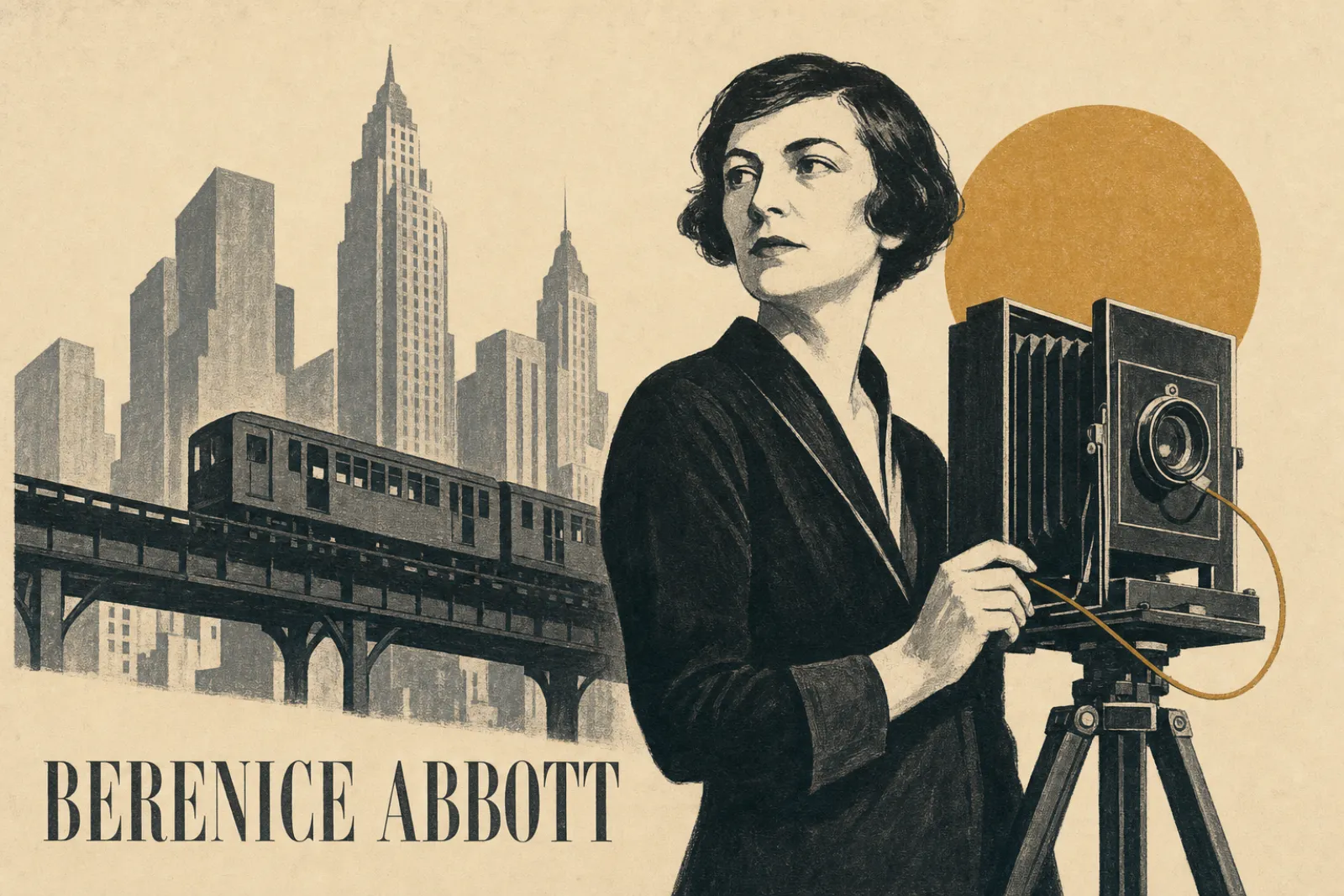
Berenice Abbott (1898 to 1991) was an American photographer who worked in Paris in the 1920s and in New York from 1929. She made portraits of writers and artists, then spent a decade photographing the buildings and streets of New York with a large view camera, and later made photographs that explained physics. She is best known for Changing New York, her record of the city in the 1930s.
Abbott learned photography in the Paris darkroom of Man Ray, who hired her as an assistant in 1923. Through him she saw the work of Eugène Atget, the old photographer who had spent decades recording the streets of Paris in plain, detailed pictures. Atget’s methodical record of a changing city impressed her deeply. She believed the camera’s strength was the realistic image formed by the lens, and she saw no reason to distort it. After Atget died she bought what remained of his archive and spent some forty years making sure his work was seen. Then she did for New York what he had done for Paris.
Ohio, Paris and a portrait studio
Abbott was born in Springfield, Ohio, on July 17, 1898. She spent a short time at Ohio State University, left for New York in 1918 and studied sculpture. In 1921 she went to Paris, and she also studied in Berlin. The job with Man Ray began with darkroom work and led to portrait photography of her own. By 1926 she was working independently, with a studio of her own.
Her sitters were the writers and artists of Paris between the wars, among them James Joyce, Jean Cocteau and Janet Flanner. The portraits are direct. The sitter is placed simply, and nothing is added to make the picture clever. In 1927 she persuaded Atget himself to sit for her, shortly before his death. In 1928 she acquired his remaining prints and negatives. She helped produce the 1930 book Atget, photographe de Paris, and she kept the archive until 1968, when she sold it to the Museum of Modern Art in New York.
Curious what makes a plain portrait hold attention? Portrait photography covers light, framing and how to work with a sitter.
Changing New York, 1929 to 1939
Abbott visited New York early in 1929 and saw a city being torn down and rebuilt at speed. She moved back that September and began to photograph it. At first she used a small hand held camera. She then bought a Century Universal, a view camera that took 8×10 inch negatives, and worked from a tripod.
For six years she carried on the project on her own, through the Depression. In 1935 the Federal Art Project, part of the Works Progress Administration, took the project on and hired her to supervise it, with assistants to help in the field and in the office. By the time she left in 1939 she had made more than 300 photographs for it. The first exhibition was held at the Museum of the City of New York in October 1937. The book Changing New York came out in 1939, with text by Elizabeth McCausland.
The subject was the city as a made thing: skyscrapers, gasoline stations, bridges, elevated railways, shop fronts, signs, docks and ferries. Old buildings were recorded before they came down and new ones as they went up. People appear, but usually as part of a street. It is a clear example of documentary photography planned as a long project with a stated purpose.
Photographing science
Abbott taught photography at the New School for Social Research in New York from the 1930s, and in 1941 she published A Guide to Better Photography, based on her teaching. She also became convinced that science was the great subject of her time and that photography should explain it to ordinary people. She designed equipment to help, including a camera she called Super-Sight, begun in 1942, which projected an enlarged image of an object directly onto large light sensitive paper to avoid the grain of an enlarged negative.
In the late 1950s the Physical Science Study Committee at the Massachusetts Institute of Technology hired her to make illustrations for a new high school physics textbook. From 1958 to 1960 she photographed wave patterns in water, bouncing balls, light passing through a prism and other physical phenomena. The pictures had to be correct as physics and clear to a student, and they are also handsome photographs.
She also travelled the length of U.S. Route 1 from Florida to Maine, making more than 2,500 negatives. After a lung operation she left New York for Maine, where she bought a house in Blanchard and later lived in Monson. Her book A Portrait of Maine was published in 1968. She died in Monson on December 9, 1991.
How Abbott made a city hold still
A big negative for a big subject. The 8×10 camera recorded every sign, brick and window. Abbott wanted the detail because detail was the information. The camera is slow, so each picture had to be planned: where to stand, when the light would be right, how long the exposure would be. The guide to large format photography explains how such a camera is used and how its movements keep tall buildings from leaning.
High and low viewpoints. She often left eye level. Some pictures look down from rooftops and upper floors, so that streets become patterns. Others look steeply up from the pavement, so that towers crowd the sky. Changing the height of the camera was her main tool for showing how the new city pressed on the old one.
How do you keep a building’s lines straight, or tilt them on purpose? Architecture photography covers converging verticals, lenses and light on buildings.
Old beside new. The project set out to show historic and modern New York together, and many frames hold two eras at once. She placed the camera so that the old structure and the new one were both sharp and neither was hidden. This is composition used to make an argument about change.
Signs and words left in. Shop windows, painted prices and street signs are part of her pictures. They date the picture and tell the viewer what life cost and what was being sold.
Timing by calculation. For her view of Manhattan at night she worked out in advance the one time of year and time of day that would give the result, then made a long exposure. The guides to night photography and long exposure photography cover the same planning with modern equipment.
Straight printing. The prints are sharp and full of detail, with no soft focus and no added effects. The broader guide to black and white photography explains how tone carries a picture when color is absent.
Thinking about a long project on your own town? Photo sequencing explains how to edit and order a body of work into a book or exhibition.
Photographs to look for
- Portrait of Eugène Atget (1927). Made shortly before his death, these are her portraits of the photographer whose archive she went on to save. Look at them beside her other Paris portraits and note that she gave an unknown old craftsman the same direct treatment she gave famous writers.
- James Joyce (1928). Made in Paris when Joyce was at the height of his fame, this is one of the best known of her portraits of writers. Notice how plainly the sitter is placed and that nothing in the frame competes with him.
- Nightview, New York (1932). Midtown Manhattan seen from high in the Empire State Building, with thousands of office windows lit. Abbott chose late afternoon on the shortest day of the year, when it was dark outside while offices were still occupied, and made a long exposure with her view camera.
- Blossom Restaurant, 103 Bowery (1935). A restaurant with its menu painted on the windows and on a board out front. Men stand at the entrance to the barbershop below it, beside a barber’s pole. The lettering is the subject. It reads like a page of the city’s daily accounts.
- Bouncing Ball in Diminishing Arcs. One of the physics pictures made for the MIT textbook project between 1958 and 1960. The path of a ball is recorded as a series of arcs that shrink with each bounce. The photograph shows a law of motion in a single frame.
Try this: one block, high and low
Give yourself 20 minutes on a single street block that has at least one old building and one new one.
- Make three frames from as low as you can get, with the camera near the pavement and pointed up.
- Make three frames from as high as you can get: a stair, a bridge, a parking deck or an upper window.
- Make three frames at eye level in which an old thing and a new thing are both fully visible and both sharp. Use a small aperture such as f/8 or f/11, or on a phone tap to focus on the nearer one and step back.
- In at least two frames, include a sign or painted words that will tell a viewer what year it roughly was.
Lay out the nine frames. Pick the three that would tell a stranger the most about the block, and write one plain caption for each with the address and the date.
Questions people ask about Berenice Abbott
What is Berenice Abbott best known for?
She is best known for Changing New York, more than 300 photographs of the city made for the Federal Art Project between 1935 and 1939 and published as a book in 1939. She is also known for her Paris portraits of the 1920s and for her science photographs of the late 1950s.
What was Berenice Abbott’s connection to Eugène Atget?
She met Atget in Paris through Man Ray, photographed him in 1927 and bought his remaining prints and negatives in 1928 after his death. She promoted his work for about forty years and sold the archive to the Museum of Modern Art in 1968.
What camera did Berenice Abbott use for Changing New York?
She began photographing New York with a small hand held camera and then moved to a Century Universal view camera that made 8×10 inch negatives. The large negative gave the fine detail her record of the city needed.
Why did Berenice Abbott photograph science?
She believed science was the most important subject of her era and that photographs could explain it to a wide public. In the late 1950s she was hired by the Physical Science Study Committee at MIT to illustrate a high school physics textbook.
Berenice Abbott is one of the photographers in the A to Z of photographers, and she is quoted on the photography quotes page.