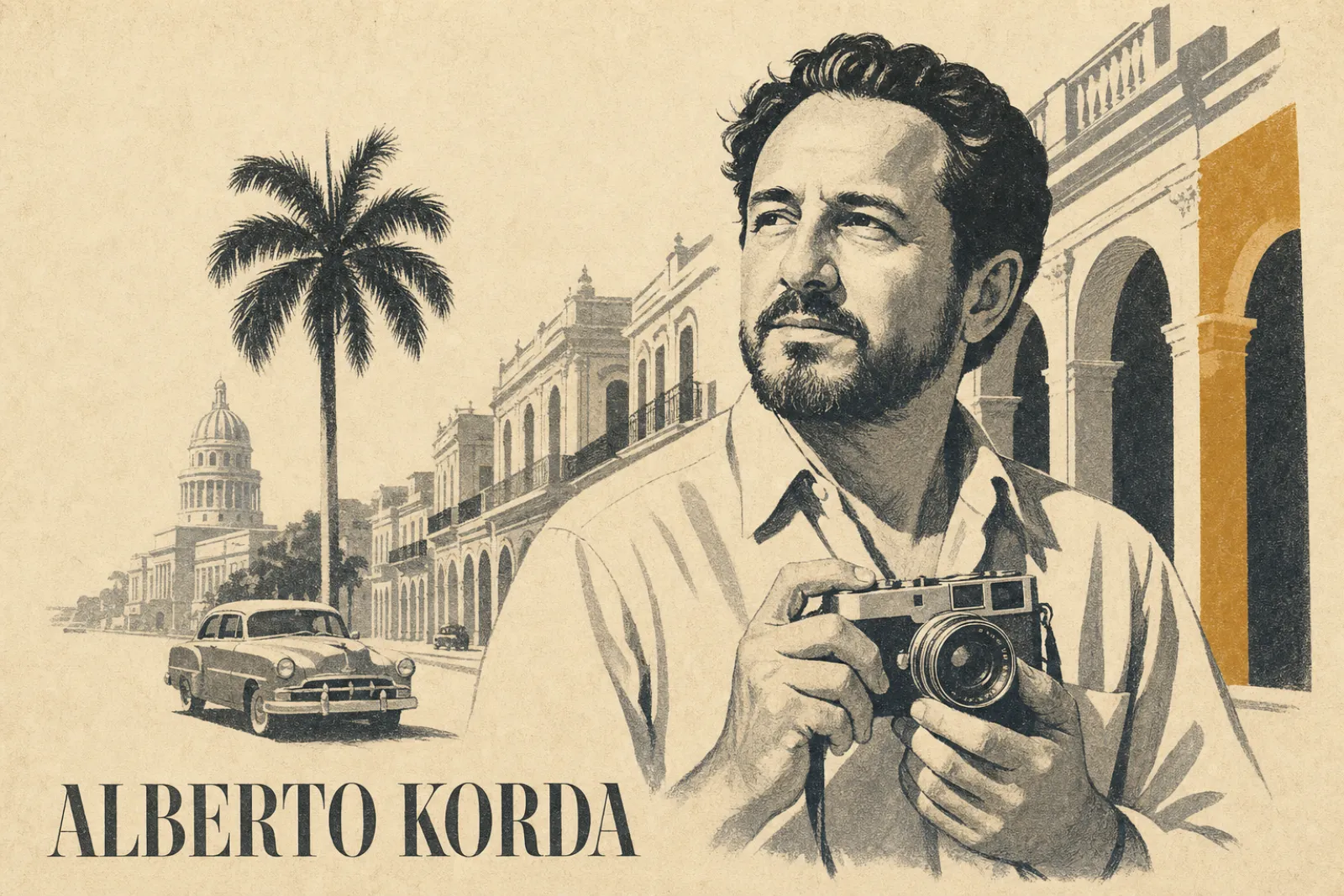
Alberto Korda (1928 to 2001) was a Cuban photographer who worked in Havana, first as a fashion and advertising photographer in the 1950s and then, after 1959, as a newspaper photographer and the personal photographer of Fidel Castro. He made black and white pictures by natural light. He is known for one frame above all: Guerrillero Heroico, his 1960 portrait of Che Guevara, often described as the most reproduced photograph in the world.
Korda’s real name was Alberto Díaz Gutiérrez. He learned the trade by doing it, starting with the cheapest commercial work there was. What he reacted against was the studio convention of his day: he disliked artificial light and preferred to work by daylight. A useful comparison is with a studio portraitist of public figures such as Yousuf Karsh, whose portraits depend on arranged lighting. Korda’s best known portrait was made outdoors, from a distance, in the few seconds his subject was in view.
From banquet pictures to Havana’s leading fashion studio
Korda was born in Havana on 14 September 1928, the son of a railway worker. He did various jobs before taking up photography, and his first paid pictures were of banquets, baptisms and weddings. He would photograph the guests, develop the film quickly and sell the prints as souvenirs. The early results were poor. The images blurred and the paper yellowed within months, and he had to learn proper chemical processing to stop it happening.
In the 1950s he opened a studio in Havana with a partner, Luis Peirce Byers. The name Korda is usually said to come from the film directors Alexander and Zoltan Korda, and both men came to be known by it. The studio did advertising and fashion photography, and Alberto became the leading fashion photographer in Cuba. His second wife, Natalia Menéndez, known as Norka, was a well known Cuban model.
The studio pictures were made with natural light. Korda disliked artificial lighting and felt it gave a false picture of what was in front of the camera. He worked in black and white and was exacting about composition and framing.
Can a whole portrait or fashion picture be lit without lamps or flash? Natural light photography explains how to use windows, shade and the direction of the sun.
Ten years beside Fidel Castro
In 1959 the Cuban Revolution brought Fidel Castro to power, and Korda’s work changed direction. A picture he had made of a small girl holding a piece of wood as her doll is linked with his decision to put his photography at the service of the revolution. He joined the new newspaper Revolución as a photographer and became one of the main visual chroniclers of the revolution’s first years. The position was unusual. Documentary photographers such as Dorothea Lange had recorded hardship for government projects as observers. Korda photographed a revolution from inside it, for its own newspaper.
For about ten years he was Castro’s personal photographer. He travelled with him around Cuba and abroad, including the visit to Washington in April 1959 and to the Soviet Union, and he photographed Castro with Nikita Khrushchev. He photographed Castro’s entry into Havana, crowds at rallies, and Castro and Guevara both at public events and off duty, fishing and playing golf.
What separates a news photograph from a posed portrait? Photojournalism describes how the job works and the rules photographers follow.
5 March 1960: two frames
On 4 March 1960 a ship, La Coubre, exploded in Havana, and many people were killed. A memorial service was held the next day, and Castro spoke. Korda was there for Revolución with a Leica M2, a 90mm lens and Kodak Plus-X film. The French writers Jean-Paul Sartre and Simone de Beauvoir were among the guests on the platform.
Guevara came into view on the platform for a few seconds. Korda, about 25 to 30 feet away, made two exposures: one with the camera held horizontally and one vertically. Then Guevara moved back out of sight. In the vertical frame another person’s head showed above Guevara’s shoulder, so the horizontal frame was the one Korda used.
The newspaper’s editor did not run the picture. The report used photographs of Castro, Sartre and de Beauvoir. Korda made a cropped print for himself and hung it on his wall. Revolución published it the following year. In 1967 the Italian publisher Giangiacomo Feltrinelli came to the studio, and Korda gave him prints without charge. Feltrinelli issued the image as a poster, and after Guevara’s death in October 1967 it spread around the world.
How the Che portrait was made to work
The picture is a useful lesson because almost nothing about it was controlled. What made it work were a few choices before and after the shutter.
- A short telephoto from a distance. A 90mm lens on a 35mm camera, from across a crowd, gave a head and shoulders view without the photographer coming near. The guide to telephoto photography covers what longer lenses do to a face and its background.
- Available light. Korda worked by daylight as a matter of principle, on black and white film. There was nothing to set up and nothing to wait for.
- Readiness, not luck alone. He had the camera up and the subject in the viewfinder when the expression arrived. The idea is set out in the decisive moment: frame first, then wait for the gesture.
- The crop. The full negative is horizontal and shows the profile of another man on one side and a palm tree on the other. Korda cut both away and kept an upright portrait of the central figure. A picture of an event became a picture of one face.
- High contrast. Reduced to dark hair, dark beret and pale face, the image survived being copied, screen printed and simplified. Strong contrast is the reason it still reads at the size of a stamp.
How far can a frame be cut down before it falls apart? How to crop photos covers the reasons to crop, the shapes to choose from and what it costs in resolution.
The sea, and a late argument over rights
Korda worked at the studio until 1968. From 1968 to 1978 he concentrated on underwater photography, working with Cuba’s Institute of Oceanology. An exhibition in Japan in 1978 revived international interest in his earlier pictures.
He never received royalties for the Guevara portrait. Cuba was not then a party to the Berne Convention, the international agreement on copyright, and Korda did not object to the image being used to spread Guevara’s ideas. He did object to it being used to sell alcohol. In 2000 he took legal action over a vodka advertisement, against the advertising agency Lowe Lintas and the picture agency Rex Features. The case was settled out of court for 50,000 US dollars, which he gave to the Cuban health system.
Who owns a photograph, and what can the owner stop others doing with it? Copyright basics for photographers sets out how the rules generally work.
Korda died of a heart attack in Paris on 25 May 2001, aged 72, while there for an exhibition of his work. He was buried in the Colón Cemetery in Havana.
Photographs to look for
- Guerrillero Heroico (1960). The title means “heroic guerrilla fighter”. Look at the fixed stare under the dark beret, and at how little else there is in the frame. Then find the uncropped frame and compare.
- La Niña de la Muñeca de Palo (1958). A small girl holds a piece of wood as a doll. This is the picture linked with his change of purpose. Notice how plain it is: a child, an object, and nothing to distract from them.
- El Quijote de la Farola (1959). A man in a straw hat sits on top of a lamp post above a vast crowd at a rally. The single raised figure against the mass below is a lesson in scale.
- Fidel Castro in the Sierra Maestra. A full-length side view of a young Castro in uniform with a backpack, looking out over the mountains. It was reported to be one of Castro’s favourite photographs of himself and was displayed at his memorial in Havana in 2016.
- Fidel Castro at the Lincoln Memorial (1959). From the visit to Washington in April 1959, early in Korda’s years of travelling with Castro. Compare it with the rally pictures: the same subject, away from his own crowds.
Try this: one frame, three crops
This takes about fifteen minutes and needs a public event or a busy place where someone is raised above the crowd: a speaker, a musician on a stage, a statue will do.
- Stand back, 8 to 10 metres from the subject, and use the longest lens or zoom setting that still gives a sharp picture.
- Hold the camera horizontally. Put the subject near the centre and let other people and objects fall on either side.
- Make only two exposures, one horizontal and one vertical. Do not check the screen between them.
- Later, take the horizontal frame and make three crops: the full scene, a tighter horizontal, and an upright head and shoulders.
- Put the three side by side. Note what each one is a picture of. The full frame is usually about the event. The tightest is about a person.
Questions people ask about Alberto Korda
What camera did Korda use for the Che Guevara photograph?
A Leica M2 35mm rangefinder with a 90mm lens, loaded with Kodak Plus-X black and white film. He made two exposures.
When and where was the Che Guevara photograph taken?
On 5 March 1960 in Havana, at a memorial service for the victims of the explosion of the ship La Coubre the day before. Guevara was on the speakers’ platform while Fidel Castro gave the address.
Did Korda make money from the photograph?
No. He received no royalties, and he gave prints to the publisher Feltrinelli free of charge in 1967. The 50,000 US dollars from his one legal settlement, in 2000, went to the Cuban health system.
Was Korda his real name?
No. He was born Alberto Díaz Gutiérrez. Korda was the name of the studio he ran with Luis Peirce Byers, usually said to be borrowed from the film directors Alexander and Zoltan Korda.
Korda is one of the photographers in the A to Z of photographers, and he is quoted on the photography quotes page.