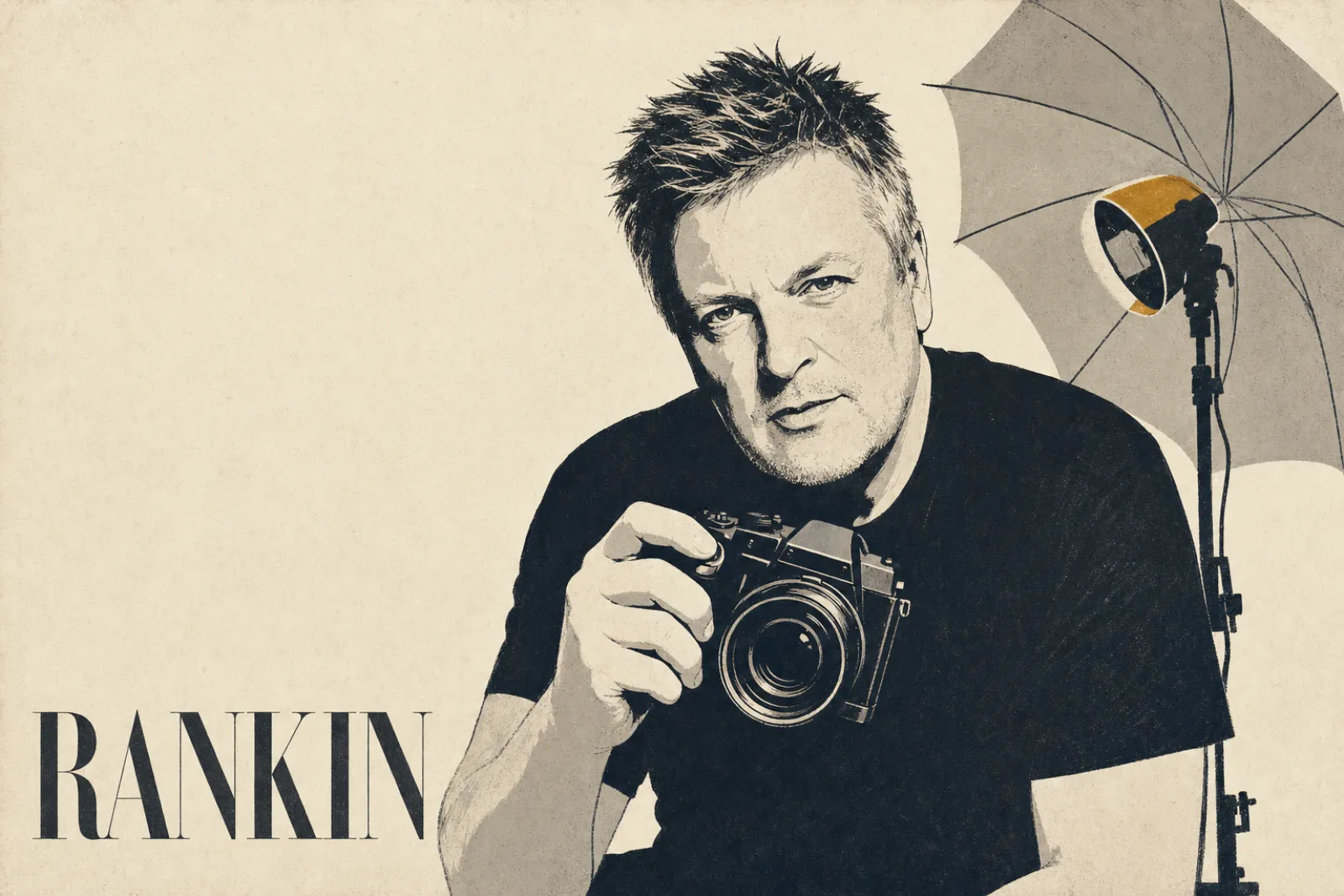
Rankin is the working name of John Rankin Waddell, a British portrait and fashion photographer born in Glasgow in 1966. He co-founded the magazine Dazed & Confused in London in 1991 and went on to photograph musicians, actors, models, politicians and Queen Elizabeth II. He is best known for close, bright, direct portraits of famous faces, and for projects that turn the same camera on people who are not famous at all.
Rankin did not come up through an apprenticeship with an older photographer. He came up through publishing, making the magazine that printed his own pictures. The older British portraitist he is most often set beside is David Bailey: the two showed together at the Proud Gallery in London in 2002, and a book, Bailey and Rankin, followed in 2003. For a different answer to the same problem of the celebrity portrait, compare the still, stripped back sittings of Richard Avedon.
From an accounting course to a student magazine
Rankin went to school in Yorkshire and in St Albans, then began an accounting course at Brighton Polytechnic. He dropped out. By his own account he took his first photograph in 1986 and was given his first proper camera, a Praktica, for his twenty first birthday in 1987. He studied photography at Barnfield College in Luton and then at the London College of Printing, which he left without graduating.
Jefferson Hack was a fellow student at the London College of Printing. The two worked together on a college magazine called Untitled, and in 1991 they launched Dazed & Confused. Rankin’s first exhibition, Blowup, was held the same year. The magazine gave him something most young photographers lack: pages to fill every issue, deadlines, and the freedom to choose who and how to photograph. A later exhibition and book, The Dazed Decades, went back over that editorial work.
More titles followed. The first issue of AnOther Magazine appeared in 2001, and a men’s edition, AnOther Man, came after it. In 2011 Rankin started Hunger, a magazine of his own. He also directed a feature film, The Lives of the Saints, made commercials, and presented television documentaries about photography, among them Seven Photographs That Changed Fashion for BBC Four in 2014, in which he made his own tributes to well known fashion pictures.
Wondering what happens between the idea for an editorial and the printed page? How a fashion photo shoot happens walks through the brief, the studio setup, the shoot day and the selection afterwards.
Famous sitters, charity commissions and a thousand strangers
The list of people Rankin photographed is long: Kate Moss, whom he first photographed in 1996, Madonna for Q magazine in 1998, Björk, David Bowie, and Tony Blair in April 2002. On 6 December 2001 he photographed Queen Elizabeth II at Buckingham Palace for her Golden Jubilee the following year. In 2023 he photographed King Charles III for The Big Issue to mark the King’s seventy fifth birthday. The Royal Photographic Society gave him an Honorary Fellowship in 2002.
Alongside fashion photography and advertising, which included a 2004 campaign for Dove, Rankin took on work for charities. In 2008 he travelled to the Democratic Republic of Congo for Oxfam, and the pictures were exhibited that year and published in 2010 as We Are Congo. He also photographed campaigns for Amnesty International, the Teenage Cancer Trust and the Institute of Cancer Research. In 2020 he made portraits of National Health Service staff who were responding to COVID-19.
The third strand is the public. For Rankin Live, held at the Truman Brewery on Brick Lane in London in 2009, he set out to photograph 1,000 ordinary people, one every fifteen minutes, with each portrait printed and hung on the wall within half an hour.
How a Rankin portrait is made to work
A London newspaper once summed up his look as high gloss and hyper perfect. Underneath the gloss, the method is plain, and most of it can be practised without a studio.
- Work fast. Rankin has said that his sitting with the Queen was over in about four minutes. Rankin Live allowed fifteen minutes a person. Short sittings force the decisions about light, background and framing to be made before the sitter arrives, so that the time with the person is spent on the person. The basics of that preparation are in the guide to portrait photography.
- Get an expression, not a pose. The Jubilee portrait is remembered because the Queen is smiling broadly in it. By Rankin’s account he asked her to smile and she laughed. That came from what happened between two people in a few minutes, not from equipment. A portrait posing guide helps with the body, but the face answers to conversation.
- Keep the light simple and bright. The Jubilee portrait was lit with flash, bright enough that the picture reads as crisp and almost overlit. Flash freezes a passing expression and gives the same result frame after frame, which matters when there are only a few minutes. The common arrangements are set out in studio lighting setups and in lighting for fashion and beauty.
- Set a rule and stick to it. A thousand people, fifteen minutes each. Fifteen teenagers, the same portrait treatment for all. A fixed rule makes a set of portraits comparable, so the differences that show are differences between the people.
- Treat retouching as a decision. Fashion and beauty pictures are polished after the shoot. Rankin made that finishing stage the subject of a project in 2019, which is a reminder that every retouched portrait involves a choice about how far to go.
How much editing is too much on a face? Photo retouching ethics covers where fashion, journalism and competitions each draw the line, and photo retouching techniques shows how to keep skin looking like skin.
Photographs and projects to look for
- Queen Elizabeth II (photographed 2001, for the 2002 Golden Jubilee). The Queen is shown smiling against a Union flag. Rankin shot on film and has said that only a few frames from the sitting succeeded. Notice how much of the picture’s effect is the expression alone.
- Rankin Live (2009). Members of the public, each photographed in fifteen minutes and printed at once. Look across the wall, not at one print: the same setup produces very different people.
- We Are Congo (photographed 2008, published 2010). Portraits made for Oxfam in the Democratic Republic of Congo. Compare how the people are treated with the way he photographed celebrities, and ask what has and has not changed.
- Alive: In the Face of Death (2013). Shown at the Walker Art Gallery in Liverpool from May to September 2013. The sitters were people living with terminal illness, people who had come close to death and survived, and people who work in the funeral trade. A BBC documentary for The Culture Show followed the project.
- Selfie Harm (2019). Rankin photographed fifteen teenagers and handed each of them the unretouched portrait to edit with free phone apps until they thought it was ready for social media. Rankin described the difference made by five minutes of editing as eye opening. Look at the original and the edit of each face together, and note which features were changed.
Want a plain, well lit portrait of one person as a starting point? How to make a great headshot covers framing, lens choice, light and background for exactly that.
Try this: three portraits in fifteen minutes
This takes fifteen minutes and three willing people, or one person photographed three times.
- Before anyone sits down, choose one plain wall and one light source, such as a large window. Take a test frame of your own hand to set the exposure. Do not change the setup again.
- Give each person five minutes by the clock. Stand close enough that the head and shoulders fill the frame.
- Talk the whole time. Ask a question, and press the shutter while they answer, not while they wait.
- When the five minutes are up, stop, even if you feel you have nothing.
- Afterwards choose one frame per person and put the three side by side. Check the eyes first: a small bright catchlight in each eye is the quickest sign that the light was in the right place.
Questions people ask about Rankin
What is Rankin’s real name?
His full name is John Rankin Waddell. He was born in Glasgow, Scotland, in 1966. Rankin, his middle name, is the name he works under.
Which magazines did Rankin start?
He co-founded Dazed & Confused with Jefferson Hack in 1991. AnOther Magazine followed in 2001, with AnOther Man after it, and he founded Hunger in 2011.
Did Rankin photograph the Queen?
Yes. He photographed Queen Elizabeth II at Buckingham Palace on 6 December 2001 for her Golden Jubilee in 2002. The resulting portrait shows her smiling against a Union flag.
What was Selfie Harm?
Selfie Harm was a 2019 project made as part of Visual Diet, a campaign by M&C Saatchi with Rankin and MTArt Agency. Fifteen teenagers were photographed and then asked to edit their own portraits with filter apps, and the originals and the edits were shown together.
Rankin is one of the photographers quoted on the photography quotes page, and he sits among many others in the A to Z of photographers.