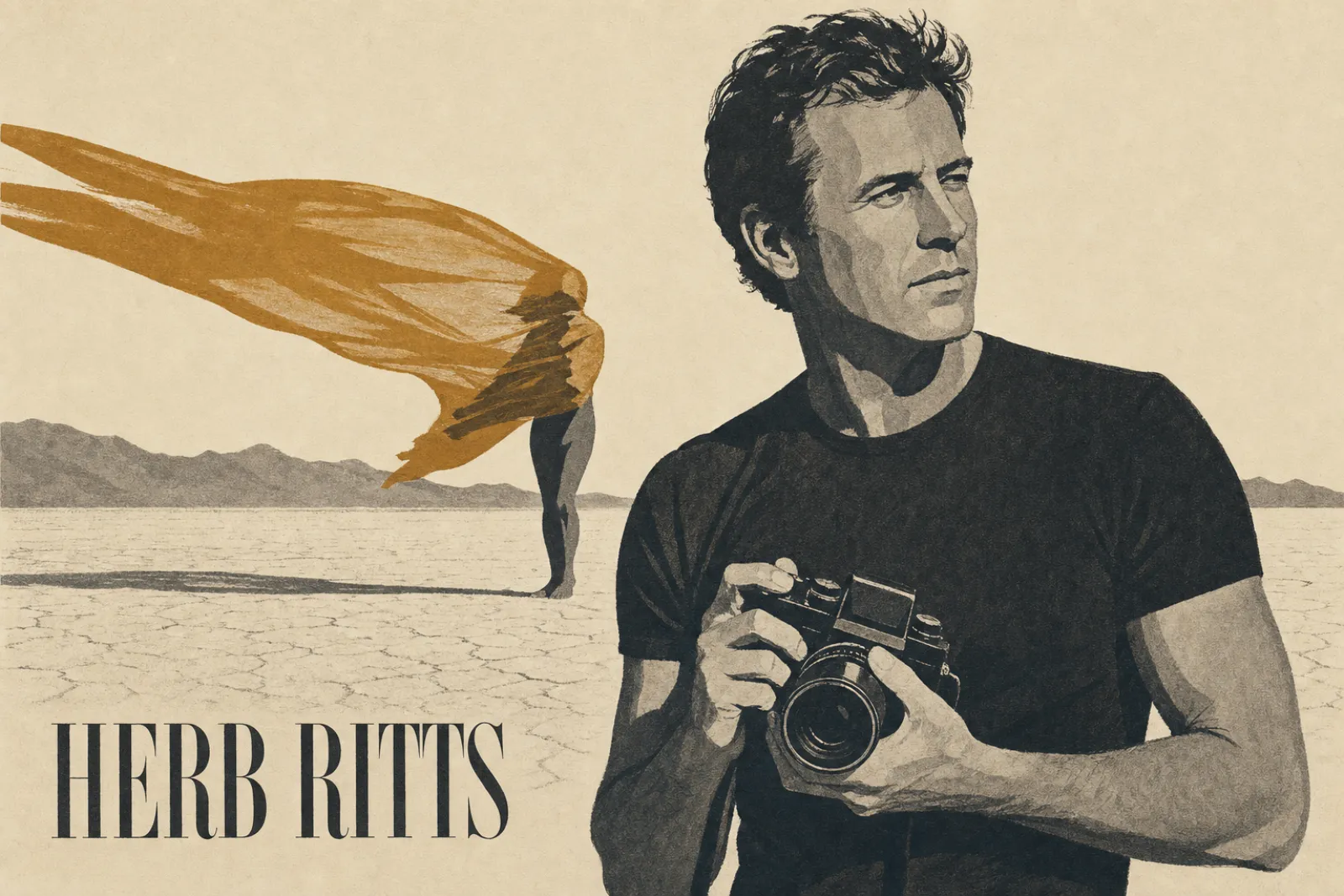
Herb Ritts (1952 to 2002) was an American photographer who worked in Los Angeles through the 1980s and 1990s. He photographed fashion, celebrities and the human body, mostly in black and white and mostly outdoors. He is known for using hard California sunlight, on beaches, in the desert and on a rooftop, to turn models and film stars into clean, sculptural shapes.
Ritts did not study photography. He took a degree in economics, with art history as a minor, at Bard College and taught himself with a camera in his spare time. Museums place him in an American line that runs through Richard Avedon, Irving Penn and Robert Mapplethorpe, all of whom moved between magazine work and the gallery wall. What set him apart from the New York photographers of his day was where he worked. They mostly built their pictures in studios. He took his subjects outside and let the sun do the lighting.
From a gas station in San Bernardino to magazine covers
Ritts was born in Los Angeles on August 13, 1952. His father designed furniture and his mother was an interior designer. After Bard he came home and worked as a sales representative in the family business, photographing friends on the side.
The picture that started his career was an accident of travel. In 1977 he and his friend Richard Gere, then a little-known actor, stopped at a gas station in San Bernardino to have a tire repaired. Ritts photographed Gere while they waited. As Gere’s film career took off, magazines wanted the pictures, and Ritts had a reason to call himself a photographer.
The work came quickly after that. In 1981 he photographed Brooke Shields for the cover of Elle and made the cover of Olivia Newton-John’s album Physical. In 1986 he shot the cover of Madonna’s album True Blue. Through the 1980s and 1990s his pictures ran in Vogue, Vanity Fair, Rolling Stone, Interview, Harper’s Bazaar, GQ and many other magazines, and he made advertising campaigns for clients such as Donna Karan and Revlon. His work sat between fashion photography and portrait photography, and he treated the two as one job: make a person look strong and simple.
Wondering how a fashion picture gets from an idea to a printed page? How a fashion photo shoot happens walks through the planning, the shoot day and the work afterward.
Books, music videos and museums
Ritts published his photographs in a run of books: Pictures (1988), Men/Women (1989), Duo (1991), Notorious (1992), Africa (1994) and Work (1996). The last of these went with a large exhibition at the Museum of Fine Arts, Boston, which opened in 1996 and drew more than 250,000 visitors. The museum still counts it among its most popular shows.
He also directed music videos, and he carried his still style into them. His first was Cherish for Madonna in 1989. In 1991 videos he directed for Janet Jackson and Chris Isaak both won prizes at the MTV Video Music Awards. Both look like his photographs set in motion: black and white, shot outdoors on a dry lake bed and a beach.
Ritts died in Los Angeles on December 26, 2002, at the age of 50, of complications of pneumonia. The Herb Ritts Foundation looks after his archive. In 2011 the J. Paul Getty Museum acquired 69 of his prints, and in 2012 it showed them in the exhibition Herb Ritts: L.A. Style, which later traveled to the Cincinnati Art Museum and the Ringling Museum in Florida.
How Ritts built a picture out of sun, skin and sky
Most photographers avoid the middle of a sunny day. Ritts went looking for it. He worked with natural light on the roof of his Los Angeles studio, on beaches and at El Mirage, a dry lake bed in the California desert. Direct sun is a small, hard light source. It makes bright highlights and black, sharp-edged shadows, and in black and white that gives bold contrast between skin, cloth and background.
How do you keep faces from looking harsh in that kind of light? How to shoot photos in harsh daylight covers shade, backlight, fill and diffusion.
The second choice was the background. A dry lake bed, an open sky, a plain wall or a stretch of wet sand gives almost nothing to look at behind the subject. With the background emptied, the body becomes a shape. Ritts posed people so that the outline read clearly: arms away from the torso, a turned shoulder, a profile against the sky. Writers often compare his figures to classical Greek sculpture, and the comparison is useful. He lit and posed people the way a carved figure is shown, with the form of muscle and bone described by light from one direction.
The third choice was texture. Hard light from the side shows every surface, so he put surfaces to work: sand on skin, wet hair, a veil across a face, mud, water, wind-blown fabric. These simple materials stand in for elaborate sets. A length of cloth and a strong wind did the work of a studio full of equipment.
The last choice was how he ran a shoot. He arrived with a visual idea and talked it through with the sitter, then improvised with props, poses and expressions as the session went on. He often kept working after the assignment was finished. Many of the lesser-known pictures in the Getty exhibition were made in those spare minutes and not for the brief.
His nudes follow the same rules. The body is treated as form, shown in strong light against a plain ground, often cropped or wrapped so that it reads as an object of study and not as a portrait of a person.
Want to see what black and white adds to a picture like this? The black and white photography guide explains how to see tone, shape and texture without color.
Photographs to look for
- Richard Gere, San Bernardino (1977). The gas station picture. Notice how little is in it: a young man in a T-shirt with a cigarette, a car, a garage. The casual pose and the working setting did more for the picture than any styling could have.
- Fred with Tires. Made on a shoot for an Italian designer. Ritts and his stylist rejected the clothes they were sent and put the model in overalls. He stands stripped to the waist with a heavy tire in each hand, caught in a pause when he was worn out. Look at how the round tires repeat the curves of the arms and shoulders.
- Tatjana, Veiled Head, Tight View, Joshua Tree (1988). As the title says, a veiled head framed tight, with the model Tatjana Patitz as the sitter. Look at how a single piece of fabric adds a layer of texture between the camera and the face.
- Stephanie, Cindy, Christy, Tatjana, Naomi, Hollywood (1989). Five of the best-known models of the period photographed together for Rolling Stone. They are entwined so closely that the group reads as a single form, with five faces as the points of interest. It is a lesson in posing several people as one shape.
- Djimon with Octopus, Hollywood (1989). Ritts persuaded Djimon Hounsou to wear an octopus on his head for the picture. The idea sounds like a joke, but the result is calm and formal, because the light and the pose are so controlled.
- Versace Dress, Back View, El Mirage (1990). Made at the dry lake bed with the model Christy Turlington, seen from behind. Wind pushes the fabric into a large, almost architectural shape. Look at the contrast between the matte cloth and skin that reflects the light.
Try this: one person, one piece of cloth, full sun
This takes about 15 minutes. You need a willing person, a bright sunny day and a plain piece of fabric such as a scarf, a sheet or a towel.
- Find the emptiest background you can: open sky from a low angle, a blank wall, a beach or a flat roof. Nothing behind the person should compete with them.
- Set your camera or phone to black and white so you judge shape and tone, not color.
- Turn the person until the sun comes from one side. Watch where the shadow edge falls on the face and body. The page on direction of light shows what each angle does.
- Take ten frames only. In each one, change one thing: the arms, the turn of the head, or what the cloth is doing. Let the wind move it, or have the person hold it taut.
- Get low for at least three frames so the figure stands against the sky.
Afterward, pick the frame where the outline of the body is clearest. Squint at it. If you can still read the pose as a dark and light shape, you have done what Ritts did.
Not sure what to ask the person to do with their hands and shoulders? The portrait posing guide gives simple starting poses for one person and for groups.
Questions people ask about Herb Ritts
What is Herb Ritts best known for?
He is best known for black-and-white fashion photographs and celebrity portraits made in strong California sunlight during the 1980s and 1990s. His pictures of models such as Cindy Crawford, Naomi Campbell and Christy Turlington, and his album covers and music videos for Madonna, reached a very large audience.
Did Herb Ritts use natural light?
Yes, for much of his work. He photographed on the roof of his Los Angeles studio, on beaches and at El Mirage dry lake, using direct sun to produce bold contrast. He chose plain outdoor settings so that the light and the body carried the picture.
How did Herb Ritts become a photographer?
He was self-taught. He studied economics at Bard College, with a minor in art history, then worked in sales for the family business in Los Angeles while photographing friends. His 1977 pictures of Richard Gere at a gas station in San Bernardino were published in magazines and led to professional assignments.
Where can Herb Ritts’s photographs be seen?
The J. Paul Getty Museum in Los Angeles holds 69 prints acquired in 2011. The Museum of Fine Arts, Boston, holds prints given by the Herb Ritts Foundation and named a photography gallery after him. His books, including Pictures, Notorious and Work, reproduce many of the well-known images.
Herb Ritts is one of the photographers quoted on the photography quotes page, and you can find more lives like his in the A to Z of photographers.