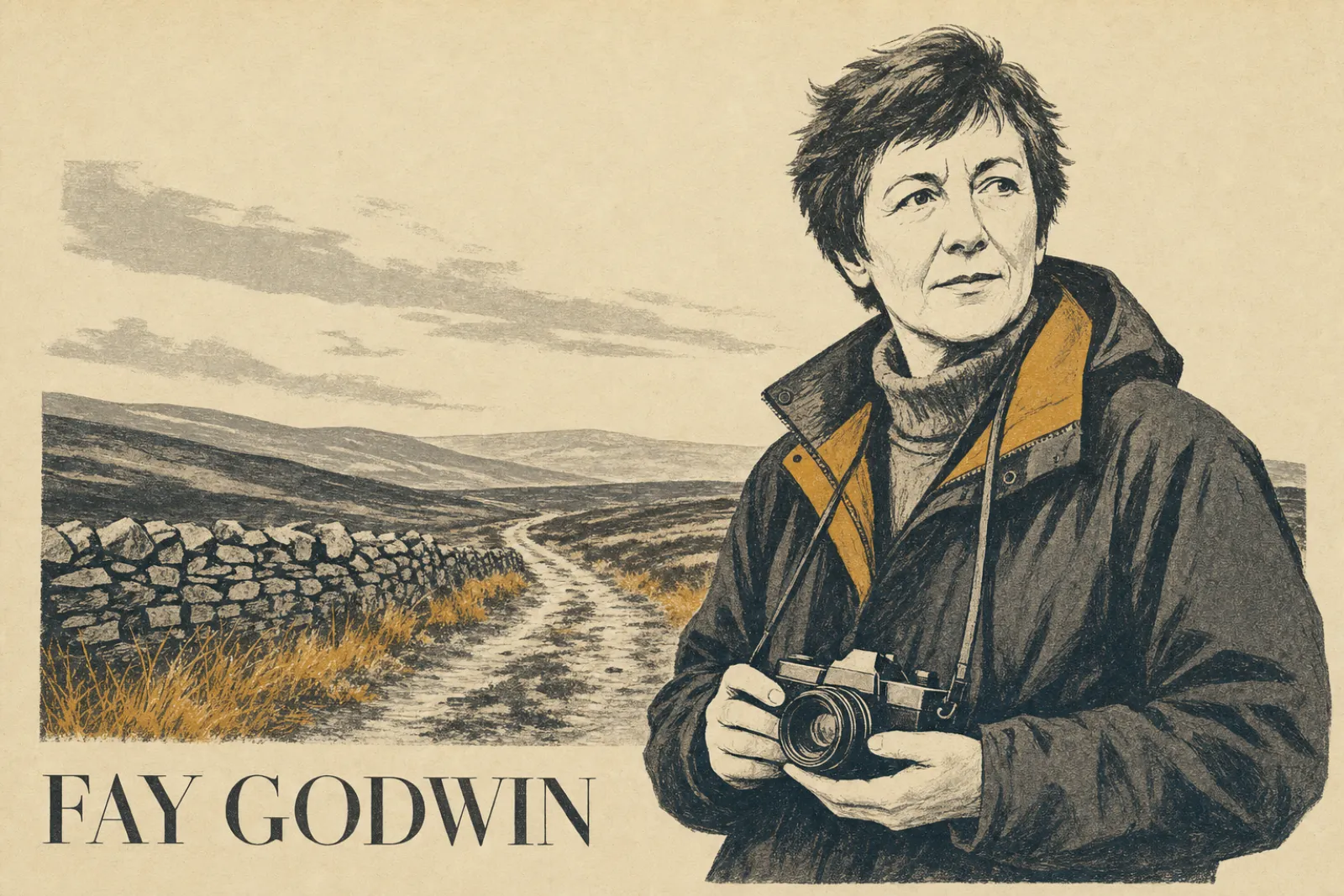
Fay Godwin (1931 to 2005) was a British photographer who worked from the late 1960s until the early 2000s. She began with portraits of writers and went on to photograph the landscape of Britain in black and white: old roads, moors, stone walls, marshes and coasts. She is known above all for her 1985 book Land and for using her pictures to argue for public access to the countryside.
Godwin had no training. She learned by photographing her two young sons in the 1960s and taught herself to develop and print. Accounts of her work name Bill Brandt and Paul Strand as influences, and both show in her pictures: Brandt in the dark, heavy skies, Strand in the plain respect for a place and the people who shaped it. She disliked being called a Romantic. She described herself as a documentary photographer whose subject was real land, with its fences, pylons and warning signs left in. That sets her apart from Ansel Adams, whose American wilderness is usually shown without a human mark on it.
From writers’ portraits to The Oldest Road
Godwin was born Fay Simmonds in Berlin on 17 February 1931. Her father was a British diplomat and her mother an American artist, and she went to nine schools as the family moved. She settled in London in the 1950s and in 1961 married Tony Godwin, a publisher. The marriage put her among London’s writers, and when it ended she turned her hobby into a living.
For about five years she worked mainly as a portrait photographer. During the 1970s and 1980s she photographed many of the leading writers of the time, among them Philip Larkin, Ted Hughes, Doris Lessing, Angela Carter, Kingsley Amis, Salman Rushdie, Jean Rhys and Tom Stoppard. She usually photographed them at home, which makes these pictures environmental portraits: the room, the desk and the window light say as much as the face.
Walking led her to landscape. Her first landscape book was The Oldest Road: An Exploration of the Ridgeway (1975), with text by J.R.L. Anderson. It sold more than 25,000 copies and set a pattern. Over the next ten years she made a series of books with writers about particular routes and regions: The Drovers’ Roads of Wales (1977) with Shirley Toulson, Islands (1978) with John Fowles and The Saxon Shore Way (1983) with Alan Sillitoe among them.
In 1978 the Arts Council of Great Britain gave her a major award to continue photographing landscape across the British Isles. The pictures that came out of it made her name.
Remains of Elmet, Land and Our Forbidden Land
Remains of Elmet (1979) paired her photographs with poems by Ted Hughes. Elmet is an old name linked with the Calder valley in West Yorkshire, west of Halifax. Godwin photographed its valleys, reservoirs and moorland on camping trips with her children. The book is a model of how pictures and words can sit side by side without one explaining the other.
Land (1985), with an essay by John Fowles, gathered her landscape work from across Britain. It was shown as an exhibition at the Serpentine Gallery in London, and in 1986 Godwin was the subject of an edition of the television arts programme The South Bank Show.
From 1987 to 1990 she was president of the Ramblers’ Association, which campaigns for walkers’ rights. Our Forbidden Land (1990) came out of that work. She went looking for places that showed the loss of public access and photographed blocked footpaths, hand-painted signs telling people to keep out, and land left littered by the military. The book won the first Green Book of the Year Award. It is angry, and it uses the same careful craft as Land to make its case.
In her later years Godwin changed direction. A fellowship at the National Museum of Photography, Film and Television in Bradford led to color work and urban subjects. Glassworks and Secret Lives (1999), which she published herself, is a book of color close-ups of plants and natural forms seen through screens and nets. A retrospective, Landmarks, was shown at the Barbican in London in 2001. She died in Hastings on 27 May 2005. Her archive, including about 11,000 exhibition prints, the contents of her studio and letters, is held by the British Library.
Curious how a set of pictures becomes a book and not just a pile? Photo sequencing covers the first edit, pairing and pacing.
How Godwin made a landscape hold your attention
She went back. Godwin did not rely on luck with the weather. Her contact sheets show that she photographed a place several times on different visits and waited until the conditions were what she wanted. British light is often flat and gray. She used that, working with cloud, mist and breaks in the sky. The page on photography in different weather conditions explains what each kind of sky gives you.
She gave the sky a job. In many of her pictures the cloud is as important as the ground. A single white cloud above a field, or a dark bank over a moor, balances the shapes on the land. This is why her pictures look composed even when the land itself is nearly empty.
She built pictures on lines. A path, a wall, a row of standing stones or the edge of a reservoir runs through the frame and gives the eye a route. The pages on lines in composition and leading lines describe the idea. Her subjects made it natural: she was photographing old roads, and a road is a line.
She kept the evidence of people. Fences, drains, concrete, signs and wire stay in. This is the documentary side of her work. A reader looking at Land sees Britain as worked and worn ground, not as a park. If you have ever moved a few steps to hide a signpost, consider the opposite choice.
She printed with a plan. Godwin worked with medium format film as well as 35mm. Two of her cameras, a Hasselblad and a Leica, have been shown alongside her prints. She printed in her own darkroom and marked up sketches of each picture with notes on which areas to hold back and which to give more exposure. That is dodging and burning, and it accounts for the long, smooth range of grays that obituaries called velvety.
She sequenced on a board. For Land she laid out contact prints on a board and moved them until the order worked. The book ends on a picture of concrete slabs on the shore at Pett Level in Sussex, a blunt last note after pages of older, softer ground.
Want the practical side of making prints like these? Darkroom basics covers the equipment, a first print, and dodging and burning under the enlarger.
Photographs to look for
- Path and Reservoir above Lumbutts, Yorkshire (1977). A path and a reservoir on the Yorkshire moors. Notice how the line of the path sets the direction for the whole picture.
- Stones of Stenness, Orkney (1979). Ancient standing stones, the kind of site that recurs in her work. Look at how the stones are spaced in the frame and how much room the sky is given.
- Large White Cloud near Bilsington, Kent (1981). Here the cloud is the subject and the land is the base it sits on. It shows how a plain field becomes a picture when the sky does something.
- Flooded Tree, Derwentwater (1981). A tree standing in the still water of a lake in Cumbria. Godwin photographed the spot on several occasions before she got this version. Her negatives, contact sheets and printing notes for it survive in her archive.
Looking for the basics of the whole genre? The landscape photography guide covers settings, light and composition.
Try this: fifteen minutes on one path
Pick a path, track or lane you can walk to. Go on a cloudy day if you can. Set your camera or phone to black and white.
- Stand where the path enters the bottom of the frame and runs away from you. Take one picture.
- Walk twenty steps and take another. Do this five times. Each time, decide where the horizon goes: give the sky two thirds of the frame if the clouds are interesting, one third if they are not.
- In at least two frames, include something people put there: a gate, a sign, a fence, a pylon. Do not hide it. Give it a clear place in the picture.
- Do not crop or straighten anything afterward. Put the five pictures in the order that makes the best short walk for someone who was not there.
The test is the same one Godwin set herself: does the set tell you what the place is like and what has been done to it? The guide to black and white photography will help if the grays come out flat.
Questions people ask about Fay Godwin
What is Fay Godwin famous for?
She is known for black-and-white photographs of the British landscape, published in books such as Remains of Elmet (1979, with poems by Ted Hughes) and Land (1985). She is also remembered for Our Forbidden Land (1990) and for her time as president of the Ramblers’ Association from 1987 to 1990.
What camera did Fay Godwin use?
She used medium format and 35mm film cameras. A Hasselblad 500C/M and a Leica M6 that belonged to her were lent by the British Library for display with her prints at the National Science and Media Museum in Bradford.
Was Fay Godwin a landscape photographer or a documentary photographer?
Both labels fit, but she preferred the second. She rejected the word Romantic and called herself a documentary photographer. Her pictures show land that has been farmed, fenced, mined and closed off, which places her work close to documentary photography.
Fay Godwin is quoted on the photography quotes page, and the A to Z of photographers lists others who worked the same ground.