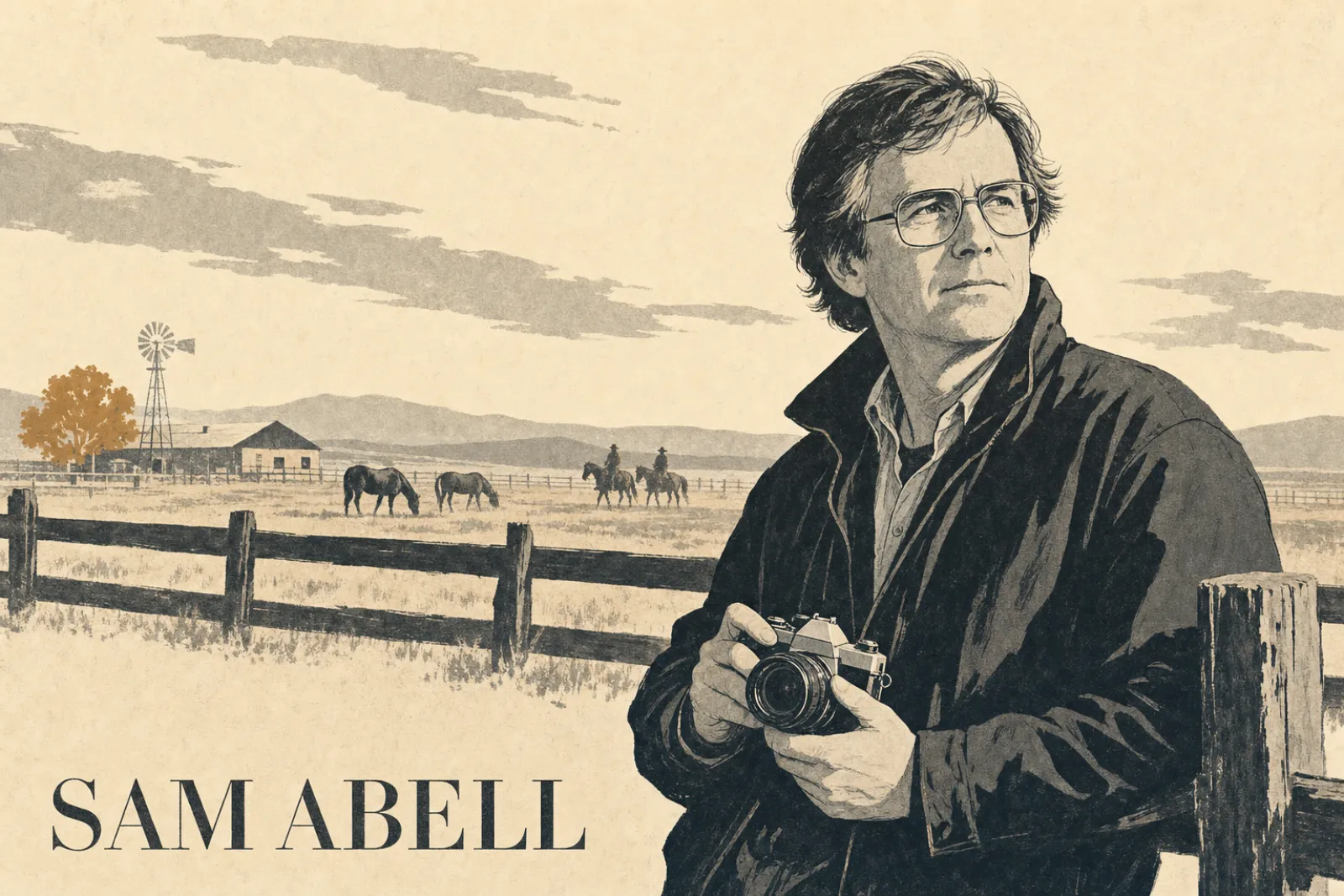
Sam Abell (born 1945) is an American photographer who worked for National Geographic for 33 years, from 1970 to 2001, as a contract and staff photographer. He made quiet, carefully layered color pictures of places and the people in them, from Montana ranches to Japan, Ireland and Russia. He is known for one working method, which he called “compose and wait”, and for teaching it.
Abell learned photography from his father, and he said that the compose and wait method came from him. In 1967 he spent a train journey from New York to Washington looking through Walker Evans‘s book American Photographs. His approach sits at some distance from the idea of the photographer as a hunter of instants that is associated with Henri Cartier-Bresson. Abell settled the frame first and let the moment come to it.
A geography teacher’s son from Sylvania, Ohio
Abell was born on 19 February 1945 in Sylvania, Ohio. His father, Thad Abell, was a geography teacher who ran a photography club. Thad had taken a night class from a photographer at the University of Toledo and passed on what he learned to his son.
On an outing with his father, Abell made a photograph that went on to win a prize in a photo contest. He credited that prize as a major influence on the direction his life took.
He studied English at the University of Kentucky and graduated in 1969. The following year he began photographing for National Geographic.
Thirty-three years of National Geographic stories
Abell produced more than 20 feature stories for the magazine. The subjects ranged widely. His own archive is arranged under headings that include Amazonia, Australia, Canoeing, Cuba, the Galapagos, Ireland, Newfoundland, Ontario, the Pacific Crest Trail, the Shakers, Tolstoy and Venice.
Several assignments recur whenever his work is discussed. In 1980 he spent a month in Hagi, a small city on the southwest coast of Honshu in Japan, photographing its historical architecture. He had no car. He photographed in Moscow, and he photographed cowboys in winter in the Little Belt Mountains of Montana. He photographed a story on the life of the Montana cowboy artist Charles M. Russell, and another on Lewis and Clark with the writer Stephen Ambrose.
He photographed Ireland for a story published in 1994. In his first week he was robbed in St. Stephen’s Green in Dublin and lost his camera. He carried on, and a picture from that assignment, of children with a pony in Clondalkin, Dublin, became the cover of the September 1994 issue. His final assignment for the magazine was the Japanese Imperial Palace, twenty years after Hagi.
All of this was shot on film. He could not check a picture until the film was developed, so each assignment went forward on trust in the method.
Planning to photograph a place you are visiting? Travel photography covers preparation, light and working with people on the road.
Books, an exhibition and the classroom
In 1990 the International Center of Photography in New York gave Abell a one-person exhibition. The book that accompanied it, Stay This Moment, has an introduction by Robert E. Gilka.
Three later books form a trilogy. Seeing Gardens (2000) is a personal account of looking for gardens while on assignment around the world. Sam Abell: The Photographic Life (2002), with Leah Bendavid-Val, joins autobiography to pictures from across his career. The Life of a Photograph (2008) presents photographs in series, as lessons in setting the scene, composing and waiting. He also photographed the National Geographic book Australia (1999), written by Roff Martin Smith. A further set of books was published as The Sam Abell Library.
Alongside photographing he built a second career as a writer, lecturer and teacher. He taught workshops including The Next Step and Character of Place at Santa Fe Workshops. He described the shift in his teaching as a move from the single successful image to the sustained body of work. He received an honorary Doctor of Letters from the University of Toledo in 2009. In 2024 he received the Lifetime Achievement Award of The Photo Society and was inducted into the International Photography Hall of Fame.
Trying to turn single pictures into a body of work? Photo sequencing explains how to edit and order a set.
Compose and wait: how an Abell picture is built
The method can be stated in a few rules. Each is something he said about his own practice.
- Seek the setting, not the subject. In a 2013 interview with A Photo Editor he said that people arrive at his workshops consumed with seeking the subject, and that he teaches seeking the setting. Find the place where a picture could happen before there is anything in it.
- Build from the back to the front. In the same interview he said he teaches composition “from the back to the front”. Decide the farthest layer first, then the middle, then what stands nearest the camera. This is the practical side of layering foreground, midground and background.
- Compose, then wait. With the frame fixed, he waited for something to give it life: a person, an animal, a gust of wind. Speaking to National Geographic in 2014 he called himself a charter member of the “compose and wait” school of photography. Compare this with the idea of the decisive moment, where timing is the headline. For Abell timing was the last step, not the first.
- Protect the horizon. Of his Montana cowboy picture he said that it would not exist if the rider in the distance were not above the horizon. If the horizon ran through the horse’s head he would not publish it. That is a strict version of checking for tangents and mergers.
- Join a still life to a landscape. He spoke of wanting to link a still life to a landscape in one picture. Something small and near, such as fruit on a windowsill or fish in a tank, sits against something large and far. It is a dependable way to give a picture depth.
- Make several frames and choose. Once the composition was settled he took a number of frames and later picked the one where the near and far elements related best. See working the scene for the general habit.
- Go slowly. He described photography as a thoughtful process and valued slow, craftsmanlike work over speed.
Want the wider set of tools this rests on? Photography composition: 15 techniques sets them out with examples.
Photographs to look for
- Fish tank, Hagi, Japan (1980). An aquarium found at a farmers’ market in a parking lot. By photographing through the glass he joined the water, the sky, clouds and trees into one scene, so the fish seem to swim through a landscape. He made several frames and chose the one with the best relationship of foreground to background. It is a lesson in reflections.
- Pears on a windowsill, Moscow. Pears on a sill behind a white lace curtain, with Red Square beyond. The still life and the landscape share one frame. Look at how the near objects and the far skyline relate.
- Cowboys at work, Montana. Made for the Charles M. Russell story and left out of the magazine article at the time. National Geographic later named it one of the 50 greatest pictures made for the magazine. Find the distant rider and check where the horizon sits.
- Children with a pony, Clondalkin, Dublin (1994). The September 1994 cover. He composed first and waited. The picture came when a gust of wind blew and the children turned toward the sound of a car horn.
- Fungie the dolphin and Jock the dog, Dingle Bay. A wild dolphin meeting an innkeeper’s terrier, from the same Ireland story. The animals could not be directed, so he set the frame and waited. For twenty minutes he knew he was not getting the picture, and then the dolphin leaped.
- The Life of a Photograph (2008). A book to study for its series. The photographs are grouped to teach setting the scene, composing and waiting.
Try this: frame first, then wait fifteen minutes
- Find a setting with a clean, interesting background: a wall, a shoreline, a row of trees, a doorway. There should be nothing happening in it yet.
- Build the frame from the back. Place the background, then a middle layer, then something close to the lens.
- Check the horizon and any strong lines. Move until none of them will cut through the place where a head is likely to appear.
- Hold that frame. Brace the camera or phone against something solid so it does not drift.
- Wait up to fifteen minutes for a person, animal or change of light to enter. Take a frame each time something does.
- Compare the frames afterwards. Pick the one where the newcomer sits cleanly against the background.
Questions people ask about Sam Abell
What does Sam Abell mean by “compose and wait”?
It means deciding the composition before the subject arrives, then waiting for something to complete it. He credited the idea to his father. It is the opposite of chasing action with the camera.
How long did Sam Abell work for National Geographic?
He worked for the magazine for 33 years, from 1970 to 2001, as a contract and staff photographer, and produced more than 20 feature stories. He was also a Photographer in Residence there.
What books has Sam Abell published?
His main collections are Stay This Moment (1990), Seeing Gardens (2000), Sam Abell: The Photographic Life (2002) and The Life of a Photograph (2008). The last three form a trilogy.
What does “back to front” composition mean?
It is his way of teaching composition. The photographer settles the background first, then works forward through the layers of the scene. The main subject, nearest the camera or entering the frame, comes last.
Sam Abell is quoted on the photography quotes page, and more photographers are listed in the A to Z of photographers.