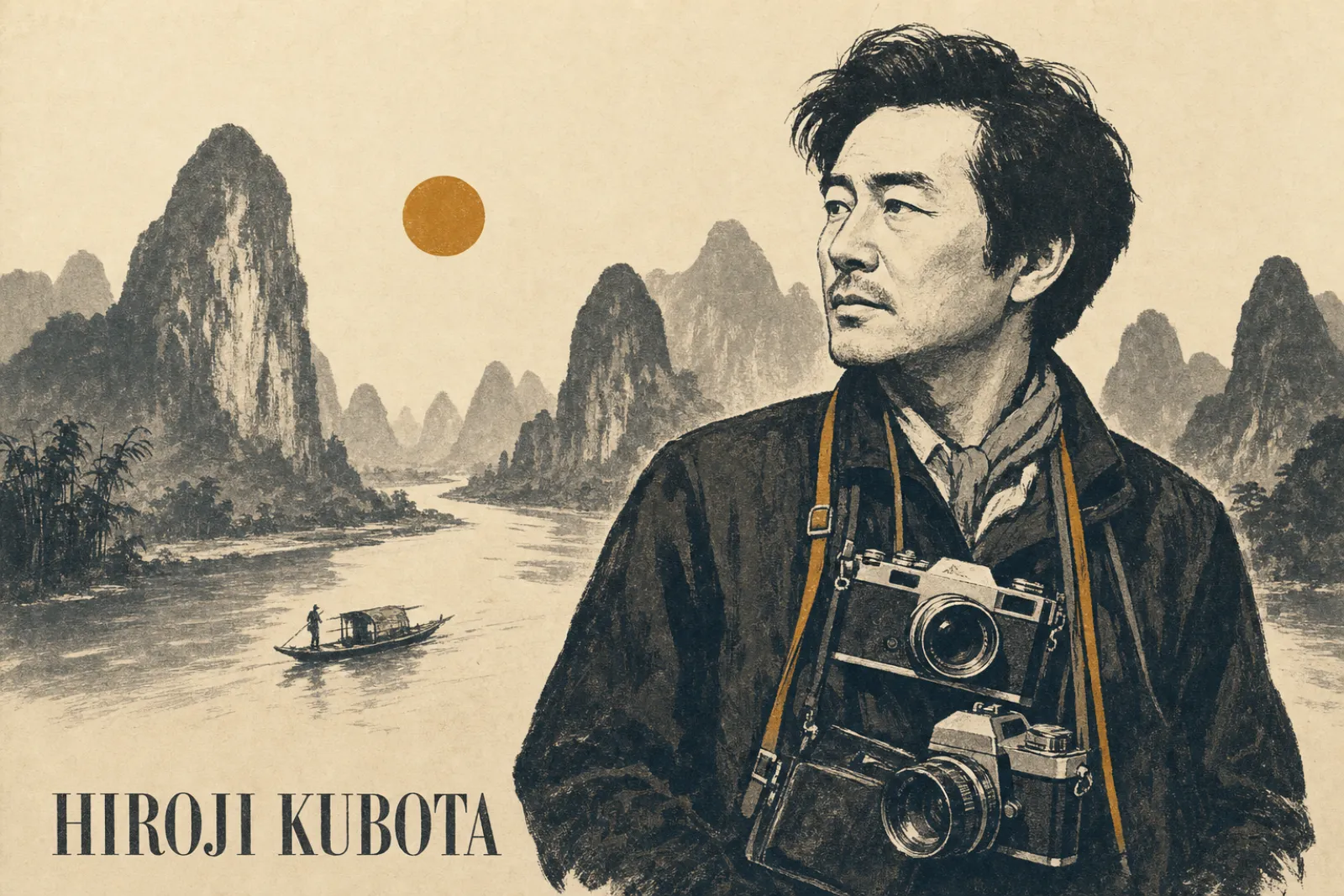
Hiroji Kubota is a Japanese photographer, born in Tokyo in 1939, who worked for Magnum Photos across the United States and Asia from the 1960s onward. He began in black and white in the America of the civil rights years, then turned to colour and to long surveys of Burma, China, North Korea and Japan. He is known for patient, large scale colour pictures of Asia, above all his 1,000 days of photographing in China.
Kubota learned the trade from Magnum photographers. As a politics student in Tokyo he helped a visiting group that included René Burri, Burt Glinn and Elliott Erwitt, and Erwitt later acted as his sponsor when he moved to the United States. His early pictures follow the 35mm reportage tradition he met through them. What he set himself against was the war picture. He was a child in Japan during the Second World War and saw the destruction and hunger at its end, and as a photographer he chose not to make violent images. His long colour studies of Asian countries invite comparison with Steve McCurry, a Magnum colleague who worked in the same region, though Kubota’s frames stand further back and take in more of the place.
Tokyo, Chicago and an American apprenticeship
Kubota was born on 2 August 1939 in the Kanda district of Tokyo. He studied politics at Waseda University and graduated in 1962. Meeting the Magnum photographers while he was still a student changed his plans, and so did a copy of Henri Cartier-Bresson‘s book The Decisive Moment. He left for the United States in 1962.
He settled in Chicago, worked for a Japanese catering business to pay his way, and studied journalism and international politics at the University of Chicago. He kept photographing throughout. In 1965 he became a freelance photographer, and in the same period he assisted Erwitt and Cornell Capa. An early newspaper assignment was to photograph the grave of the painter Jackson Pollock in East Hampton.
The America he photographed was in upheaval. He was at the March on Washington on 28 August 1963. He photographed anti-war gatherings in New York in the middle of the decade, the 1968 presidential election, and members of the Black Panther Party in Chicago in 1969. These pictures are black and white documentary photography, made mostly with a 35mm lens and from close range. Kubota has said that he liked to stand near enough to a person that they could tell him to go away if they wished.
Turning toward Asia, and toward colour
Kubota went back to live in Japan after covering the 1968 election. In 1970 he received the first Publishing Culture Award from the publisher Kodansha. He photographed Okinawa before the islands were returned to Japanese control, and from 1970 he began visiting Burma, a country he returned to about 75 times. He became a Magnum associate in 1971. In 1975 he was in Saigon when the city fell, and after that he gave his attention to Asia.
The change of subject came with a change of material. His black and white work runs from 1963 to 1989, and the colour pictures he later chose to print begin in 1978. That is the year of his photograph of the Golden Rock at Kyaiktiyo in Burma, a Buddhist holy place, and also the year he first photographed in North Korea. From then on colour carried the main work.
Between 1979 and 1984 he made the project that defined him. Over about 1,000 days he travelled through the provinces of China and made more than 200,000 photographs. The book and exhibition China followed in 1985. He then spent 1988 to 1992 photographing across the United States, published in 1992 as From Sea to Shining Sea: A Portrait of America. He became a full member of Magnum in 1989. Out of the East, in the late 1990s, collected his work from across Asia, and a book on Japan followed in 2005. He also published Can We Feed Ourselves?. In the early 1980s he received the Annual Award of the Photographic Society of Japan and the Mainichi Art Prize.
In 2015 Aperture published Hiroji Kubota Photographer, a survey of some 400 pictures with a preface by Elliott Erwitt, and showed it in New York from November 2015 to January 2016. A retrospective of more than 100 photographs was held at WestLicht in Vienna in 2016.
How does a subject this large become a finished body of work? How to build a long-term photography project breaks the job into phases from first idea to edit.
How Kubota’s pictures are made to work
He went back. The most important choice was time. Seventy-five visits to one country and 1,000 days in another are a method, not a statistic. Repeated visits gave him access that a single trip could not, including to North Korea when few foreign photographers were admitted, and they let him wait for weather, season and ceremony. The guide to travel photography treats planning and research as the start of the work for the same reason.
He stepped back. In China and North Korea his subjects were often whole places and whole crowds: the steel works at Anshan, the strip coal mine at Fushun, the mass games in Pyongyang. Subjects like these do not fit in a close frame. They need distance, and often height. A high viewpoint turns a crowd or a valley into a pattern and makes scale the subject.
How do you get above a scene without a drone? Aerial photography without a drone covers rooftops, hilltops and other raised viewpoints.
He matched the format to the place. For 35mm work Kubota used small rangefinder and single lens reflex cameras. For the widest subjects he used two custom-made Fuji panoramic film cameras in different long formats. A very wide frame suits a mountain range or a mass gymnastics display because it holds the full spread without tilting the camera. The same proportions can be tried with any camera, as the guide to aspect ratio shows.
He used transparency film for clean, strong colour. Kubota worked mainly on Fujichrome slide film. Slide film has little tolerance for exposure error, so the colour in his pictures was settled at the moment of exposure. Film stocks compared explains how slide film differs from negative film. In a picture such as the Golden Rock one colour dominates and the rest is quiet. That restraint is the practical lesson in using colour to direct attention.
He printed with care. For his retrospective the black and white pictures were made as platinum prints and the colour as dye transfer prints, a slow and costly process that had largely gone out of use. Both are chosen for depth of tone and for permanence.
He kept the people dignified. Kubota has said that he does not like brutal pictures and is never unkind to the people he photographs. Whatever the political setting, the individuals in his frames are shown at work, at prayer or at a festival, and never as specimens.
What do you owe the people and places you photograph abroad? Cultural sensitivity in photography covers permission, sacred sites and avoiding stereotypes.
Photographs to look for
- Golden Rock, Kyaiktiyo, Burma, 1978. A gilded boulder at a Buddhist pilgrimage site. It dates from the year his printed colour work begins. Notice how one colour carries the whole picture, and ask what in the frame tells you how large the rock is.
- Black Panthers, Chicago, 1969. Black and white 35mm work from his American years. Compare the working distance with the later Asian pictures. This is the close 35mm reportage he learned first.
- Sanja Matsuri, Asakusa, Tokyo, 1967. A festival in his home city, photographed during his American years. Look at how he handles a public festival in a single frame, a kind of subject he came back to for decades.
- Steel works, Anshan, China, 1981. Heavy industry from the 1,000 day survey of China. Look at how he fits the size of the plant into one frame.
- Mass games, Pyongyang, North Korea, 1982. A mass display staged for the birthday of Kim Il Sung. Look at how the viewpoint lets the pattern of performers read across the full frame.
Try this: one place from three distances
Give yourself 20 minutes and one location with some height nearby: a market below a footbridge, a park beside a hill, a square with a car park or a balcony above it.
- Start close. Photograph one person or one stall from two or three metres, at eye level, with a moderate wide lens or your phone’s main camera. Ask first if that is the custom of the place.
- Step back until the frame holds the whole activity: the row of stalls, the full playing field, the entire queue.
- Go up. Find the highest safe public viewpoint and photograph the same place as a pattern.
- In each of the three frames, find the one strongest colour and place it deliberately. Leave out competing colours if you can.
- Crop the high frame to a long panoramic shape, about 2.5 to 1, and compare it with the uncropped version.
The constraint is three distances, one subject, one dominant colour. Laid side by side, the three frames show what each distance explains and what it hides.
Questions people ask about Hiroji Kubota
When did Hiroji Kubota join Magnum Photos?
Kubota met Magnum photographers in Tokyo as a student and worked with the agency from the mid 1960s. Magnum records that he became an associate in 1971 and a full member in 1989. Some biographies give earlier dates because of his long informal association.
What is Hiroji Kubota best known for?
He is best known for his colour photographs of Asia, especially the survey of China he made from 1979 to 1984, published as China in 1985. His pictures of North Korea, his many visits to Burma and his American book From Sea to Shining Sea are the other main bodies of work.
Did Hiroji Kubota photograph in black and white or colour?
Both. His American work of the 1960s and much of his early Asian work is black and white. From 1978 colour became his main medium, and his retrospective paired platinum prints of the black and white pictures with dye transfer prints of the colour.
For more photographers to study alongside Kubota, see the A to Z of photographers.