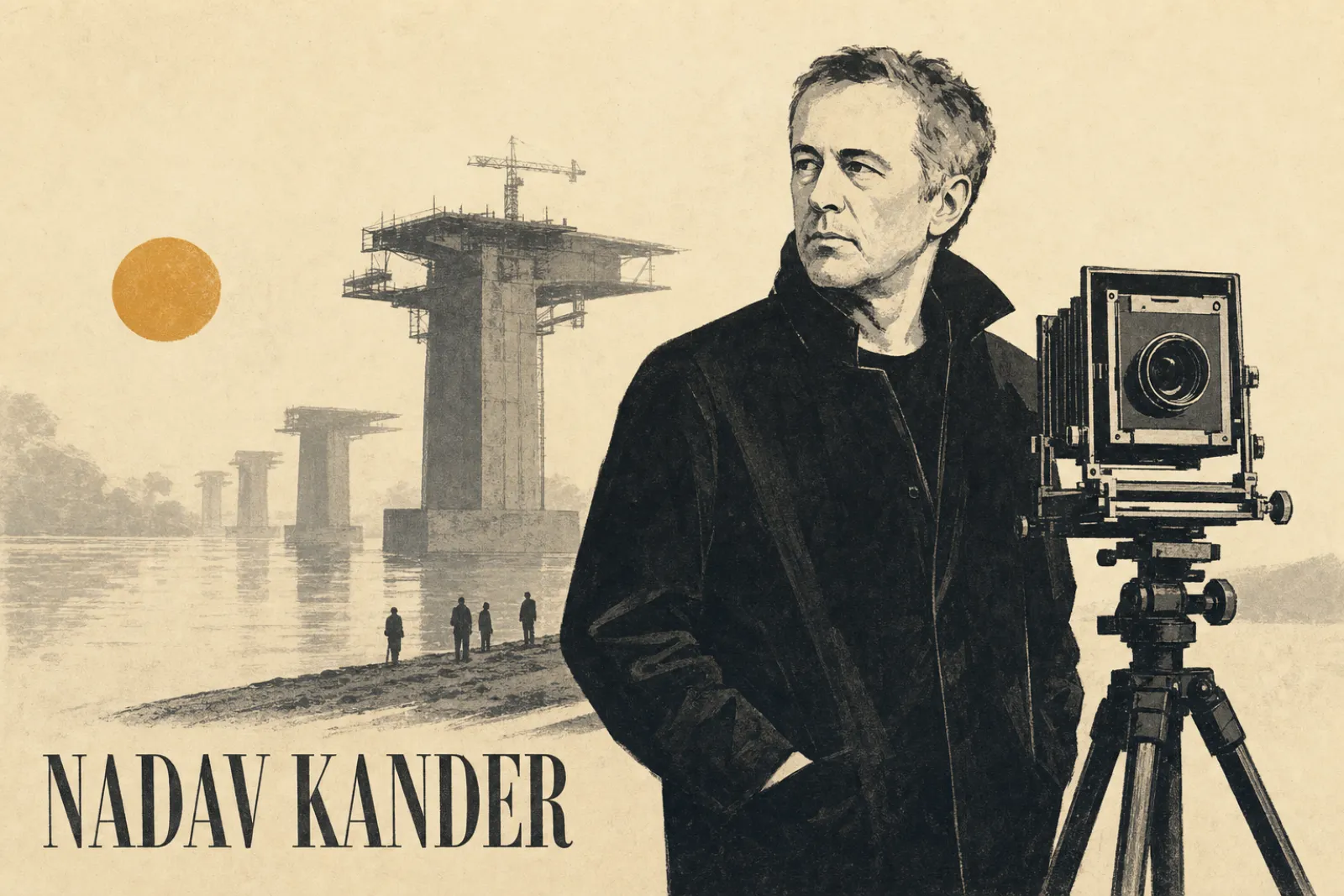
Nadav Kander is a photographer, born in Tel Aviv in 1961 and raised in Johannesburg, who built his career in London. He made two kinds of picture side by side: portraits of public figures for magazines, and large, slow landscapes of places changed by people. He is best known for Yangtze, The Long River, a journey along China’s longest river that won the Prix Pictet in 2009, and for Obama’s People, 52 portraits that filled a whole issue of The New York Times Magazine the same year.
Kander learned in a military darkroom and then in the editorial and advertising world of London, and he kept commissioned portraits and personal landscape projects going side by side. His landscapes sit alongside those of Edward Burtynsky and Andreas Gursky, who also made very large colour pictures of a world reshaped by industry, though Kander’s are quieter and leave more unexplained. His plain-background portraits of people in power invite comparison with Richard Avedon, who worked the same ground a generation earlier.
A Pentax at thirteen and an air force darkroom
Kander was born in Tel Aviv in 1961. His family moved to Johannesburg in 1963. At thirteen he bought a Pentax camera with the money from his bar mitzvah and began to photograph.
He was drafted into the South African Air Force and assigned to a darkroom, where he printed aerial photographs. He has said that this was where he became certain that photography would be his work. In the 1980s he moved to London.
There he built a career in editorial and commercial photography. His pictures ran in The Sunday Times Magazine, Rolling Stone and Dazed & Confused, and he shot advertising campaigns for large international brands. An early book, Beauty’s Nothing, was published in 2001. The Royal Photographic Society gave him its Terence Donovan Award and, in 2015, an Honorary Fellowship. His work entered the collections of the National Portrait Gallery and the Victoria and Albert Museum in London.
Along the Yangtze, from the sea to the source
In the mid 2000s Kander made a series of journeys along the Yangtze, working upstream from the river’s mouth near Shanghai to its source in Qinghai Province, a distance of about 4,100 miles. He has pointed out that more people live along the river’s banks than in the whole of the United States.
He did not set out to illustrate a thesis. By his own account he worked by intuition, responding to what he found. What he found was a country building at great speed: new bridges, the Three Gorges Dam, heaps of rubble where houses had stood, and communities lost to the rising water. In picture after picture he stepped back until the people were small and the structures around them were huge. Families picnic and people bathe in the river, dwarfed by the bridges and construction sites around them.
The series won the Prix Pictet in 2009, awarded that year on the theme of Earth, and was published as a book in 2010. In 2009 he was also named International Photographer of the Year at the Lucie Awards.
How do you make a picture feel deep and vast instead of flat? Depth in photography covers the cues that give a still image three dimensions.
Fifty-two portraits in one issue
In 2008 Kathy Ryan, the photo editor of The New York Times Magazine, commissioned Kander to photograph the people who would make up the incoming administration of Barack Obama. Over two trips in December and January he photographed 52 of them, from the vice president to a special assistant to the president. The portraits were published on 18 January 2009 as Obama’s People and took up the entire issue.
The setup was the same for everyone: a white seamless background, two large softboxes, and a medium format camera with a digital back connected to a computer. Sitters brought an object that said something about them, such as a pair of headphones or a basketball. Some were photographed full length, some seated, some as a head alone, and Kander has said he chose by instinct. He gave little direction and watched for small gestures.
He went on photographing public figures for magazines, including the Time Person of the Year cover in 2016, and won first prize for a single staged portrait at World Press Photo in 2013. The Meeting, published by Steidl in 2019, was his first book devoted to portraits and covers some thirty years of them.
How do softboxes, backgrounds and light positions fit together in a simple studio? The studio lighting guide explains the equipment and the standard setups.
Closed cities, painted bodies and the Thames
Three later projects show his range. Bodies. 6 Women, 1 Man, made between 2010 and 2012, shows unclothed figures coated in white marble dust, often with the face turned away, so that they read as sculpture more than as portraits. Dust, published in 2014, records the ruins around Kurchatov and Priozersk on the border of Kazakhstan and Russia. These were closed Soviet military towns, absent from maps, close to the test site known as the Polygon where hundreds of nuclear devices were exploded before testing ended in 1989. Dark Line, The Thames Estuary, shown in London in 2017, is a set of tall, narrow pictures of water and horizon where the river meets the sea.
In 2019 he received the award for Outstanding Contribution to Photography at the Sony World Photography Awards.
What makes a Kander picture work
Small figure, large world. The Yangtze pictures get their force from scale. A person who takes up a tiny part of the frame is enough to tell the viewer how big the bridge is, and to raise the question of what it is like to live beside it. In landscape photography a human figure is the most reliable ruler there is. Kander places it low and small and gives the rest of the frame to the structure and the sky.
Less in the frame. Kander’s projects grew sparer over time. In Bodies the styling is minimal and the faces are turned away. In Dark Line he worked slowly, at the pace of the river, and reduced the pictures to water, horizon and atmosphere, close to abstraction. Taking things out is a method anyone can practise: ask of each element in the frame whether the picture needs it.
Beauty set against the facts. Kander has written about the tension in Dust between how handsome the ruins looked and what radiation had done to the people who lived nearby. He did not resolve it. The pictures are composed with care, and the essays in the book carry the history. This is one honest way to approach difficult subjects in documentary photography: make the viewer look first, then tell them what they are looking at.
The same simple light for everyone. In Obama’s People a fixed setup removed rank. Two softboxes give broad, diffused light with gentle shadows, and a white ground removes any setting. Every difference between the pictures then comes from the person: how they stand, what they hold, where they look. A fixed setup is a good discipline for any portrait photography project with many sitters.
The shape of the frame as part of the meaning. The Dark Line pictures are much taller than they are wide, a proportion that recalls Chinese scroll painting, and were hung low so that each one stood roughly at body height. Choosing an unusual aspect ratio changes how a viewer meets a picture before they have taken in what is in it.
How does a group of pictures become a series with a beginning and an end? Creating a photo story or series covers choosing a subject, shooting to a plan and editing the set.
Photographs and series to look for
- Chongqing IV (Sunday Picnic) (2006). From the Yangtze series. A family eats Sunday lunch on a riverbank, on the rubble of newly demolished homes. Notice how ordinary the picnic is and how strange the place is, and how small the people are in the frame.
- Obama’s People (2009). Fifty-two portraits against white. Look at several in a row and note what changes when the light and background do not: posture, hands, the object each person brought.
- Dust (2014). Abandoned buildings and empty ground in the former closed towns of Kurchatov and Priozersk. Notice that the danger the series is about cannot be seen in any of the pictures.
- Bodies. 6 Women, 1 Man (2010 to 2012). Figures coated in white, faces hidden. The lesson is in what is withheld: with no face to read, the viewer attends to form.
- Dark Line, The Thames Estuary (shown 2017). Tall pictures of dark water and a distant horizon. Look at how little is in each frame and how much the proportions do.
Try this: one small person in a very large place
This takes 15 to 20 minutes with a camera or phone.
- Find the largest built thing within walking distance: a bridge, a car park, a stadium wall, a block of flats, a dam, a pier.
- Stand far enough back that the whole structure fits in the frame with room to spare. Use the widest view your camera offers without distortion you dislike.
- Wait for a person to walk into the lower part of the frame. Do not zoom in on them. They should be no taller than one tenth of the picture’s height.
- Take the picture when they are clear of any clutter, with plain ground or wall behind them. Make six frames with different people or positions.
- Choose the frame where the figure is smallest but still easy to find. Check whether the picture says something about the place that it would not say empty.
Questions people ask about Nadav Kander
What is Nadav Kander known for?
He is known for Yangtze, The Long River, a series of large landscapes made along the length of the Yangtze that won the Prix Pictet in 2009, and for magazine portraits of public figures, above all the 52 portraits of Obama’s People published by The New York Times Magazine in January 2009.
Where is Nadav Kander from?
He was born in Tel Aviv, Israel, in 1961. His family moved to Johannesburg, South Africa, in 1963, and he grew up there before moving to London in the 1980s.
How did Nadav Kander light the Obama’s People portraits?
Very simply, by his own description: two large softboxes and a seamless white background, with a medium format digital camera connected to a computer. Shadows were added afterwards, and each sitter was asked to bring a personal object.
What is the Dust series about?
Dust records the remains of Kurchatov and Priozersk, closed military towns on the border of Kazakhstan and Russia that were used for nuclear and missile testing during the Cold War. The book was published in 2014 with an essay by Will Self.
Nadav Kander is one of the photographers in the A to Z of photographers, and he is quoted on the photography quotes page.