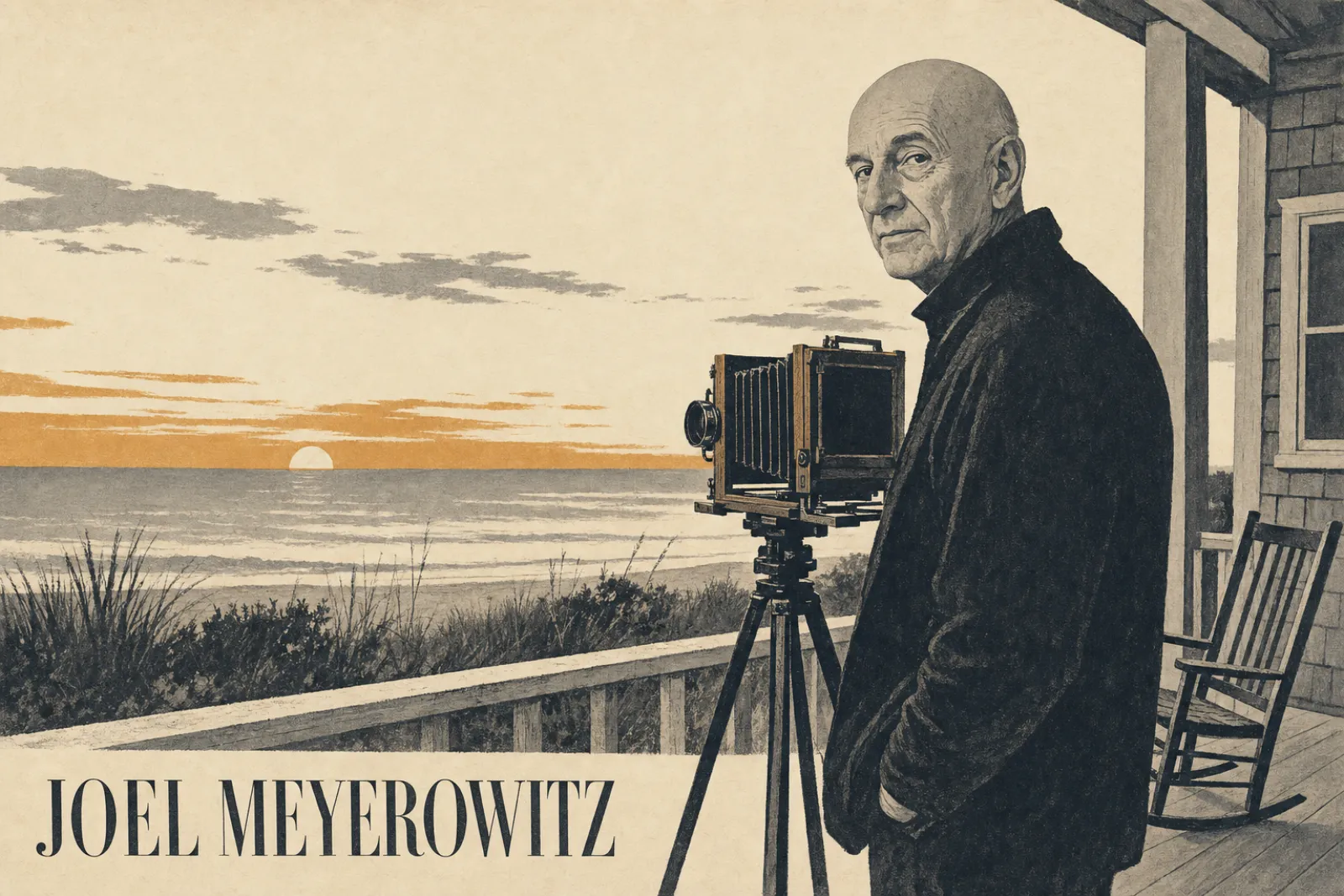
Joel Meyerowitz is an American photographer, born in the Bronx in 1938, who began photographing the streets of New York in 1962 and loaded colour film from the start, when serious photography was expected to be black and white. In the 1970s he slowed down with a large view camera on Cape Cod. He is known for making colour respectable in art photography, first on the street and then in the 1978 book Cape Light.
Meyerowitz had no training in photography. He took up a camera after watching Robert Frank at work, and he has named Frank, Henri Cartier-Bresson and Eugène Atget as his inspirations. On Fifth Avenue he walked and photographed for years beside Garry Winogrand, and the British photographer Tony Ray-Jones was a close friend in the same period. He committed fully to colour in 1972, four years before the Museum of Modern Art’s 1976 exhibition of William Eggleston brought colour photography to wide attention. What he pushed against was the assumption that colour belonged to advertising and snapshots.
An art director who quit after one afternoon
Meyerowitz was born on 6 March 1938 to working class parents. He studied painting and medical illustration at Ohio State University, graduated in 1959 and went to work as an art director at an advertising agency in New York.
In 1962 the agency hired Robert Frank to shoot a job, and Meyerowitz went along. Watching Frank work changed his mind about what a camera could do. He gave up his job, his boss lent him a camera, and he went out onto the street.
His earliest pictures, from 1962 and 1963, were in colour. Through the 1960s he used both colour and black and white 35mm film, working with a Leica in the crowds of Fifth Avenue. The method was the classic one for street photography: stay on the move, stay close, and be ready before anything happens. In 1968 the Museum of Modern Art showed My European Trip: Photographs from the Car, pictures he had made from a car while travelling in Europe. In the early 1970s he taught photography at Cooper Union in New York.
How do you catch a gesture that lasts a fraction of a second? The decisive moment covers anticipation, timing and setting a stage before the actor arrives.
From a Leica on Fifth Avenue to a view camera on Cape Cod
In 1972 he gave up black and white and worked in colour only. In the mid 1970s he made a second change and took up an 8×10 Deardorff, a view camera that stands on a tripod and takes one sheet of film at a time.
He took it to Cape Cod, Massachusetts, in the summers of 1976 and 1977. The pictures are of everyday scenes: a grocery store at dusk, an approaching storm, the view from a bedroom window. Nothing much happens in them. The subject is light and what it does to colour over the course of a day. Cape Light was published in 1978 and became one of the most widely bought photography books of its time, with more than 100,000 copies sold.
More view camera books followed, among them St. Louis and the Arch in 1980, Wild Flowers in 1983 and A Summer’s Day in 1985. He also published a book of portraits, Redheads. In 1994 he and Colin Westerbeck published Bystander: A History of Street Photography. In 1998 he made a film, Pop, about a road trip with his father and his son.
Inside Ground Zero, and after
After the attacks of 11 September 2001, Meyerowitz obtained access to the World Trade Center site in New York later that month. He was the only photographer allowed to work there without restriction. He photographed the site and the recovery work over the months that followed, and the pictures were published as Aftermath in 2006. It is a work of record, closer to documentary photography than to anything he had done before.
His later books included still lifes of the objects kept in the studios of the painters Giorgio Morandi and Paul Cézanne, and Where I Find Myself, a 2018 retrospective arranged in reverse order, from later work back to his first pictures. He received two Guggenheim Fellowships, the Royal Photographic Society’s Centenary Medal in 2012 and a place in the Leica Hall of Fame in 2017. He also appeared in the 2013 documentary about Vivian Maier.
How the pictures are made to work
Two cameras, two kinds of attention. The 35mm camera was for reacting. It is small, fast and held to the eye for an instant. The 8×10 was for looking. It needs a tripod, a dark cloth and several minutes per picture, and each sheet of film is costly. Meyerowitz used the first to catch things that were about to vanish and the second to describe things that stayed put. The page on large format photography explains how a view camera works and what it gives in return for the trouble.
The whole frame, not one hero. In his street pictures several things tend to happen at once, spread from edge to edge and from near to far, and no single figure is allowed to dominate. Composing this way means watching the edges and the background as closely as the centre.
How do you organise a frame with more than one subject? Foreground, midground and background shows how to layer people in street scenes and keep the layers from merging.
Focus set in advance. A hand held 35mm camera on a crowded pavement leaves no time to focus on each person. The standard answer is to preset distance and aperture so that a band of the street is sharp. Zone focusing gives the method and the numbers.
Colour as subject. In the Cape Cod work the colour of the light is what the picture is about. Several were made at dusk, when the sky is cool and lamps and signs are warm, so that two colours of light share the frame. A camera can only correct for one colour of light at a time, which is why these mixtures register so strongly. The white balance guide explains mixed light and when to leave it alone.
Waiting for the light, not the event. On the Cape the changes he photographed were changes of weather and hour: a storm coming in, dusk at a shop front. That is a landscape photographer’s discipline applied to houses and streets. Natural light photography describes how daylight changes through the day, and landscape photography covers planning around it.
Thinking of trying colour film yourself? Film stocks compared sets out how colour negative, slide and black and white films differ.
Photographs and books to look for
- New York City (1963). An early colour picture from the Puerto Rican Day Parade, with a young man in a blue car. Notice how much of the picture’s force is the colour itself.
- New Year’s Eve, NYC (1965). A couple kiss under a cinema banner advertising the comedy Kiss Me, Stupid. A black and white 35mm picture built on the match between a sign and a gesture.
- Red Interior, Provincetown (1977). From Cape Light. A car stands with its doors open and its red interior lit, against a blue evening sky and white walls. Look at how three colours carry the picture.
- Cape Light (1978). Read the book as a study of one kind of light. Compare the pictures made in the middle of the day with those made at dusk.
- St. Louis and the Arch (1980). A view camera book about one city and one structure. Ask how he keeps a single landmark from turning every picture into the same picture.
- Aftermath (2006). The record of the World Trade Center site. The attention to light and colour that he brought to Cape Cod is turned on a place of destruction, which is what makes the pictures hard to look at.
Try this: one doorway, two colours of light
Allow 20 minutes around sunset. Use a phone or any camera, and a support if you have one.
- Find a porch, doorway, shop front or window that has a lamp or sign switched on and some open sky behind or beside it.
- Set white balance to daylight if you can, so the camera does not correct the colours. On a phone, leave it on automatic and avoid any filter.
- Frame the scene once, with the whole doorway and a good piece of sky, and do not change the framing.
- Take one picture every three minutes, starting just before sunset and ending when the sky is nearly dark.
Lay the pictures out in order. Early on the sky is bright and the lamp barely shows. Late on the lamp is bright and the sky is black. Somewhere in the middle the warm light and the cool sky balance, and that frame will be the strongest. Note the time it was taken.
Questions people ask about Joel Meyerowitz
What camera did Joel Meyerowitz use?
For street work he used a 35mm Leica. From the mid 1970s he also used an 8×10 Deardorff view camera, the camera behind Cape Light and his later large format books.
Why is Joel Meyerowitz important to colour photography?
He photographed in colour from 1962 and gave up black and white in 1972, before museums and critics had accepted colour as a medium for art. Cape Light, published in 1978, reached a very large audience and helped change that view.
How did Joel Meyerowitz start in photography?
He was working as an art director at a New York advertising agency in 1962 when he watched Robert Frank photograph a job. He left the agency, borrowed a camera from his boss and began photographing on the street.
What is Aftermath?
It is his book of photographs of the World Trade Center site after the attacks of September 2001, published in 2006. He was the only photographer given unrestricted access to the site during the recovery work.
Meyerowitz is one of many photographers profiled in the A to Z of photographers.