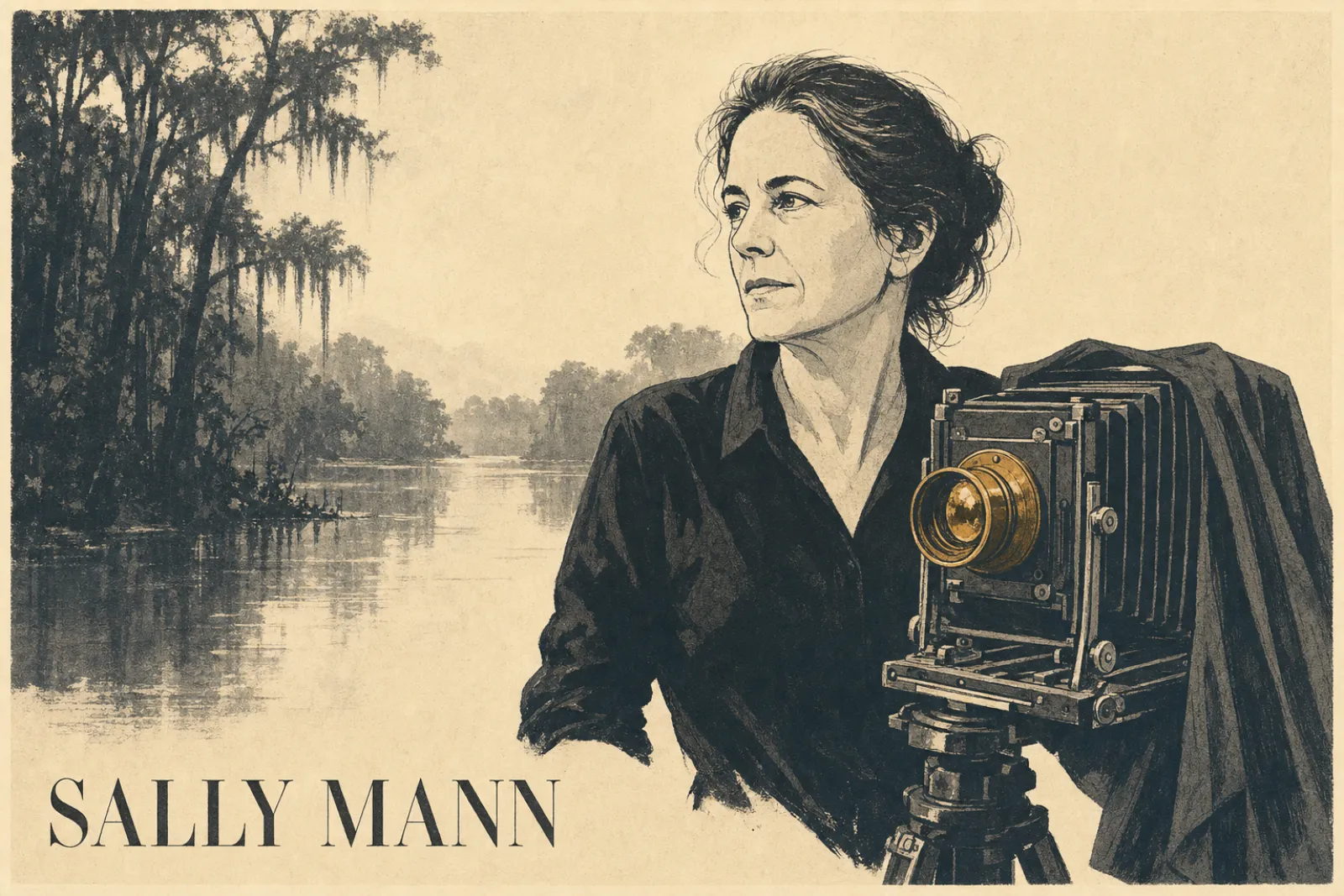
Sally Mann, born in Lexington, Virginia, in 1951, is an American photographer whose work was made almost entirely in the American South from the 1970s onward. She photographed her children, her husband, the Southern landscape and Civil War battlefields in black and white with an 8×10 view camera, and from the mid 1990s with the wet plate collodion process. She is best known for Immediate Family, published in 1992.
Mann had no formal training in photography. Her degrees were in literature and creative writing, and writing stayed part of her work. As a teenager she was shown the medium by her father, a doctor who owned a 5×7 camera, and in the late 1960s she attended the Yosemite workshops run from the gallery of Ansel Adams. She kept the large camera and the black and white print of that tradition and turned them on subjects it had left alone: her own family and a landscape heavy with history. Her later process, wet plate collodion, was the standard process of the American Civil War years, the one used for the war photographs published under the name of Mathew Brady.
Lexington, a writing degree and a first show at the Corcoran
Mann was born Sally Munger on May 1, 1951. She graduated from the Putney School in Vermont in 1969, attended Bennington College, and took a bachelor’s degree at Hollins College in Virginia in 1974 and a master’s in creative writing there in 1975. In the mid 1970s she worked as a photographer for Washington and Lee University in Lexington, where she photographed the construction of its law school building.
Her first solo museum exhibition was at the Corcoran Gallery of Art in Washington in 1977. A first book, Second Sight, followed in 1983. Her second, At Twelve: Portraits of Young Women, was published by Aperture in 1988. It is a set of portraits of girls at the age between childhood and adulthood. Her own published biography names it as the book with which she found her direction.
Immediate Family and the argument it started
From 1984 Mann photographed her three children, Emmett, Jessie and Virginia, at the family’s remote summer cabin on the Maury River in rural Virginia. The pictures show ordinary moments of childhood, such as playing, sleeping and eating, and they also touch larger themes, including injury and mortality. They were first exhibited in New York in 1990 and published by Aperture as Immediate Family in 1992.
In a number of the pictures the children are unclothed. That drew strong criticism, including accusations that the work exploited them, as well as strong praise for its honesty about childhood. Mann was never charged with any offence. The argument made the book widely known.
The photographic point is separate from the argument. These are family pictures made with the slowest and most formal camera available. An 8×10 view camera sits on a tripod, shows its image upside down on a ground glass, and takes one sheet of film at a time. Using it for family life produced pictures with the stillness and detail of nineteenth century portraits and the subject matter of a snapshot album.
Photographing your own children and not sure where to start? How to photograph your kids covers getting down to their level, natural light and settings that keep up with them.
The Southern land, the battlefields and the wet plate
In the 1990s Mann turned from her children to the land. She photographed in Virginia, Georgia, Louisiana and Mississippi. For these pictures she used antique lenses and high contrast film, and then, from the mid 1990s, wet plate collodion. The landscapes were published as Deep South in 2005.
Wet plate collodion dates from the 1850s. A sheet of glass is coated by hand with syrupy collodion, dipped in silver nitrate to make it sensitive to light, exposed in the camera while still wet and developed at once. In the field that means carrying a darkroom along. The process is slow, and it is easy to get wrong. Mann used the errors.
She took the same process to the battlefields of the Civil War in 2001 and 2002, among them Antietam, Manassas and Chancellorsville. Those pictures form part of What Remains, published in 2003, a study of death and the land in several parts. Proud Flesh, published in 2009, is a series of studies of her husband, Larry, made over six years as he lived with muscular dystrophy. Later work looked at the legacy of slavery and segregation in Virginia, including photographs of African American churches and the Blackwater tintypes made between 2008 and 2012.
Her memoir Hold Still, published in 2015, was a finalist for the National Book Award and won the Andrew Carnegie Medal for Excellence in Nonfiction in 2016. In 2018 the National Gallery of Art in Washington and the Peabody Essex Museum presented Sally Mann: A Thousand Crossings, a survey of about 115 photographs that later travelled to other museums. She received a Guggenheim Fellowship in 1987, three fellowships from the National Endowment for the Arts, and the Prix Pictet in 2021.
Curious about hand made processes like this one? Alternative photography processes gives an overview of the options and how to choose one to try.
How Mann’s pictures get their weight
- Stay home. Nearly all of the work was made in the American South, much of it close to home, over decades. Knowing a place and its people that well let her wait for the right day instead of hoping for luck on a visit. It is the logic behind any long term photography project.
- Use a slow camera on a fast subject. Large format forces a decision before the exposure. There is no burst of frames to choose from afterward, only single sheets of film. That discipline is why the family pictures look composed even when the subject is play.
- Work in the light that is already there. The family pictures were made at the cabin and the river, not in a studio. Reading and using daylight on location is explained in natural light photography.
- Let the lens fail. She chose antique lenses on purpose, and accepted the light flares, blurs and streaks they gave. Old lenses often darken the corners too, a fault with a name, vignetting, and the glow and flare of old glass are described in the guide to using vintage lenses.
- Keep the accidents. A collodion plate made by hand picks up streaks and scratches. On the finished prints these marks become part of the picture. The lesson is to judge a flaw by what it does to the picture, not by whether it is correct.
- Stay with black and white. She experimented with colour but kept returning to monochrome and to the oldest ways of making it. Without colour, a picture depends on tone, shape and surface. What that asks of a photographer is covered in black and white photography.
Wondering how the wet plate fits into the story of the medium? The history of photography has a section on the wet plate years of the 1850s to the 1870s.
Photographs and series to look for
- At Twelve: Portraits of Young Women (1988). Portraits of adolescent girls. Look at how hands, posture and the distance between people in the frame tell you what the faces hold back.
- Candy Cigarette (1989). From Immediate Family. One of her daughters holds a candy cigarette. Notice how the adult gesture pulls against the child’s age.
- Deep South (1992 to 2004, published 2005). Landscapes made in Virginia, Georgia, Louisiana and Mississippi. Look at the corners and edges, where the lens and the plate leave their marks.
- Battlefields (2001 to 2002). Ground where Civil War battles were fought, photographed with the process of that era. The flaws of the plates are left in. Ask how much of the feeling comes from the place and how much from the surface.
- Proud Flesh (published 2009). Studies of her husband made over six years. It reverses the usual roles of photographer and subject in the history of the nude.
- Blackwater (2008 to 2012). Tintypes that belong to her work on the history of slavery in the South. A tintype is a unique image on a metal plate, with no negative to print from. Look at how small changes of tone carry the whole picture.
Try this: one room, one person, a slow camera
This takes about 15 minutes. Use a phone or camera, a family member or friend, and a porch, doorway or window with daylight. Flash off.
- Put the camera on something solid: a tripod, a chair back, a stack of books. It does not move for the whole exercise.
- Watch your subject for two minutes without shooting. Pick one gesture or position you saw them fall into on their own.
- Ask them to do it again and hold it for a slow count of three.
- Make six exposures only. Between each, change one thing by asking: a hand, the turn of the head, where they look.
- Convert to black and white and darken the corners a little. Choose the frame that looks least posed.
The constraint is the fixed camera and the six frames. It makes you direct a real moment instead of chasing one.
Want more control over how a person looks in the frame? Portrait photography covers light, lens choice, and directing and posing.
Questions people ask about Sally Mann
Why was Immediate Family controversial?
The book, published in 1992, includes photographs of her three young children in which they are sometimes unclothed or shown with minor injuries. Critics accused the work of exploiting them, and others defended it as an honest picture of childhood. Mann was not charged with any offence.
What camera and process did Sally Mann use?
She used an 8×10 inch bellows view camera for most of her work. From the mid 1990s she made negatives by the wet plate collodion process on glass, often with antique lenses, and she also made tintypes and explored platinum printing.
What is Hold Still?
Hold Still is her memoir with photographs, published in 2015. It grew out of lectures she gave at Harvard University in 2011. It was a finalist for the National Book Award and won the Andrew Carnegie Medal for Excellence in Nonfiction in 2016.
What was A Thousand Crossings?
It was a survey exhibition of about 115 of her photographs, organised by the National Gallery of Art in Washington and the Peabody Essex Museum. It opened in Washington in 2018 and looked at how the American South shaped her pictures of family, land and history.
Mann is one of the photographers in the A to Z of photographers, and she is quoted on the photography quotes page.