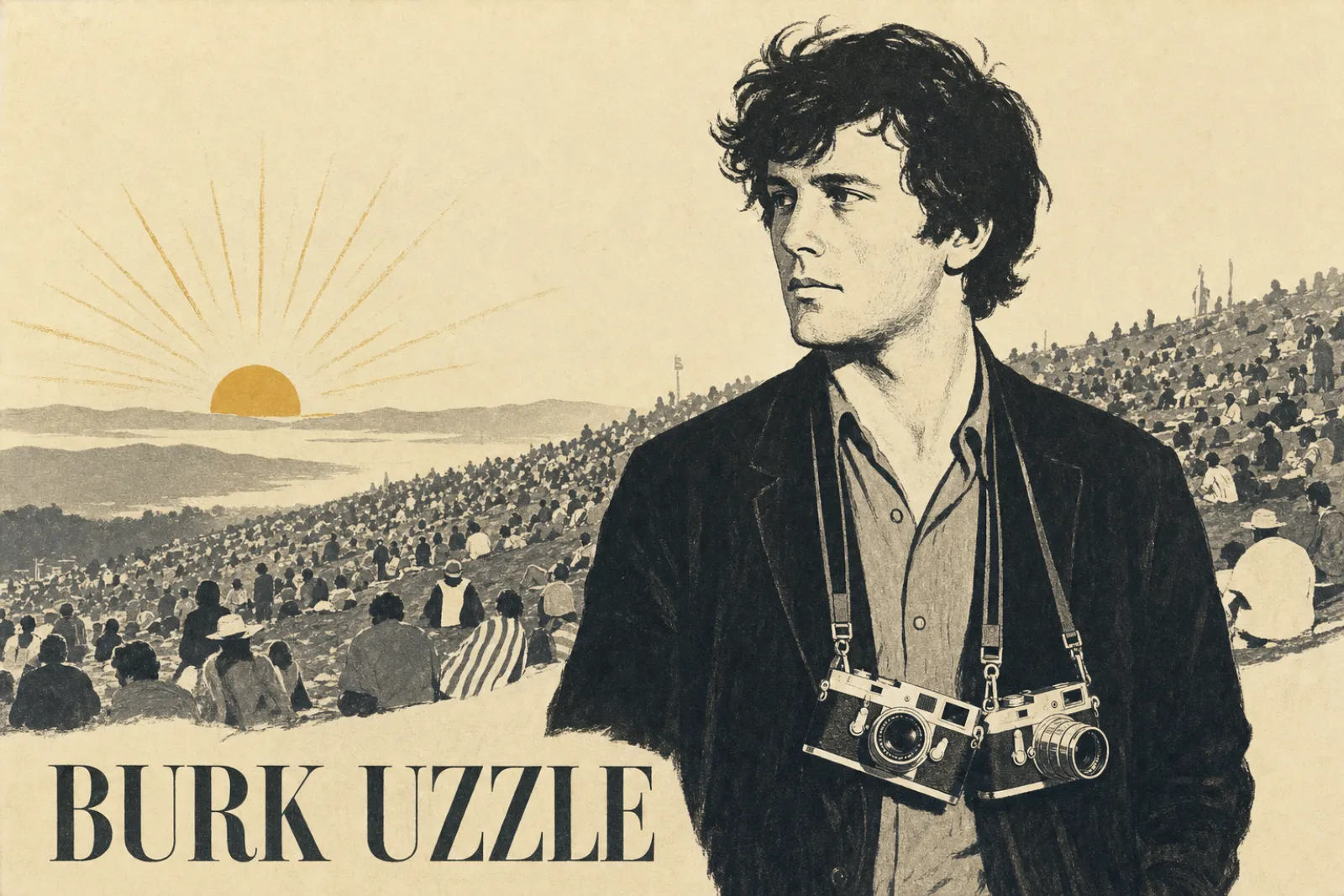
Burk Uzzle is an American photographer, born in Raleigh, North Carolina, in 1938. He worked for Life magazine in the 1960s and was a member of Magnum Photos from 1967 to 1983, photographing the United States in the years of the civil rights movement and the Vietnam War. He is best known for one frame from the Woodstock festival in 1969: a young couple wrapped in a blanket at dawn, which became the cover of the Woodstock album.
Uzzle learned on the job at a newspaper and then inside the two great picture institutions of his time, Life and Magnum. He has named Henri Cartier-Bresson, one of Magnum’s founders, as a mentor, and the quick, exact timing of his 35mm pictures comes from that school. His subject, though, was his own country. Like Lee Friedlander and Garry Winogrand, he was drawn to the ordinary American scene of highways, fairs, parades and parking lots, and to what looked odd in it once it was framed. Within Magnum his contemporaries included Bruce Davidson and Elliott Erwitt.
A newspaper job at 17, Life at 23
Uzzle started as a staff photographer on the News & Observer in Raleigh in 1955, when he was 17. From 1957 to 1962 he was a contract photographer for the Black Star agency. In 1962, aged 23, he became the youngest contract photographer Life magazine had hired, and he worked for the magazine until 1968.
The Life years gave him the standard training of a magazine photojournalist: go where the editor sends you, come back with a story. In 1962 he photographed the town of Dunn, North Carolina, where his father was city manager. In 1964 he hitchhiked across the country with his cameras.
He joined Magnum in 1967. The following year he photographed the aftermath of the assassination of Martin Luther King Jr. and the funeral. His pictures of the mourners and of King lying in his open coffin are among the lasting records of those days.
How is a news picture different from any other photograph of an event? The photojournalism guide sets out the rules of the trade and the skills it asks for.
Woodstock, with two Leicas and no assignment
In August 1969 Uzzle was 31 and freelancing through Magnum. He went to the Woodstock festival in New York State without an assignment and took his two young sons. He had planned to stay a day and stayed through the weekend.
He carried two Leica 35mm rangefinder cameras, one with a normal lens and one with a moderately wide lens, and shot both black and white and colour film. He decided early that the story was not on the stage. It was the crowd: hundreds of thousands of people helping each other put up tents and swimming in a pond.
Before sunrise on Sunday 17 August he got up and walked through the sleeping audience. On the hillside he saw a couple, Nick Ercoline and Bobbi Kelly, holding each other under a muddy quilt. By his own account the light was so low that he worked with the lens wide open at f/1.4 and a shutter speed of about 1/15 of a second, with the focus already set by distance. The colour frame became the cover of the Woodstock soundtrack album.
How do you get a sharp picture without stopping to focus? Zone focusing explains how to set a distance in advance and shoot anything that falls inside it.
After the magazines: the American scene as his own subject
Magnum gave Uzzle room to work on pictures nobody had ordered. His first book, Landscapes, was published by Magnum in 1973. All American, published by Aperture in the mid 1980s, gathered his black and white pictures of the country’s public life. He also worked abroad: in Liverpool in 1967, in Haiti in the mid 1970s, and in the refugee camps of Thailand and Cambodia in 1979 and 1980. He served as president of Magnum in 1979 and 1980 and left the cooperative in 1983. From 1984 he worked independently. A third book, A Progress Report on Civilization, accompanied an exhibition at the Chrysler Museum in 1992.
Through the 1980s he photographed Bike Week at Daytona Beach. Later he moved from the 35mm camera to larger formats and to colour. Just Add Water (2007) was his first book of large format colour photographs.
In 2007 he moved back to North Carolina after almost fifty years away and set up a studio in the town of Wilson. From there he photographed the rural South: churches standing in cleared land, abandoned vehicles, roadside scenes. In the 2010s he made a long series of portraits of African American residents of eastern North Carolina, shown in 2017 as Perceptions and Recognitions at the Greenville Museum of Art.
In the summer of 2016 three North Carolina museums showed his work at the same time: the Ackland Art Museum in Chapel Hill (All About America), the Nasher Museum of Art at Duke University (Southern Landscapes) and the North Carolina Museum of Art in Raleigh (American Chronicle). A documentary film about him, F11 and Be There, directed by Jethro Waters, was released in 2020.
How an Uzzle picture is put together
He photographs the audience, not the stage. At Woodstock every photographer could see the performers. Uzzle turned around. The habit applies anywhere: at a parade, a match or a wedding, the people watching are often the better subject, and far fewer cameras are pointed at them. This is the core of candid photography: people absorbed in something other than you.
He sets the camera before the moment. The Woodstock exposure was at the edge of what could be held by hand. It worked because the decisions were already made: aperture open, shutter as slow as he dared, focus set by distance. All that was left was to frame and press. Knowing how slow a shutter speed you can hold steady is worth testing before you need it.
He looks for two things that do not belong together. Much of his American work turns on a visual mismatch: a church with the forest cut away around it is one example. Museums that have shown his work describe it as a study of the stresses, contradictions and joys of American life. He does not caption the joke. He frames both halves clearly and leaves the rest to the viewer.
He keeps a crowded frame readable. A crowd is hard to photograph because everything in it asks for attention at once. In the Woodstock picture the couple are the one clear subject, and the hillside and the people around them are there to say where they are.
How do you arrange near, middle and far so a crowded scene still reads? Foreground, midground and background shows how to layer a photograph.
He changed tools when the subject changed. The fast 35mm camera suited news and street photography. The later southern landscapes were made in black and white and in colour, and the colour pictures in Just Add Water were made on large format cameras. His own account of the later portraits describes them as a collaboration with the people in them.
What turns a set of pictures about a place into a body of work? Documentary photography covers how long projects are planned, shot and edited.
Photographs and series to look for
- The Woodstock couple (1969). Nick Ercoline and Bobbi Kelly wrapped in a quilt at dawn. Notice that the picture is about two people and still tells you how big the event was.
- The funeral of Martin Luther King Jr. (1968). A set of pictures, not a single frame, made within days of the assassination. Look at them as a sequence and ask what each frame adds that the others lack.
- Landscapes (1973) and All American. His two books of the American scene from the Magnum years. Look for the mismatch each picture turns on, and for how little is left in the frame that does not serve it.
- Clear Cut Church, North Carolina (2006). From the southern work made around the time he came home. One building and one fact about the land around it, and nothing else needed.
- Perceptions and Recognitions (shown 2017). Portraits of African American residents of eastern North Carolina. Compare their stillness with the speed of the 1960s work.
Try this: turn your back on the main event
This takes 15 to 20 minutes with any camera or phone, at any place where people have gathered to watch something: a game, a street performer, a school concert, a fireworks display.
- Take one picture of the thing everyone is watching. That is your control.
- Then turn around and do not photograph the main event again.
- Walk the edge of the crowd. Look for one person or pair doing something different from the people around them: standing when others sit, looking away, asleep, embracing.
- Make ten frames in total. In each, keep the whole figure in the frame and include enough of the crowd to show what they are part of.
- Compare your best frame with the control picture. Ask which one tells a stranger more about what the day was like.
Questions people ask about Burk Uzzle
Who took the photograph on the Woodstock album cover?
Burk Uzzle took it at dawn on Sunday 17 August 1969. He was at the festival as a freelance Magnum photographer without an assignment, and was photographing the crowd, not the performers.
Who are the couple in the Woodstock photograph?
They are Nick Ercoline and Bobbi Kelly, who had been dating for about ten weeks at the time. They later married.
Was Burk Uzzle a member of Magnum?
Yes. He joined Magnum Photos in 1967, served as its president in 1979 and 1980, and left in 1983. Before that he was a contract photographer for Life magazine from 1962 to 1968.
What camera did Burk Uzzle use at Woodstock?
He carried two Leica 35mm cameras, one with a normal lens and one with a moderately wide lens, and shot both black and white and colour film.
Burk Uzzle is one of the photographers in the A to Z of photographers, and he is quoted on the photography quotes page.