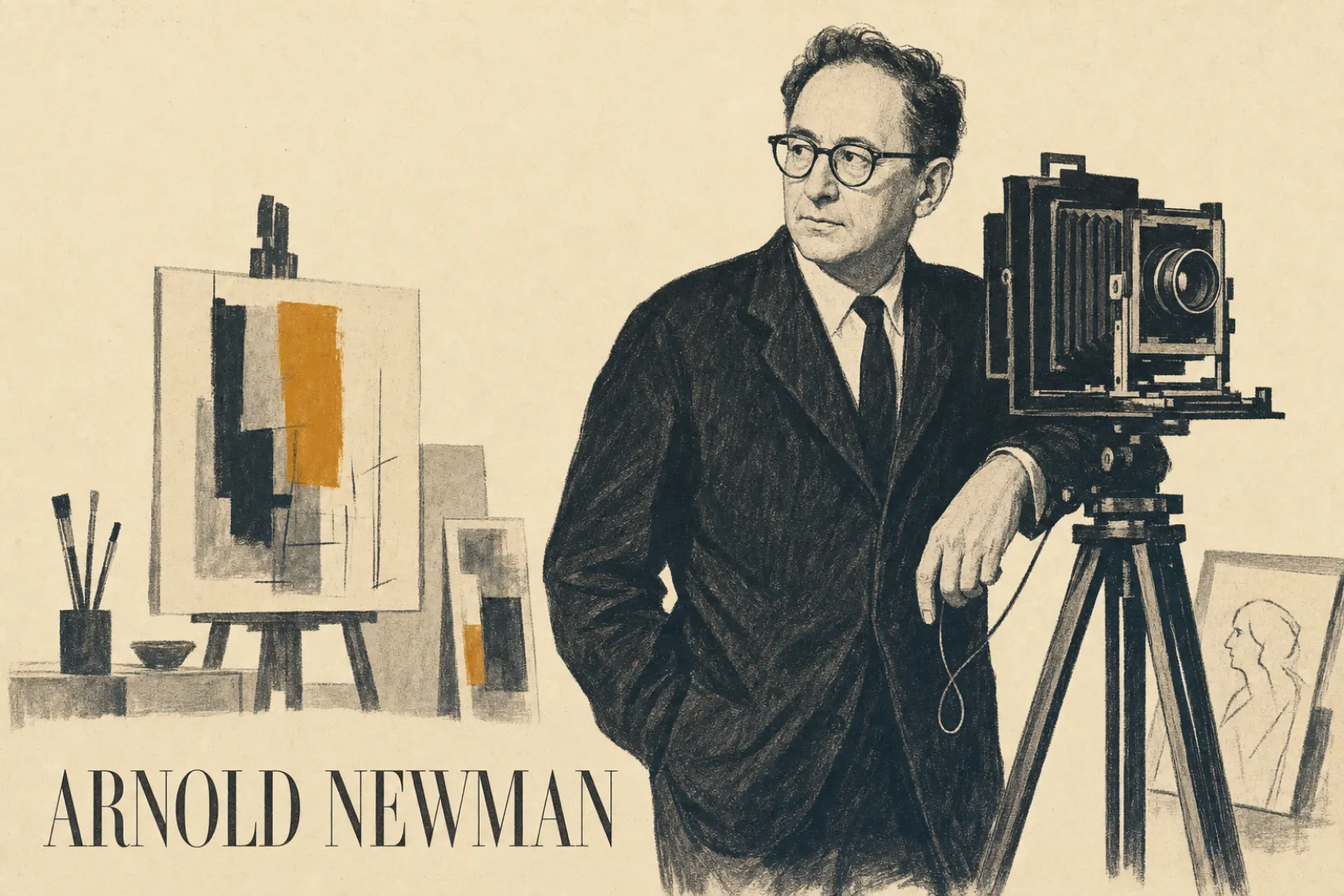
Arnold Newman (1918 to 2006) was an American portrait photographer who worked from New York for sixty years. He photographed painters, composers, writers, scientists and presidents for magazines such as Life, Fortune and Newsweek. He is known for the environmental portrait: a picture in which the sitter’s own surroundings, carefully arranged, say who the person is and what they do.
Newman trained as a painter, and he composed like one. In 1941 Beaumont Newhall and Alfred Stieglitz saw his work in New York and helped him to an exhibition there. His approach was a break from the studio portrait of the period, in which a famous face was set against a plain backdrop and shaped by light alone, as in the work of Yousuf Karsh or later Richard Avedon. Newman went to the sitter. He took the camera and the lights to the studio, the laboratory or the office and built the picture out of what he found there.
From 49 cent portraits to “Artists Look Like This”
Newman was born in Manhattan on March 3, 1918 and grew up in Atlantic City and Miami Beach. He studied painting and drawing at the University of Miami for two years, until his family could no longer afford it. In 1938 he took a job in a portrait studio in Philadelphia, turning out portraits that sold for 49 cents each. It was routine work, and it gave him daily practice in lighting and handling people.
In 1941 he showed his pictures at the A-D Gallery in New York. Over the next few years he photographed artists where they worked and lived, among them Piet Mondrian and Max Ernst, both in New York in 1942. In 1945 the Philadelphia Museum of Art presented his portraits of living artists as “Artists Look Like This”, a solo exhibition. It drew national attention, and in 1946 he moved to New York and opened Arnold Newman Studios.
What is an environmental portrait, and how is one planned? Environmental portrait photography covers choosing and using a setting.
Sixty years of magazine sittings
From 1946 Newman worked freelance for the big illustrated magazines. A sitting usually began as an assignment: a composer for Harper’s Bazaar, an industrialist for Newsweek, a politician or a scientist for Life. His sitters included Igor Stravinsky, Pablo Picasso, Marilyn Monroe, Langston Hughes, Truman Capote, Robert Oppenheimer and John F. Kennedy. He was also one of the few photographers allowed to make a portrait of the famously camera shy Henri Cartier-Bresson.
He is best known for black and white, but he also worked in colour, and he made collages from cut and torn prints. He taught for many years at Cooper Union. His books include One Mind’s Eye (1974) and Artists: Portraits from Four Decades (1980). The International Center of Photography gave him its Infinity Award for Master of Photography in 1999, and the Royal Photographic Society awarded him its Centenary Medal in 2004. He made his last formal portrait in December 2005 and died in New York on June 6, 2006. His archive, including all of his negatives and contact sheets, went to the Harry Ransom Center at the University of Texas at Austin.
How Newman built a portrait
Newman said that the surroundings had to add both to the composition and to the understanding of the person. Each half of that matters. A background that explains the sitter but makes a messy picture fails. So does a handsome design that says nothing about them.
- He chose one idea from the setting. A piano for a composer, an easel for a painter, a factory floor for an industrialist. He did not show the whole room. He picked the one object or shape that carried the meaning and let it dominate. The page on shape in composition covers how a strong outline holds a frame.
- He decided how big the person should be. In some portraits the face fills the frame. In others the sitter is small and the setting does the talking. Scale was a statement about the relation between the person and the work.
- He used a large camera on a tripod. Newman worked mostly with large format view cameras. The slow, fixed setup let him study every edge of the frame and gave negatives sharp enough to show the texture of a canvas or a machine. The guide to using a tripod explains what a locked camera position makes possible.
- He shot many variations. The contact sheets in his archive show ten, twenty, thirty and sometimes more than fifty exposures of one sitter, each with a small adjustment of pose, expression or framing.
- He finished the picture afterwards. He marked up his contact sheets and wrote notes along their edges, so the sitting was only the start of the work. Choosing and trimming a frame afterwards is covered on the page on how to crop photos.
- He brought his own lights. Working on location did not mean accepting whatever light was there. The guide to portrait lighting patterns shows how the position of a light changes a face.
How do you arrange everything inside the frame so it reads at once? Photography composition sets out fifteen techniques, including placement, balance and negative space.
Portraits to look for
- Piet Mondrian (1942). The painter stands upright in a suit and tie beside an easel in New York. The straight lines of the picture repeat the lines of his paintings. Only his hand, draped over the easel, breaks the flatness of the design.
- Igor Stravinsky (1946). The raised lid of a grand piano dominates the picture and forms a shape like a huge note of written music, with the composer at the piano. Harper’s Bazaar, which had commissioned it, turned the picture down. It became Newman’s signature image.
- Pablo Picasso, Vallauris (1954). Made in France, where Picasso was working. Compare how much of the frame Newman gave to the man and how much to his surroundings with the choices he made for Mondrian and Stravinsky.
- Alfried Krupp (1963). A colour portrait of the German industrialist, who had been convicted after the Second World War of using slave labour, made in one of his factories for Newsweek. Newman, who was Jewish, posed him leaning forward with his hands clasped under his chin and set out to make him look sinister. He later acknowledged that his own feelings shaped the picture. It is a lesson in how far a portrait can state an opinion.
- Marilyn Monroe (1962). Among the last portraits made of her. The picture is worth comparing with her publicity portraits.
- Otto Frank. The father of Anne Frank is shown in the attic where the family hid. Here the setting is not a workplace but a history, and it carries the picture.
Wondering how Newman’s approach compares with a plain backdrop and a single light? Portrait photography covers the main ways of photographing people.
For a different use of the sitter’s surroundings in the same years, see Bill Brandt, whose wide lens and dark printing made the setting strange where Newman’s made it clear.
Try this: one person, one object, three sizes
This takes about 20 minutes. Choose someone you know who makes or does something: a cook, a gardener, a guitarist, a student at a desk.
- Go to the place where they do it. Look for the single object that says most about the activity, and clear away anything near it that distracts.
- Fix the camera position. Use a tripod, or brace the phone against something solid.
- Frame one: the person fills most of the picture and the object is a small detail.
- Frame two: person and object take equal space.
- Frame three: the object dominates and the person takes up a quarter of the frame or less.
- For each framing, take at least five exposures, changing one small thing each time.
- Choose the single best picture, then try two different crops of it.
Questions people ask about Arnold Newman
What is Arnold Newman known for?
He is known for environmental portraiture, in which a person is photographed in surroundings that show their work and character. He is often credited with establishing the approach and is called the father of the environmental portrait.
What camera did Arnold Newman use?
He worked mainly with large format view cameras mounted on a tripod. The method was slow and deliberate and suited portraits that were composed down to the last detail.
What is the story behind the Stravinsky portrait?
Newman photographed Igor Stravinsky in 1946 on assignment for Harper’s Bazaar. He used the open lid of a grand piano as the main shape, so that it reads like a large musical note and stands for the composer’s work. The magazine rejected the picture, which went on to become his best known photograph.
Why does Alfried Krupp look menacing in Newman’s portrait?
Because Newman meant him to. He chose the pose and the factory setting so that Krupp would appear threatening, and said afterwards that his personal feelings about the man had influenced the picture.
Newman is one of the names in the A to Z of photographers, and he is quoted on the photography quotes page.