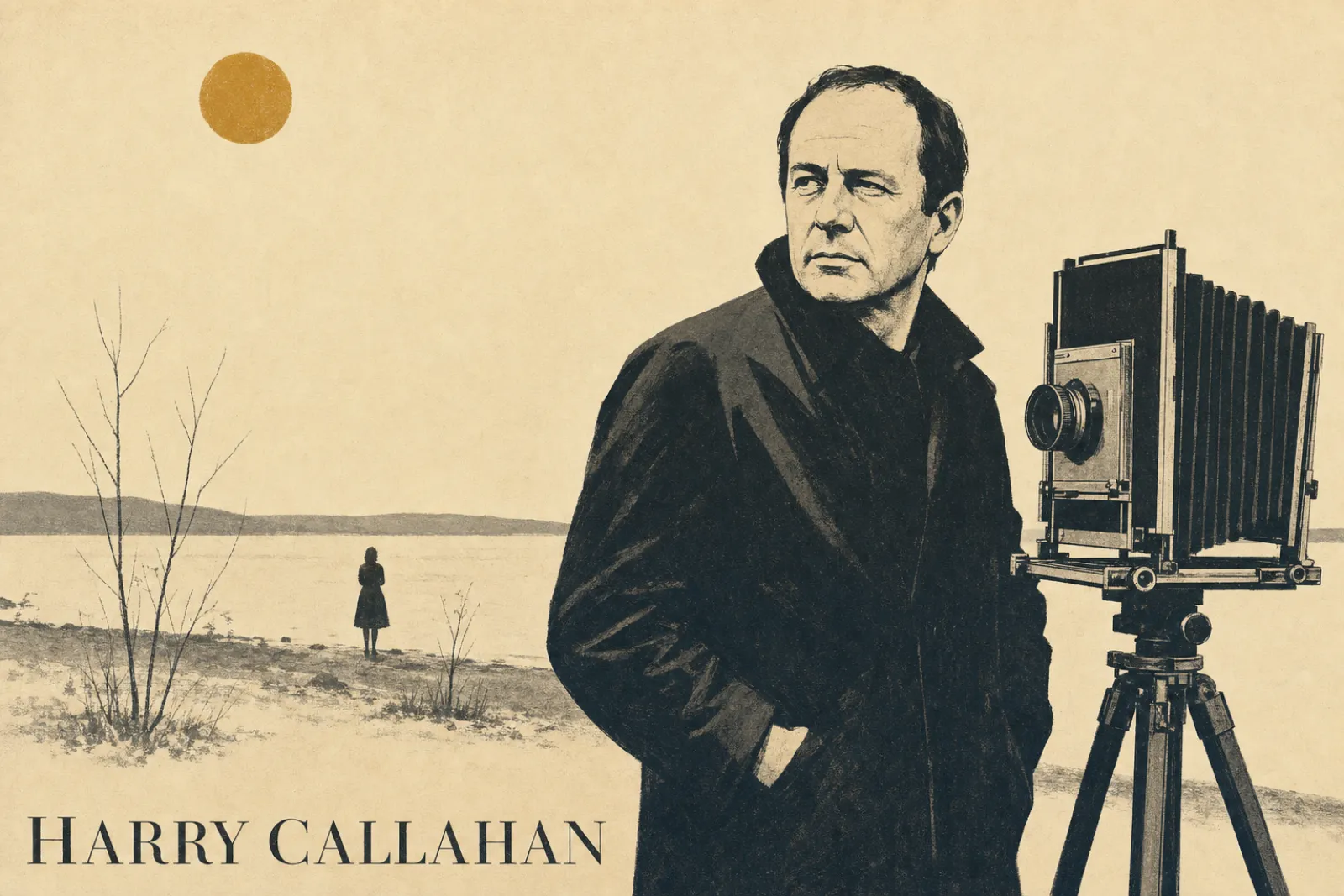
Harry Callahan (1912 to 1999) was an American photographer and teacher who worked in Detroit, Chicago, Providence and Atlanta. He photographed a small set of subjects again and again for nearly sixty years: his wife Eleanor, weeds and trees, water, and people and buildings on city streets. He is best known for the spare, tender pictures of Eleanor and for showing how much one photographer could do by changing the method instead of the subject.
Callahan had no formal training in photography. He took it up as a hobby in 1938 while working for Chrysler in Detroit, and the turning point came in 1941 when Ansel Adams visited his camera club. Adams showed him that a photograph could be a serious, personal thing. Callahan then went his own way. Where Adams prized a full, rich range of greys, Callahan often printed in stark black and white, with almost nothing in between. In 1946 László Moholy-Nagy hired him to teach at the Institute of Design in Chicago, a school built on Bauhaus ideas about experiment. He later invited Aaron Siskind to teach with him at Rhode Island School of Design, and in 1962 his work was paired with that of Robert Frank in a two person exhibition at the Museum of Modern Art in New York.
From a Detroit camera club to the Institute of Design
Callahan was born in Detroit on October 22, 1912. He studied engineering at Michigan State for a short time, left, and in 1933 took a job as a shipping clerk at Chrysler. He married Eleanor Knapp in 1936. He bought his first camera, a Rolleicord, in 1938 and joined the Chrysler Camera Club. By 1944 he was working as a processing assistant at the General Motors Photographic Laboratories.
The Detroit pictures from the early 1940s already hold most of what came later. He photographed weeds standing in snow and in water. He tested what the camera could do by making multiple exposures, in black and white and in color. When he moved to Chicago in 1946 to teach, he was only eight years into photography. He led the photography department at the Institute of Design from 1949 and stayed until 1961, when he left to set up the photography program at Rhode Island School of Design in Providence. His students included Ray K. Metzker, Emmet Gowin and Kenneth Josephson.
Eleanor, Barbara and the same few subjects
Eleanor was his main subject through the 1940s and 1950s. He photographed her indoors and outdoors, close and far away, clothed and nude, alone and, after their daughter Barbara was born in 1950, with the child. Some pictures are plain and still. Others are layered multiple exposures. For the family pictures he often used a large 8×10 inch view camera on a tripod, which is slow and formal. The results are quiet and private, without being sentimental.
He kept a steady routine. He walked the city almost every morning with a camera and made proof prints in the afternoon. On the street in Chicago he photographed pedestrians and building fronts. He also photographed trees, grasses and water. He received a Graham Foundation award in 1956 and spent 1957 to 1958 in France with his family, settling in Aix-en-Provence.
Wondering how a view camera changes the way a picture gets made? Large format photography explains sheet film, the ground glass and why the process is so slow and deliberate.
Providence, color and the later years
Callahan had made color pictures since the 1940s, but in the 1970s he returned to color and gave it most of his attention. The later color work was made in Providence, in Atlanta, where he lived in his last years, and on trips abroad to places such as Morocco, Portugal and Ireland. He also photographed beaches on Cape Cod and the Atlantic coast, with sand, water and sky reduced to a few bands.
Recognition came steadily. The Art Institute of Chicago gave him his first solo exhibition in 1951. The Museum of Modern Art in New York held a retrospective in 1976, organised by John Szarkowski. In 1978 he represented the United States at the Venice Biennale, alongside the painter Richard Diebenkorn. The National Gallery of Art in Washington showed a retrospective in 1996, the same year he received the National Medal of Arts. He died in Atlanta on March 15, 1999. His archive is held at the Center for Creative Photography in Tucson, Arizona.
How a Callahan picture is put together
The first choice is to take things out. A Callahan frame usually holds one subject and very little else: a weed and the snow, a face and the water, a figure and a wall. This is the same thinking that drives minimalist photography, where every element left in the frame has to earn its place.
The second choice is tone. In many of the nature studies he exposed and printed for extreme contrast, so that snow or sky became blank white paper and the plant became a thin black line. The negative of his 1950 picture of trees in Chicago held fine detail in the bark. He chose to print it hard, dropping the middle greys, so the picture reads as shape and line first. That decision is the lesson: the print is where he decided what the photograph was about. The broader guide to black and white photography covers how to see a scene as tone before you press the shutter.
Want to push a subject to pure black shape against a bright ground? Silhouette photography shows how to expose for the background and choose a subject with a clear outline.
The third choice is method. Callahan treated technique as a way to see a familiar subject again. He used multiple exposures, time exposures, camera movement during the exposure, very small figures in very large spaces, and very close views that turn grass or water into something close to abstract photography. He would stay with one method for a while, then set it down and come back to it years later.
Curious how two exposures end up on one frame? Double exposure photography walks through doing it on film, in a digital camera and in software.
The fourth choice is distance. Eleanor is sometimes a face filling the frame and sometimes a tiny figure in the middle of a wide field or an empty street. The change in scale changes the feeling completely, even though the person and the photographer are the same. The pictures of pedestrians belong to the craft of street photography, and in the family pictures he worked slowly with the big camera.
Photographs to look for
- Weeds in Snow, Detroit (1943). A few dark stems stand against white. There is almost no grey. Notice how the snow has stopped being snow and become a blank page, and how the stems read like pen lines.
- Eleanor, Chicago (1949). Eleanor rises from the water of Lake Michigan with her eyes closed and her dark hair spread around her. Callahan chose this frame over others in which the hair fell differently. Look at how still it is, and how much the position of the hair matters to the whole frame.
- Chicago (1950). Bare trees along Lake Shore Drive in winter, printed very hard. A faint horizon line is the only thing that crosses the vertical trunks. Bark texture is gone on purpose.
- Chicago (1949). A worn twin house, one half painted dark and the other light. It is a study in symmetry, and a reminder that he looked at buildings the way he looked at weeds.
- Barbara, Chicago (1950). His newborn daughter on a white blanket against black. The picture is built from a few lines and shapes, yet it stays a family photograph.
- Atlantic Coast (1978). A color picture: a diagonal band of sand, white traces of waves and grey fog. Compare it with the weeds from 1943 and the same eye is plain to see.
Try this: one weed, twelve frames
Give yourself 15 minutes. Find one thin plant, twig or stalk of grass and a plain bright background for it: an overcast sky, snow, a white wall or pale sand.
- Get low or move around until nothing but the plant and the plain ground is in the frame.
- Make the background brighter than the camera wants. Add one to two stops of exposure compensation, or on a phone tap the plant and drag the exposure up until the background turns white.
- Make exactly twelve frames of the same plant. Change only where it sits in the frame and how close you are.
- Convert the best three to black and white and raise the contrast until the middle greys are almost gone.
Pick the one where the line of the plant holds your eye longest, and ask what you would lose by adding anything to it.
Not sure how surface detail and hard tone trade against each other? Texture in photography explains how light direction and contrast reveal or hide a surface.
Questions people ask about Harry Callahan
What is Harry Callahan known for?
He is known for decades of photographs of his wife Eleanor, for spare studies of weeds, trees and water, and for city pictures made in Detroit, Chicago and Providence. He is also known as a teacher who led the photography programs at the Institute of Design in Chicago and at Rhode Island School of Design.
Who was Eleanor in Harry Callahan’s photographs?
Eleanor Knapp met Callahan in 1933 and married him in 1936. She was his most frequent subject through the 1940s and 1950s, photographed alone and with their daughter Barbara, who was born in 1950. A book of the pictures, titled Eleanor, was published in 1984.
What camera did Harry Callahan use?
His first camera, bought in 1938, was a Rolleicord. Over his career he worked with both 35mm cameras and an 8×10 inch view camera, and he made straight single exposures as well as multiple exposures, in black and white and in color.
Did Harry Callahan study photography?
No. He studied engineering briefly and was self taught as a photographer, learning through a Detroit camera club. A 1941 visit to the club by Ansel Adams was when he began to take photography seriously.
Harry Callahan is one of the photographers in the A to Z of photographers, and he is quoted on the photography quotes page.