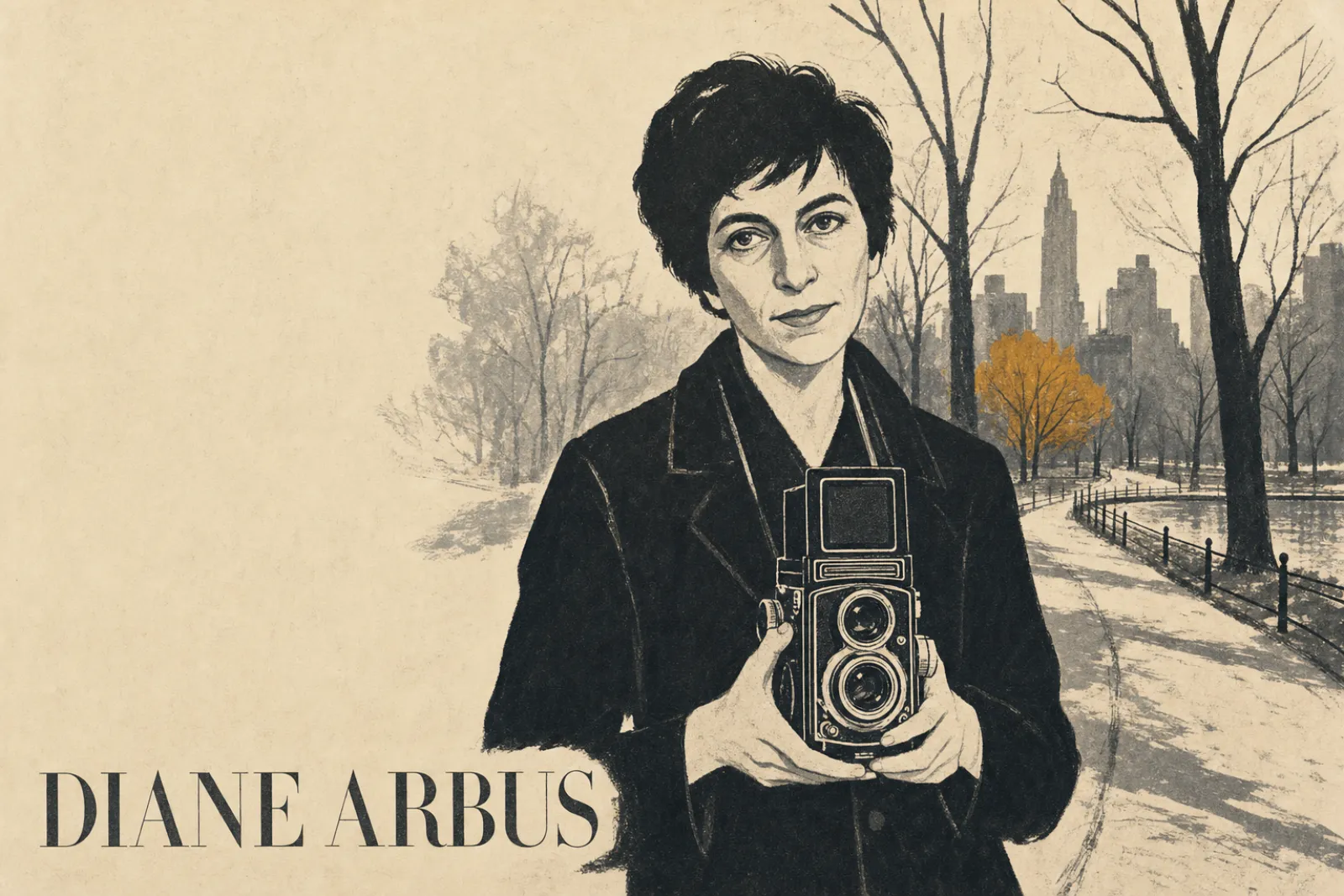
Diane Arbus (1923 to 1971) was an American photographer who worked in and around New York City. After a decade in fashion photography she spent the late 1950s and the 1960s making black and white portraits of strangers: children, couples, families, performers and people living at the edges of ordinary society. She is known for square, frontal portraits in which the sitter looks straight back at the camera and at the viewer.
Arbus took classes with Berenice Abbott, studied briefly with the art director Alexey Brodovitch in 1954, and in the mid 1950s found her most important teacher in Lisette Model. In 1967 the Museum of Modern Art showed her beside Lee Friedlander and Garry Winogrand in the exhibition New Documents. All three pointed cameras at everyday American life. Where the other two caught people on the move, Arbus stopped them, asked, and made a portrait.
From a Fifth Avenue childhood to a fashion studio
She was born Diane Nemerov in New York City on March 14, 1923. Her family owned Russeks, a Fifth Avenue department store co-founded by her grandfather. Her brother Howard Nemerov became a poet. In 1941 she married Allan Arbus, who gave her a Graflex camera soon afterwards.
From 1946 to 1956 the couple ran a commercial photography business under the name Diane & Allan Arbus. Allan photographed and Diane worked as art director and stylist. Their clients included Glamour, Seventeen and Vogue. One of their pictures, a father and son, was included in The Family of Man, the 1955 exhibition organised by Edward Steichen.
In 1956 she left the business to photograph for herself. She began numbering her negatives that year. The fashion years had taught her how a picture is planned, styled and controlled. Her own work kept the control and dropped the styling.
Out on the street, then into people’s homes
Until about 1962 Arbus worked with a 35mm Nikon. Around 1962 she changed to a Rolleiflex, a twin lens reflex camera that makes square negatives on medium format film. From 1964 she also used a Mamiyaflex with a flash. The larger negative gave her prints far more detail than 35mm could, and the square frame became the shape of her mature work.
Magazines paid for much of it. Esquire published her photographs in 1960. Her pictures later ran in Harper’s Bazaar, The Sunday Times Magazine and other titles. She received Guggenheim Fellowships in 1963 and 1966 for a project she called American Rites, Manners and Customs.
The titles of her photographs say where she went. A park, a parade, a street corner, and then, more and more, a living room or a bedroom: A Young Man in Curlers at Home on West 20th Street, A Family on Their Lawn One Sunday in Westchester, A Jewish Giant at Home with His Parents in the Bronx. Many of her portraits were made where the sitter lived. From 1969 to 1971 she photographed at residences in New Jersey for people with developmental disabilities, at picnics, dances and Halloween parties. Those pictures were left untitled.
How do you photograph someone in the place where they live so that the room says something too? Environmental portrait photography covers choosing the setting and working with the light already in it.
Arbus taught at Parsons School of Design, at Cooper Union and at the Rhode Island School of Design. In May 1971 Artforum published her work. She died in New York on July 26, 1971, at the age of 48. In 1972 her photographs were shown at the Venice Biennale, and a retrospective of 125 photographs opened at the Museum of Modern Art and then toured until 1975. The Aperture book Diane Arbus, edited by her daughter Doon Arbus and Marvin Israel, came out the same year with 80 photographs and has stayed in print. Her archive, including the negatives from about 7,500 rolls of film, went to the Metropolitan Museum of Art in 2007.
How an Arbus portrait is made to work
The pictures look simple. The choices behind them are specific and can be learned.
- Ask first, then photograph. Her best known portraits are not stolen moments. Arbus often got to know her subjects, and the sitter knows the camera is there. That is the difference between a candid and a street portrait, and it is why the sitters look back so steadily.
- Stand square to the person. In the famous pictures the subject faces the lens and looks into it. A square frame suits this, because it has no long side to pull the eye away from the centre. The guide to aspect ratio explains what each frame shape does to a composition.
- Use the centre and the pair. Twins, triplets, couples and families stand side by side. Arranged evenly, the small differences between two people become the subject. The page on symmetry in photography shows how a balanced frame makes any break in the balance stand out.
- Add flash. From 1964 her camera carried a flash. Flash lights the person sharply and lifts them away from whatever is behind. The basics are in flash photography: when and how to use flash.
- Choose the frame afterwards. The contact sheet for her 1962 picture of a boy in Central Park shows an ordinary child showing off for the camera. Arbus printed the one frame in which he looked strained and strange. Selection was part of the work.
- Print it yourself. Arbus printed her own work, so the choices made in the darkroom were hers as well. The process is outlined in darkroom basics.
Her method raises a question that has followed the work since the 1960s: who benefits when a stranger is made into a picture? The boy in Central Park said that as a teenager he felt the photograph mocked him, and that as an adult he came to think she had seen something true in him. The father of the twins in her most famous picture thought it a poor likeness of his daughters. Neither reaction settles the argument, and both belong to it.
Where is the line between a portrait and taking advantage of someone? Photography etiquette and ethics sets out the questions of consent that come with photographing strangers.
Photographs to look for
- Child with Toy Hand Grenade in Central Park, N.Y.C. (1962). A thin boy holds a toy grenade in one hand, the other hand clenched like a claw, one shoulder strap hanging loose. Notice how much of the picture is carried by his expression, and remember that it was one frame chosen from several.
- A Young Brooklyn Family Going for a Sunday Outing, N.Y.C. (1966). A young family on their way out for the day. Look at each face separately, one at a time, and ask what each person is doing with the fact of being photographed.
- Identical Twins, Roselle, New Jersey (1967). Two seven year old sisters, found at a Christmas party for twins and triplets, stand side by side in matching dresses, white tights and white headbands. One has the trace of a smile and the other a slight frown. The picture is a lesson in how sameness makes the eye hunt for difference.
- A Jewish Giant at Home with His Parents in the Bronx, N.Y. (1970). A portrait of Eddie Carmel standing with his much shorter mother and father in the family apartment. Look at how the room and the two smaller figures give his height its scale. It is a picture about size made in an ordinary domestic setting.
- Untitled (1969 to 1971). The late series from New Jersey residences, made at picnics, dances and Halloween parties. Arbus left the pictures without titles, and the series was named after her death. Compare them with the earlier portraits and decide whether the relationship between photographer and sitter has changed.
- A box of ten photographs. A portfolio of ten prints from 1963 to 1970 in a clear box designed by Marvin Israel. She planned an edition of 50 and sold four in her lifetime, two of them to Richard Avedon.
Wondering why almost all of this was done in black and white? Black and white photography explains what a picture gains when it is built from tone alone.
Try this: one stranger, twelve frames
This takes about fifteen minutes and needs one person you do not know well.
- Set your camera or phone to a square (1:1) frame.
- Ask someone if you may make their portrait where they are: at a market stall, on a doorstep, at a desk. Say it will take two minutes.
- Stand directly in front of them, about two metres away, with the camera at their eye level. Put them in the centre and include them from the knees up.
- Ask them to look into the lens. Do not ask for a smile and do not pose them.
- Take exactly twelve frames, with a pause between each. Say very little.
- Later, look at all twelve side by side and pick one. Write down in a sentence why that frame is the portrait and the others are not.
Questions people ask about Diane Arbus
What camera did Diane Arbus use?
She used a 35mm Nikon until about 1962, then a Rolleiflex twin lens reflex, and from 1964 a Mamiyaflex with flash. The last two make square negatives on medium format film, which is why her best known pictures are square.
Who taught Diane Arbus?
She took classes with Berenice Abbott and studied briefly with Alexey Brodovitch in 1954. Her main teacher was Lisette Model, with whom she studied in the mid 1950s.
What was the New Documents exhibition?
New Documents was a 1967 exhibition at the Museum of Modern Art in New York, organised by the curator John Szarkowski. It presented Arbus with Lee Friedlander and Garry Winogrand, and almost 250,000 people saw it.
What is Diane Arbus’s most famous photograph?
Identical Twins, Roselle, New Jersey, from 1967, is among her most famous pictures. Child with Toy Hand Grenade in Central Park, from 1962, is nearly as well known.
Arbus is quoted on the photography quotes page, and the A to Z of photographers lists the people she learned from and worked beside.