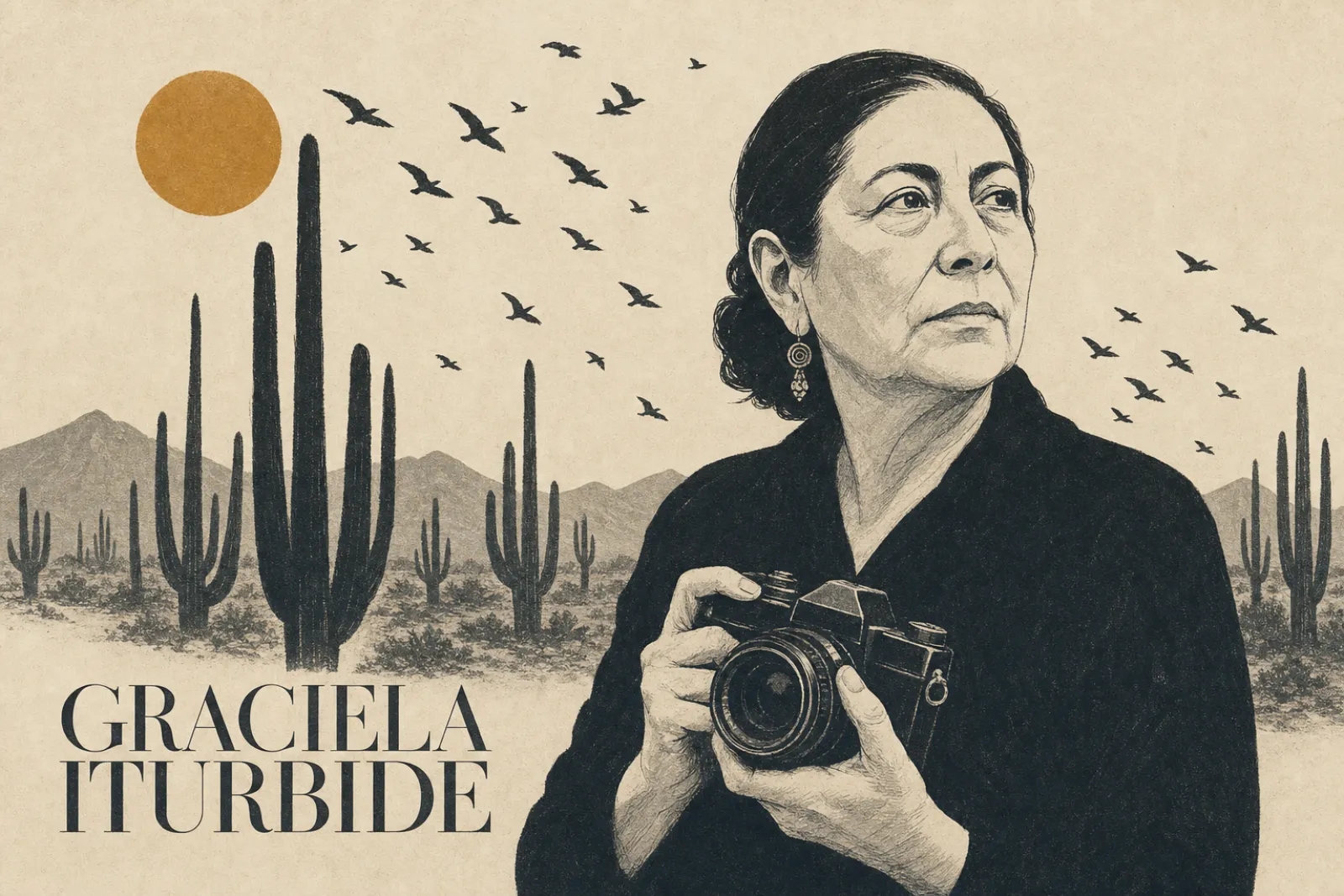
Graciela Iturbide is a Mexican photographer, born in Mexico City in 1942, whose photographs, from the 1970s onward, are almost entirely in black and white. She photographed the Seri people of the Sonoran Desert, the Zapotec town of Juchitán in Oaxaca, a neighbourhood of East Los Angeles, and later birds, plants and objects. She is best known for Juchitán de las Mujeres, a study of a town where women hold the central place in daily life.
Her teacher was Manuel Álvarez Bravo, the leading Mexican photographer of the generation before hers. Tina Modotti and Sebastião Salgado are also counted among her influences, and in 1978 she met Henri Cartier-Bresson, whose work mattered a great deal to her. What she set herself against was the distant, outside view of documentary work. She lived with the people she photographed and made pictures with their agreement.
Film school and two years beside Álvarez Bravo
Iturbide was born on 16 May 1942, the eldest of thirteen children in a traditional Catholic family. In 1969, at the age of 27, she enrolled at the Centro Universitario de Estudios Cinematográficos, the film school of the National Autonomous University of Mexico. She meant to become a film director.
Álvarez Bravo was teaching there. She turned to still photography and worked as his assistant in 1970 and 1971, travelling with him on photographic trips around Mexico. From him she took a habit of patience: the idea that there is always time for the picture you want, and no need to hurry it.
The Sonoran Desert and Juchitán
In 1978 the ethnographic archive of Mexico’s National Indigenous Institute commissioned her to photograph the Seri, a community of fishers in the desert of Sonora. She stayed with them, and the work became the series Los que viven en la arena, which means those who live in the sand. Its best known picture, Mujer Ángel, dates from 1979.
In 1979 the painter Francisco Toledo invited her to photograph Juchitán, a town on the Isthmus of Tehuantepec. She kept going back for about ten years. Juchitán is a Zapotec town where women run the market and hold much of the economic and social authority. Iturbide photographed its markets, festivals, rituals and households, and the work was published as the book Juchitán de las Mujeres.
The method in both places was the same. She did not arrive, photograph and leave. She lived in the community, was taken in by the women, and photographed what they let her see.
How do you photograph a community that is not your own without taking advantage of it? Cultural sensitivity in photography covers consent, trust and working with indigenous communities.
East Los Angeles, the Mixteca and Frida Kahlo’s bathroom
In 1986 Iturbide photographed Mexican American families and gang members in the White Fence neighbourhood of East Los Angeles. In 1990 she photographed on the border at Tijuana. In 1992 she photographed the yearly slaughter of goats in the Mixteca region of Oaxaca, a series the J. Paul Getty Museum showed in 2007 and 2008 under the title The Goat’s Dance. The subject is hard, and she treated it as ritual and labour, not as shock.
From the 1990s birds and open country took up more of her work, and she also photographed in India, Argentina, Cuba and the United States. In 2006 the Frida Kahlo Museum invited her to photograph two bathrooms in the painter’s house in Coyoacán that had been closed since Kahlo’s death in 1954. She made 28 pictures of what was found there, including corsets, crutches and medicine bottles, arranged as still lifes.
She received the W. Eugene Smith Grant in 1987, a Guggenheim Fellowship in 1988, the Hasselblad Award in 2008 and the Princess of Asturias Award for the Arts in 2025. Her books include Images of the Spirit (1996), Eyes to Fly With (2006) and Des Oiseaux (2019).
Thinking about a subject you could return to for years? How to build a long-term photography project walks through planning, shooting and finishing one.
How Iturbide made a document feel like a dream
Her pictures are documentary photographs in the plain sense that they record real people and real customs. They do not read like reports. They have been described as documents with moments of dreamlike intensity. Several choices explain why.
She kept one strange element and removed the rest. A woman with iguanas on her head, a figure in a desert with a tape recorder, a man with a flock of birds. Each frame holds one thing that does not seem to belong, set in a simple scene. Nothing else competes with it.
She worked with permission, at close range. She built relationships with her subjects before she photographed them. These are portraits made with people, in the places where they live, which is the method of environmental portrait photography.
She used black and white to simplify. Markets and festivals are full of colour. Removing it turns clothing, animals and sky into shapes and tones, and the picture stops being about costume. The guide to black and white photography explains how to see a scene in tones before pressing the shutter.
She used the sky. Birds run through her work, from Señor de los Pájaros to the book Des Oiseaux. A bird against the sky is a dark shape on a pale ground, and that is tonal contrast doing the work that colour would do elsewhere.
She photographed ritual as daily life. Her pictures of festivals and ceremonies come from someone living in the town, not from a visitor in the crowd. The pictures favour playfulness and strangeness over spectacle.
Want to take a colour scene and see what is left when the colour goes? The black and white shooting and editing guide covers conversion step by step.
Photographs to look for
- Mujer Ángel, Sonoran Desert (1979). A Seri woman in the open desert, carrying a tape recorder, who looked to the photographer as if she could fly off into the landscape. The photograph was made on a walk to a cave with indigenous paintings. Notice how the modern object changes the meaning of a picture that would otherwise look timeless.
- Nuestra Señora de las Iguanas, Juchitán (1979). A woman who had come to the market with iguanas on her head to sell, and the best known picture from the Juchitán years. Look at where the camera is in relation to her face, and at how the title lends an everyday sight the weight of a religious image.
- Magnolia, Juchitán (1986). A portrait of Magnolia with a mirror. It is a picture about how a person chooses to be seen, made with the sitter and not at their expense.
- Cholas, White Fence, East L.A. (1986). A portrait from her work with Mexican American families and gang members in the White Fence neighbourhood. Compare it with the Juchitán portraits. The place is different and the method is the same.
- Señor de los Pájaros, Nayarit (1984). The title means lord of the birds, and it is the best known of her bird pictures. Look at how the man and the birds share the frame, and compare it with the bird pictures she made from the 1990s onward.
- El baño de Frida (2006). The objects left in Frida Kahlo’s bathroom, photographed as still lifes. They form a portrait of a person through her belongings, with no person in the frame.
Try this: one odd thing against the sky
Take 15 minutes outdoors with a camera or phone set to black and white. Find one person, animal or object that looks slightly out of place where it is: someone carrying something unusual, a bird on a sign, a chair in a field. Ask permission if it is a person. Then move, lower or closer, until the subject stands against the sky or a plain wall and nothing else is behind it. Make ten frames, moving a step between each, until the background is completely clear of clutter. Choose the frame where the subject has the cleanest outline.
Not sure how to tell which frame is strongest? How to critique photography gives a method for judging your own pictures.
Questions people ask about Graciela Iturbide
What is Graciela Iturbide best known for?
She is best known for Juchitán de las Mujeres, her photographs of the Zapotec town of Juchitán made from 1979 through the 1980s, and for two single pictures from 1979: Nuestra Señora de las Iguanas and Mujer Ángel.
Who taught Graciela Iturbide?
Manuel Álvarez Bravo. She met him at the university film school in Mexico City, where he taught, and worked as his assistant in 1970 and 1971.
Why does she photograph in black and white?
Almost all of her work is black and white. It strips a scene down to form and tone, which suits pictures that depend on one strong figure against a plain ground.
What is the story behind Mujer Ángel?
It was made in 1979 while Iturbide was living with the Seri in the Sonoran Desert on a commission that began in 1978. The woman was walking with a group to a cave with indigenous paintings, and she carried a tape recorder obtained by trade with Americans.
For more photographers and what each one can teach, see the A to Z of photographers.