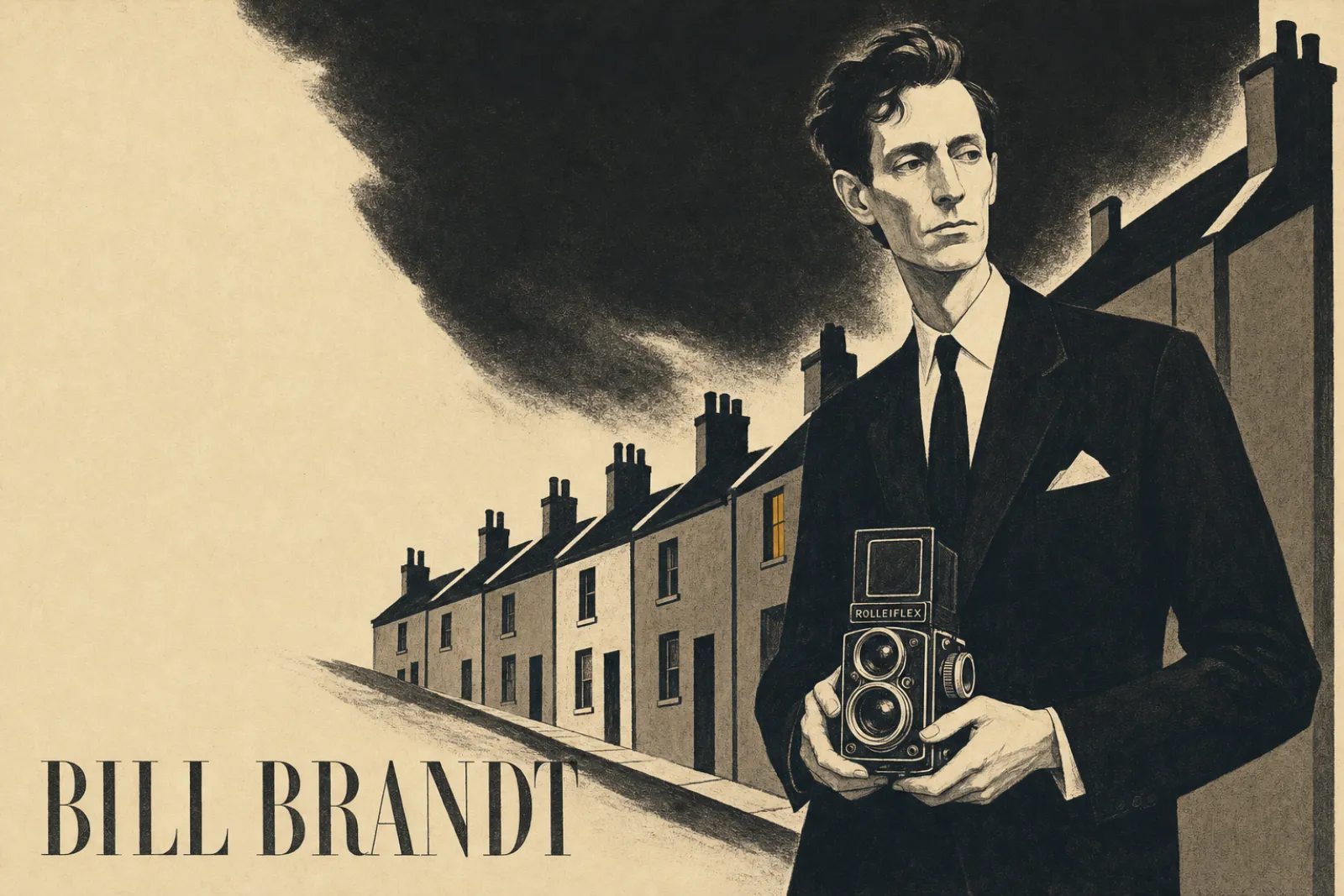
Bill Brandt (1904 to 1983) was the most widely admired British photographer of the twentieth century. He was born in Hamburg, settled in London in the 1930s and worked there for the rest of his life. He photographed the English class system, the wartime city, writers and painters, bleak landscapes and the nude. He is known above all for dark, hard, high contrast prints and for nudes bent out of shape by a very wide lens.
Brandt was already photographing in Vienna in the late 1920s. In 1930 he spent time in the Paris studio and darkroom of Man Ray, and the Surrealist taste for the strange inside the ordinary stayed with him. His book on London after dark followed the example of Brassaï, whose book on Paris at night had appeared a few years earlier. Brandt never treated the camera as a neutral recorder. He posed people, cropped hard, combined negatives and reprinted old pictures in a new style when his taste changed.
An outsider looking at the English
Brandt’s father was British and his mother German. He caught tuberculosis as a young man and spent a long period in a sanatorium at Davos in Switzerland before going to Vienna. In later life he played down his German birth and let people believe he had been born in south London. That position, half inside and half outside, shaped his first subject: how the English lived.
The English at Home (1936) set rich and poor side by side. A page showing a dinner table in a large house might face a page showing a miner’s family. A Night in London followed in 1938. Brandt worked with a Rolleiflex, a twin lens camera that makes square negatives, and he did not wait for scenes to happen. Family and friends, including his brother Rolf, acted parts in pictures that look like chance observations. In 1937 he went north and photographed towns hit by the Depression, among them Jarrow and Halifax.
From the late 1930s he was a regular contributor to the magazines Lilliput, Picture Post and Harper’s Bazaar. In November 1940 the Ministry of Information commissioned him to photograph Londoners sleeping in Underground stations during the Blitz. He made the shelter pictures over about a week, again with the Rolleiflex.
How do you build a set of pictures about how people live? Documentary photography covers choosing a subject, gaining access and shaping a story.
After the war: writers, moors and a police camera
When the war ended Brandt turned away from social reporting. He photographed the places connected with English writers and published them as Literary Britain in 1951. He made portraits of artists and authors for magazines. And he began the long series of nudes that became his best known work.
The nudes came out of a piece of equipment. In 1945 Brandt bought an old Kodak camera in a second hand shop in Covent Garden. It was a wooden plate camera with a very wide lens, built so that police staff without training could record a crime scene. Brandt found that it showed rooms and bodies in a way the eye never does. Near things grew huge and far things shrank. He used it first for nudes in London interiors, then on the beaches of southern England and France. The results were published in 1961 as Perspective of Nudes.
For later portraits he used a Hasselblad with a superwide lens that took in an angle of about 90 degrees. The collected book Shadow of Light appeared in 1966, and the Museum of Modern Art in New York gave him a retrospective in 1969.
Why does a wide lens stretch what is close to it? Perspective distortion explains that the effect comes from camera distance, and how to control it.
How Brandt made a picture hit hard
Brandt’s pictures were finished in the darkroom, and that is the first thing to learn from him. He treated the negative as raw material.
- He printed for contrast. The early prints have a full range of greys. From about the start of the 1950s he printed much harder, pushing shadows to solid black and light areas to bare white. A row of houses becomes a black wall, a path becomes a white line. The guide to contrast in photography shows how that choice changes what a picture means.
- He cropped under the enlarger. His view of Hadrian’s Wall is a section taken from a larger negative. He looked for the strongest shape inside the frame and threw the rest away. The same thinking applies to any file today: see how to crop photos.
- He designed for the printed page. Most people saw his work in magazines and books, so he built pictures from large, simple blocks of tone that survive small reproduction.
- He got close with a wide lens. In the nudes a part of the body sits very close to the camera and fills much of the frame, while a room or a beach recedes behind it. The body reads as a rounded, sculptural form. The page on using a wide-angle lens covers the same move of putting something very near the front of the frame.
- He staged and combined. In a view of the Thames in fog, made about 1935, he added a seagull from another negative. He asked relatives to play roles. He did not think of this as cheating, because the aim was a picture that felt true, not a record of one instant.
- He worked in the dark. The night streets and the wartime blackout suited a photographer who liked deep shadow. The night photography guide covers the long exposures that such scenes need.
Brandt’s portraits make a useful contrast with those of Arnold Newman, who was working at the same time. Both placed sitters in a setting. Newman arranged the setting to explain the sitter’s work. Brandt used the wide lens and the hard print to make the setting uneasy, so that a painter on a hill under a street lamp looks like a figure in a dream.
Want to control tone in a monochrome picture the way Brandt did? Black and white photography covers shooting and editing for strong blacks and clean whites.
Photographs to look for
- Parlourmaid and Under-Parlourmaid Ready to Serve Dinner (1930s). Two servants in uniform wait by a table laid for dinner. Notice that the picture is about the people who serve the meal, not the people who will eat it, which is the theme of his first book in one frame.
- Coal-Searcher Going Home to Jarrow (1937). A man pushes a heavily loaded bicycle up a steep path after searching the slag heaps for coal. In the hard, high contrast prints the figure and the ground are reduced to a few shapes, which makes the scene bleaker than a detailed print would.
- Elephant and Castle Underground Station shelter (1940). People crowd a station platform and try to sleep, with their belongings hung on the wall. The picture is quiet where a news photograph of the Blitz would be loud.
- Top Withens, West Riding, Yorkshire (1945). A farmhouse on the moors near Haworth, long associated with Emily Brontë’s Wuthering Heights, set against a dramatic sky. Look at how much of the mood comes from the sky and how little from the building.
- Nude, East Sussex Coast (1950s). Several pictures carry this title. A part of the body, in one case a bent elbow, lies on a stony beach very close to the wide lens and turns into an abstract, sculptural shape.
- Francis Bacon on Primrose Hill, London (1963). The painter stands at the lower left of the frame, looking down, with a lit street lamp and autumn trees behind him. The superwide lens makes the hill sweep away behind him in steep perspective.
Curious about the open land in Brandt’s later work? Landscape photography covers light, weather and composition outdoors.
Try this: one object, three distances, one hard print
This takes about 15 minutes with a phone or any camera with a wide lens. On a phone, use the widest lens it has.
- Ask someone to rest a hand on a table, a wall or the ground, with a room or an open view behind it. Your own hand works if nobody is free.
- Take one picture from two metres away. Take a second from half a metre. Take a third with the lens as close as it will focus, so the hand fills at least a third of the frame.
- Keep the background sharp in all three. Do not use portrait mode.
- Convert the closest picture to black and white. Raise the contrast until the darkest areas are solid black and the brightest have almost no detail.
- Crop to the strongest shape. Compare the result with the first picture and note what changed: scale, mood, and how much the hand still looks like a hand.
Questions people ask about Bill Brandt
Was Bill Brandt British or German?
He was born Hermann Wilhelm Brandt in Hamburg in 1904, to a British father and a German mother. He moved to London in the 1930s, spent his career there and died there in 1983. He later disowned his German background and said he had been born in south London.
What camera did Bill Brandt use for his nudes?
He used a second hand wooden Kodak plate camera with an extremely wide lens, bought in Covent Garden in 1945. It had been designed for police photographers to record crime scenes. For later work he also used a Hasselblad with a superwide lens.
Why are Bill Brandt’s photographs so dark and contrasty?
It was a printing decision. His prints of the 1930s and 1940s are softer, with more grey. From around the early 1950s he chose to print with strong blacks and whites, and he reprinted earlier negatives in the same hard style.
What are Bill Brandt’s most important books?
The English at Home (1936), A Night in London (1938), Camera in London (1948), Literary Britain (1951), Perspective of Nudes (1961) and Shadow of Light (1966). The last is a collection covering his whole career.
Brandt is one of the names in the A to Z of photographers, and he is quoted on the photography quotes page.