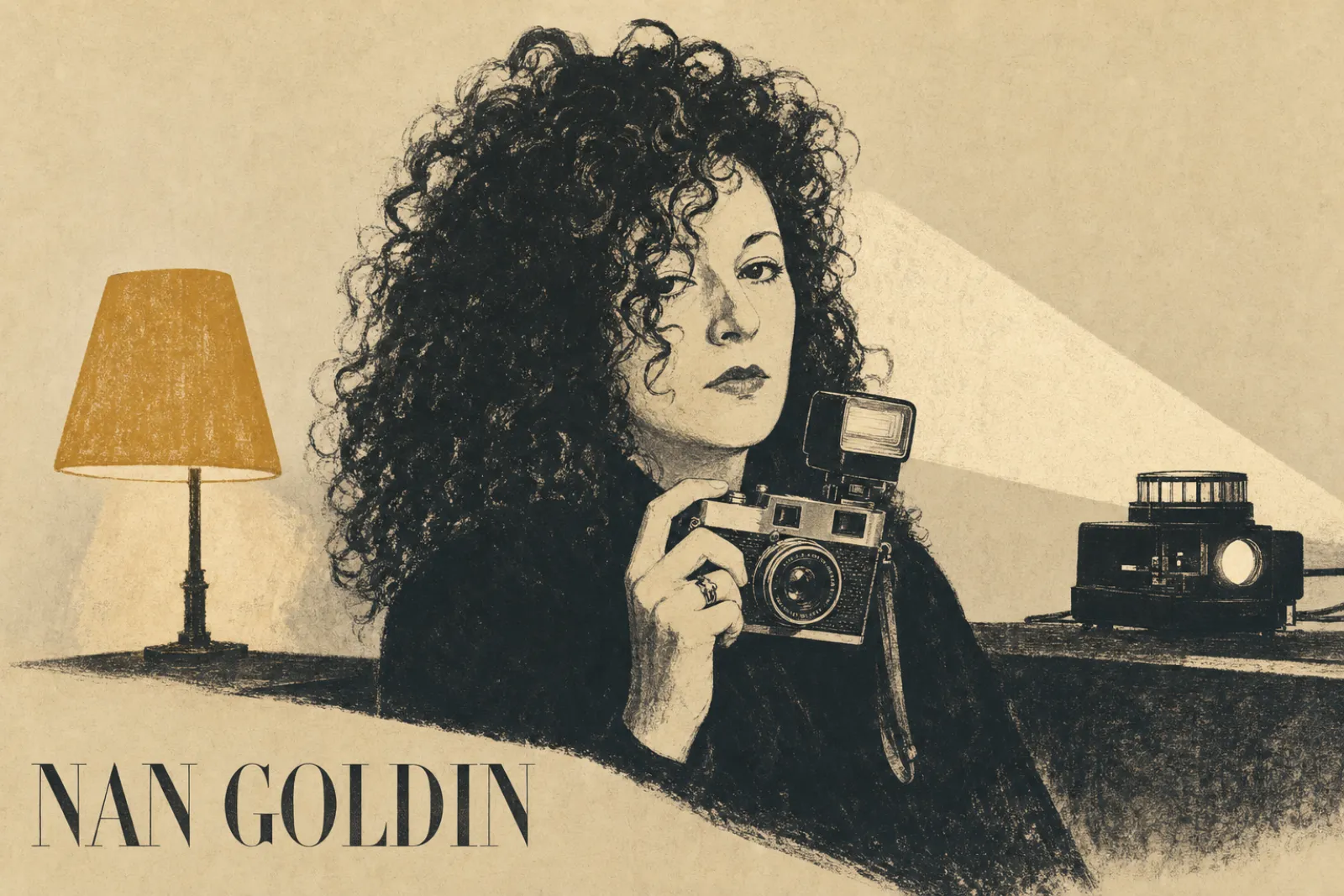
Nan Goldin is an American photographer, born in 1953, who photographed her own life and the lives of her friends in Boston, New York and Europe from the early 1970s onward. She worked in colour, mostly indoors and often with flash, and showed the pictures as slideshows set to music. She is known above all for The Ballad of Sexual Dependency, a slideshow that also became a book in 1986.
Goldin came to photography as a teenager and found her models in books and classrooms. As a student she saw the portraits of August Sander and the work of Lisette Model, whose class she attended in 1974, and Larry Clark’s 1971 book Tulsa. At art school in Boston she studied alongside David Armstrong, Philip-Lorca diCorcia and Mark Morrisroe. What set her apart from the documentary tradition she had studied was her position. She was not a visitor reporting on a community. She photographed the people she lived with, and they were also her first audience. In 1991 she curated an exhibition that placed work by Robert Mapplethorpe beside that of David Armstrong and others.
A Polaroid at school, then a first show in Boston
Goldin was born in Washington, D.C., and grew up in Massachusetts, in Swampscott and then Lexington. Her older sister Barbara died in 1965, when Goldin was eleven, and Goldin later linked her need to keep a record of the people around her to that loss. She left home in her early teens.
At sixteen she enrolled at Satya Community School in Lincoln, Massachusetts. Polaroid had donated cameras to the school, and a member of staff introduced her to photography there. She went on to evening classes at the New England School of Photography and then to the School of the Museum of Fine Arts, Boston.
Her first solo exhibition was held in Boston in 1973. Its subject was the city’s gay and transgender community, whose members were her friends. The approach was already in place: no assignment, no outsider’s distance, and pictures of people who knew and trusted the person holding the camera.
Is this documentary photography or a diary? Documentary photography sets out how the genre handles access, trust and ethics, which helps in placing her work.
New York and The Ballad of Sexual Dependency
Goldin moved to New York after art school, in the late 1970s, and lived in the downtown world of clubs, bands and artists. From 1979 to 1986 she photographed that world from the inside: friends, couples, parents and children, performers, street scenes, and herself. The pictures deal frankly with adult relationships, dependency and drug use, and with the damage those could do.
She showed the pictures as projected slides. An early showing took place at the Mudd Club in New York, at first with no soundtrack and no fixed order. In the early 1980s she presented the slides in bars and clubs, added music and settled the sequence with increasing care. By the time the work was complete it ran to several hundred slides in about 45 minutes, each on screen for a few seconds, set to songs by artists ranging from the Velvet Underground and Nina Simone to Maria Callas. The title comes from a song in Bertolt Brecht’s The Threepenny Opera.
The slideshow was screened at the Whitney Biennial in 1985, and Aperture published the book in 1986. The Museum of Modern Art in New York presented it in 2016 and 2017.
After the Ballad: loss, retrospectives and protest
The years that followed were marked by HIV and AIDS, which bore heavily on the world she had photographed. In 1989 Goldin curated Witnesses: Against Our Vanishing at Artists Space in New York, an exhibition about the epidemic. The Other Side, shown as a slideshow and published as a book, appeared in 1993. Her retrospective I’ll Be Your Mirror opened at the Whitney Museum of American Art in 1996 and toured Europe, and a second retrospective was organised by the Centre Pompidou in Paris in 2001. In 2005 she premiered Soeurs, Saintes et Sibylles in Paris, her first installation for three screens. She received the Hasselblad Award in 2007.
In 2017 Goldin spoke publicly about her recovery from dependence on a prescription opioid painkiller. She founded the group P.A.I.N. to campaign against the Sackler family, owners of the drug’s maker, and against the museums that had accepted their donations. The group staged protests at the Metropolitan Museum of Art in 2018 and at the Guggenheim Museum and the Louvre in 2019. Laura Poitras’s 2022 documentary All the Beauty and the Bloodshed, which follows both her life and the campaign, won the Golden Lion at the Venice Film Festival.
How the pictures are made to work
Closeness comes from the relationship, not the lens. The people in the pictures are relaxed, distracted or upset in front of the camera because the photographer was part of the household. That cannot be copied with equipment. It can be copied by photographing the people already in your life, over years.
Flash, indoors, at night. Much of the Ballad was shot inside, after dark, with flash. Flash fired from the camera position lights the nearest person hard and lets the room behind fall darker. It is a light most guides teach you to soften. In a diary of real evenings its bluntness reads as honesty. The guide to flash photography explains on-camera flash and why it looks the way it does, and balancing flash and ambient light shows how a slower shutter keeps the room’s own glow.
No flash to hand in a dim room? Low light photography covers what ISO, aperture and shutter speed can do before you need one.
Colour left as found. Goldin’s colour is intense, and it belongs to real interiors. A room lit by several kinds of lamp gives several colour casts at once, and a picture can keep them instead of correcting them. The section on mixed light in the white balance guide describes that choice.
Slides instead of prints. She turned to slides to avoid darkroom printing. The choice shaped the work. Slide film gives a finished positive image with strong colour and no printing stage, and a tray of slides can be reordered every night. Exhibition prints of her pictures were made as Cibachromes, a process for printing directly from slides. Film stocks compared explains how slide film differs from negative film.
Sequence and sound. No single frame carries the Ballad. Pictures are grouped loosely by theme, such as couples, women, mothers and children, and bars and parties, and each stays on screen for only seconds, so that they add up to one long impression. The music supplies mood and sometimes comment.
How do you put pictures in an order that says something? How to create a photo essay covers editing and sequencing, and photo book design does the same for the printed page.
Herself in the frame. Goldin photographed herself in the same light and at the same moments as everyone else, including at her worst. The page on self-portrait photography covers the practical side. Her titles are plain too: first names, a place, a year, in the manner of a caption written on the back of a family print.
Works to look for
- The Ballad of Sexual Dependency (1979 to 1986; book 1986). See it as a slideshow if you can, since that is its first form. Notice how pictures of different people in different years are placed together so that they seem to answer each other.
- Nan and Brian in Bed, New York City (1983). The cover image of the book. It is a double portrait in which the photographer is one of the two people, which states the terms of the whole project.
- Greer and Robert on the Bed, NYC (1982). Part of the Ballad. Look at the distance between the two figures and at what the room’s light does to the colour.
- Nan One Month After Being Battered (1984). A self-portrait made a month after she was assaulted, and described as the centre of the Ballad. She applied to herself the same direct record she kept of others.
- Misty and Jimmy Paulette in a Taxi, NYC (1991). From The Other Side. Two friends are photographed in the back of a taxi. Ask who decided how they would look in the picture, the sitters or the photographer.
- Self-Portrait on the Train, Germany (1992). Made the year after she went to Berlin on an artists’ residency. Compare the light on her here with the light in the New York interiors.
Try this: twelve frames of one evening at home
Allow 20 minutes on an ordinary evening with the people you live with, or with one friend who agrees to it. Tell them what you are doing first.
- Use a phone or camera at its normal lens, not zoomed. Stay within arm’s length or two of the person.
- Do not move lamps, tidy the room or ask anyone to pose. Photograph what is going on: cooking, talking, a phone call, someone sitting alone.
- Take six frames with the room’s own light and six with the flash on.
- Include one frame of yourself, in a mirror or at arm’s length, in the same room and the same light.
- Afterwards choose five and put them in an order. Title each with a first name, the place and the year.
Look at what the flash did to faces and backgrounds, and at whether five ordinary frames in sequence say more than the best single one. Show the set to the people in it before anyone else.
Questions people ask about Nan Goldin
What is The Ballad of Sexual Dependency?
It is a slideshow of several hundred colour photographs of Goldin, her friends and her partners, taken from 1979 to 1986 and shown with a soundtrack of songs. It runs for about 45 minutes. A book version with a selection of the pictures was published by Aperture in 1986.
Why did Nan Goldin show her photographs as slideshows?
She worked with slides to avoid darkroom printing, and she first showed them in clubs and bars to the friends who appeared in them. Projecting them let her change the order and the music from one showing to the next.
Where did Nan Goldin study photography?
She was introduced to photography at Satya Community School in Lincoln, Massachusetts, took evening classes at the New England School of Photography and then studied at the School of the Museum of Fine Arts, Boston. Her first solo exhibition was in Boston in 1973.
What is the film All the Beauty and the Bloodshed about?
It is a 2022 documentary directed by Laura Poitras about Goldin’s life and work and about her campaign with the group P.A.I.N. against the Sackler family’s museum donations. It won the Golden Lion at the Venice Film Festival.
Goldin is one of many photographers profiled in the A to Z of photographers.