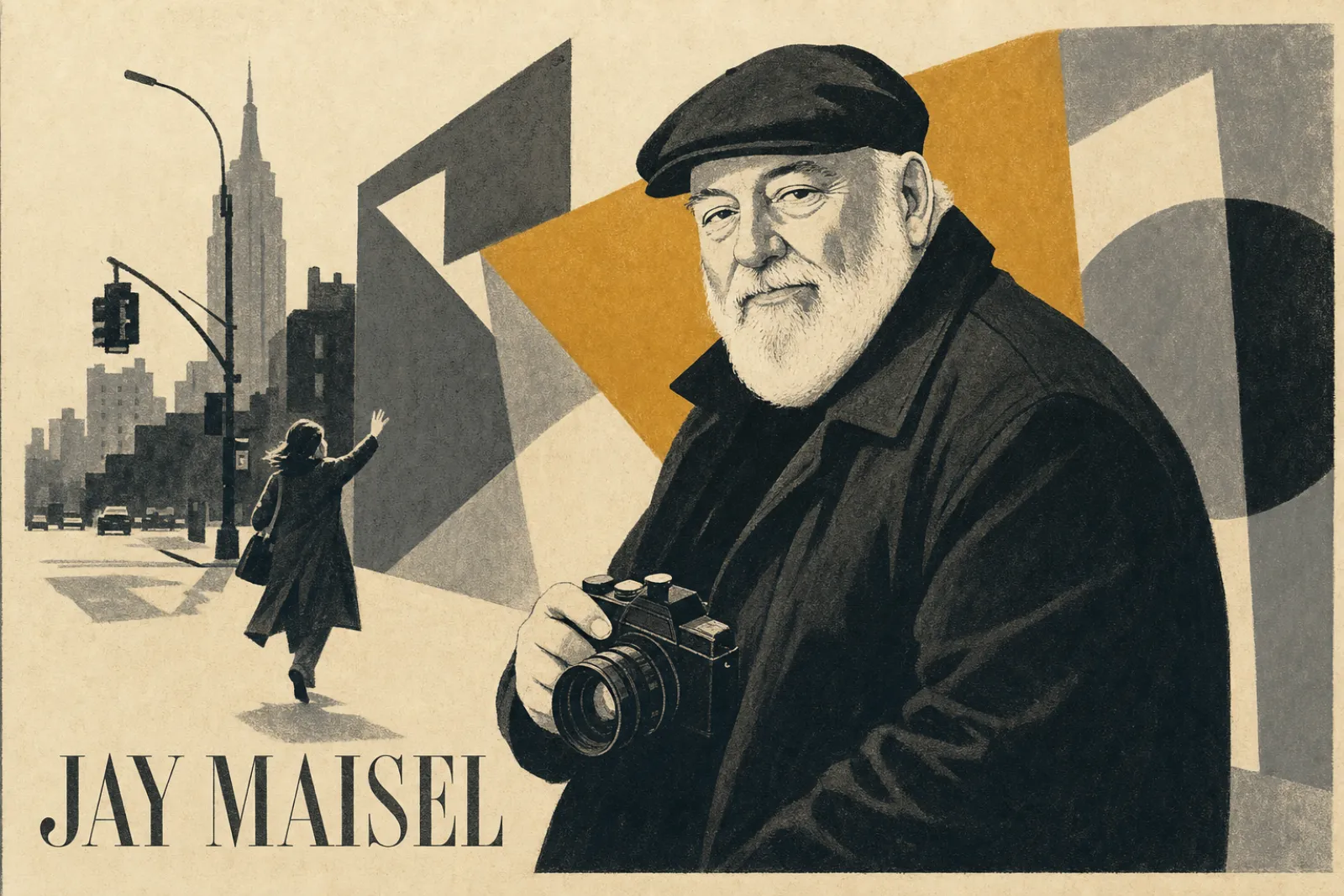
Jay Maisel (1931 to 2026) was an American photographer who worked in New York for more than sixty years. He trained as a painter, became a photographer in 1954, and spent four decades shooting for magazines, advertisers and corporations before turning wholly to personal work. He made the cover photograph for the Miles Davis album Kind of Blue, and he is remembered for color pictures of ordinary streets built on three things: light, gesture and color.
Maisel started in black and white and went over to color in the late 1950s, and color stayed at the centre of his work from then on. His circle was the New York of working professionals: when he joined the American Society of Media Photographers in 1955, his membership was proposed by Garry Winogrand. Later he became a teacher and mentor himself. Stephen Wilkes, who knew him for more than fifty years, directed the documentary film Jay Myself about him.
A painter’s training under Josef Albers
Maisel was born in Brooklyn on January 18, 1931. He studied painting and graphic design at Cooper Union in Manhattan and then went to Yale University, where he took a degree in painting in 1953. At Yale he studied color with Josef Albers, the painter and teacher whose course treated color as a matter of relationships: a color looks different depending on what sits next to it.
That idea stayed with him. When he began photographing in 1954, he brought a painter’s habits to the camera. He built pictures from color, shape and contrast, and then waited for a moment worth having inside them.
How do neighbouring colors change each other in a photograph? Color in photography covers harmony, contrast and using one color to direct attention.
Forty years of assignments and one album cover
Maisel made his living as a freelance photographer for magazines, advertising agencies and corporations. The range was wide. He shot five swimsuit covers for Sports Illustrated. He photographed the first two covers of New York magazine in 1968, the first of them a view of the skyline. He worked for the company United Technologies for twelve years. He photographed Marilyn Monroe.
The picture most people have seen is the cover of Kind of Blue, the Miles Davis album released in 1959. It shows Davis playing the trumpet, surrounded by deep blue shadow, with a narrow shaft of light on the instrument. It is a portrait made almost entirely of darkness and one color, which is a fair summary of how Maisel thought.
His work was honoured by his own profession. He received the Saint-Gaudens Medal from Cooper Union in 1977, the Infinity Award for applied photography from the International Center of Photography in 1987, a place in the Art Directors Club Hall of Fame in 1995 and a lifetime achievement award from the American Society of Media Photographers in 1996. He was inducted into the International Photography Hall of Fame in 2020.
In the 1990s Maisel stopped taking commercial assignments and photographed only for himself. By one estimate he made about four million photographs in his career.
How does a photographer earn a living from assignments like these? Commercial photography as a career describes the specialties, clients and pricing.
The bank on the Bowery
In 1966 Maisel bought the former Germania Bank building at 190 Bowery in lower Manhattan for $102,000. It had been built in 1898 and had six floors and 72 rooms. He lived and worked there for about fifty years, using it as home, studio, archive and classroom. He sold it in 2015 for $55 million.
The building matters to the photographs because of how he used the neighbourhood around it. His personal work was made on ordinary streets, of ordinary things. He believed that a fire escape, a puddle or a stranger crossing the road could hold a picture as well as any grand subject. He also photographed the site of the World Trade Center two weeks after the attacks of September 11, 2001.
Maisel died in New York in August 2026, aged 95.
Light, gesture and color: how the pictures work
Maisel taught for decades, in workshops and lectures, and he reduced his method to three words that also became the title of one of his books. Each names something to look for before raising the camera.
- Light. The light comes first, and it is often scarce: a single shaft on a trumpet, coal miners silhouetted underground, the Statue of Liberty seen through mist. The guides to silhouette photography and backlighting explain how to expose for light that comes from behind the subject.
- Gesture. This is the moment he waited for once the frame was set: the lean of a walker, the tilt of a head, the way a player holds an instrument. It is what turns an arrangement of light and color into a picture of something happening.
- Color. Following Albers, a color is judged by its neighbours. On the Kind of Blue cover one color fills most of the frame and a small lit area carries the picture.
- A long lens to select. Maisel preferred telephoto focal lengths on the street. He said a telephoto gave him more control over what was in the picture, while a wide lens made the photographer answer for a great deal of extra space. Shooting from farther back also draws the background up behind the subject, an effect explained under lens compression.
- Little equipment. He used Nikon cameras all his life. In his later years he reduced his kit to one body and a single 28 to 300mm zoom. He left focus and exposure to the camera, and switched to manual only when the camera did not give him what he wanted.
- Reacting, not hunting. He described himself as reactive. He did not go out with an idea to illustrate. He went out, stayed alert and let the picture announce itself. He preferred to speak of framing, not composing: choosing where the edges go around something already there.
Want a structure for walking and looking the way Maisel did? The photo walk guide gives routes, themes and exercises for photographing on foot, and street photography covers settings and conduct in public.
Photographs and books to look for
- Miles Davis, cover of Kind of Blue (1959). Notice how little of the frame is lit. The blue is not a background behind the musician. It is most of the picture, and the lit trumpet is the single accent.
- First covers of New York magazine (1968). The first was a view of the skyline. Look at how a subject as large and familiar as a city is reduced to shape, light and color.
- Coal miners underground. Figures reduced to outlines against light. Look at how the shape of each body, its gesture, tells everything that the missing detail does not.
- The Statue of Liberty in mist. A subject photographed countless times, made new by weather. The lesson is to return to a familiar place when the light is unusual.
- Light on America (1986). A book published by United Technologies, the company he photographed for over twelve years. Read it as a catalogue of kinds of light.
- Jay Maisel’s New York (2000) and Light, Gesture, and Color. The first is given to his home city. The second is named for the three ideas at the centre of his teaching.
Try this: one block, three lists
Allow 20 minutes and use one street block close to home. A phone is fine.
- For the first six minutes photograph only light. Ignore what the objects are. Shoot patches of sun, reflections, glowing edges and shadows.
- For the next six minutes photograph only color. Find one strong color and fill at least three quarters of the frame with it. Then find a frame where a small spot of a second color sits inside the first.
- For the next six minutes photograph only gesture: a person in mid step, a bent tree, a leaning sign, a dog pulling on a lead. The subject can be anything with a characteristic attitude.
- In the last two minutes, look for a single frame that has all three.
- At home, sort the frames into three groups and see which of the three you found easiest. The hardest one is the one to practise.
Unsure how to read the light on an ordinary street? Natural light photography describes how sun, shade and overcast sky each behave through the day.
Questions people ask about Jay Maisel
Who took the cover photograph of Kind of Blue?
Jay Maisel made the photograph of Miles Davis used on the cover of Kind of Blue, released in 1959. It is his most famous photograph.
What did Jay Maisel mean by light, gesture and color?
It was Maisel’s summary of what a photograph needs. Light is the quality and direction of illumination, gesture is the telling movement or attitude of the subject, and color is treated as a relationship between neighbouring areas. He used the three words as the title of a book.
What was 190 Bowery?
It was the former Germania Bank building in lower Manhattan, six floors and 72 rooms. Maisel bought it in 1966 for $102,000, lived and worked there for about fifty years, and sold it in 2015 for $55 million.
What camera did Jay Maisel use?
He used Nikon cameras throughout his career. In his later years he worked with one camera and a 28 to 300mm zoom lens.
Maisel is one of many photographers profiled in the A to Z of photographers.