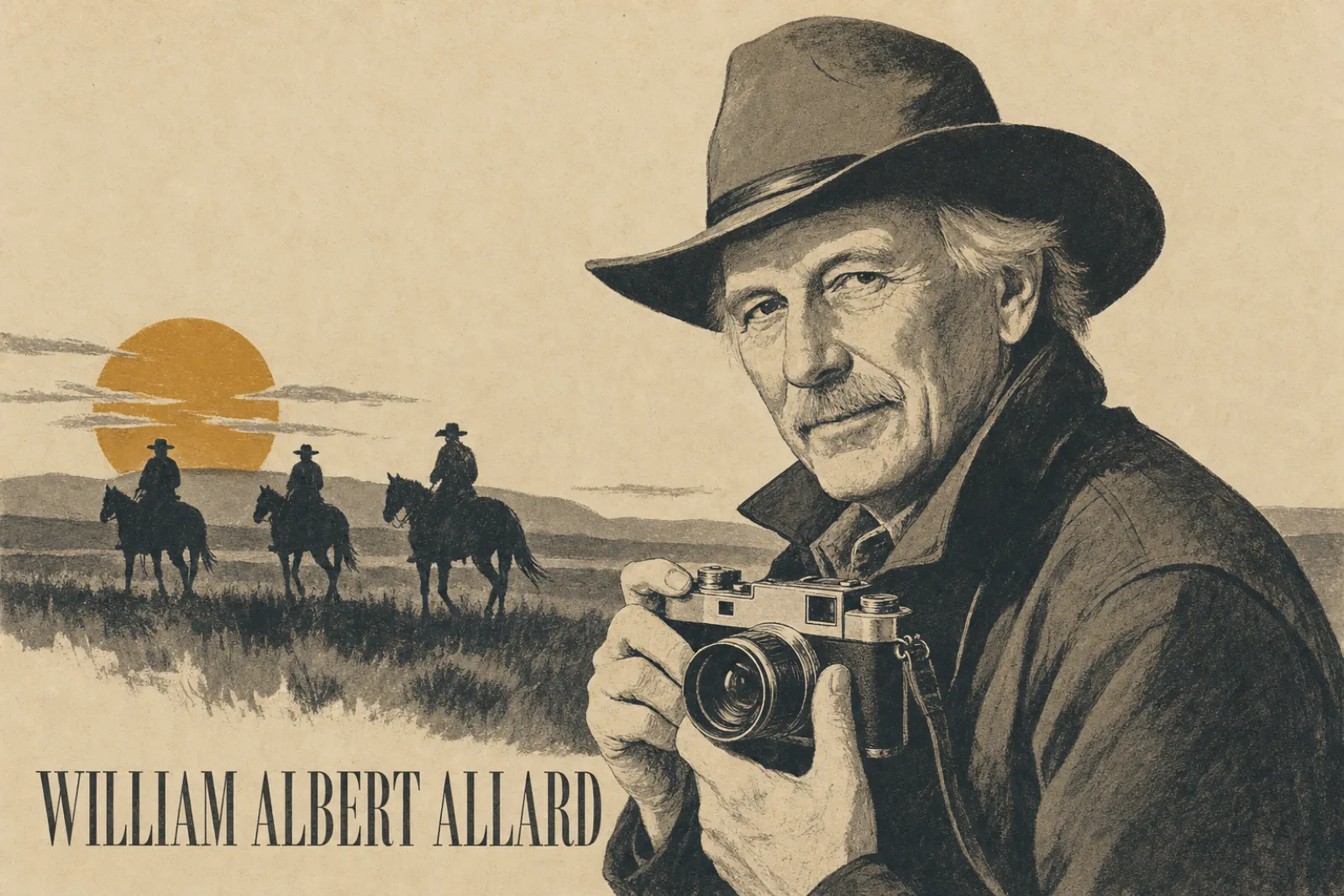
William Albert Allard (born 1937) is an American photographer and writer who contributed to National Geographic for five decades, beginning in 1964. He photographed people: Amish farmers, cowboys in the American West, Basque villagers, families in highland Peru, the streets of Paris. He is known as one of the few photographers of his generation whose whole professional body of work was made in color.
Allard came into photography through writing. He studied at the Minneapolis School of Fine Arts and the University of Minnesota hoping to be a writer, and he went on to write the text for many of his own stories. He belongs with the magazine photographers who showed that color could carry serious work about people, at a time when most documentary photographers still chose black and white. Ernst Haas is another photographer who made that case, and Sam Abell and Steve McCurry made it in the pages of the same magazine. Allard was also a contributor to the Magnum Photos agency for a time.
An intern, a first roll of color film and the Amish
Allard was born in Minneapolis, Minnesota, in 1937, the son of a Swedish immigrant. He graduated from the University of Minnesota in 1964 with a double major in journalism and photography. That year he went to Washington, D.C., and met Robert Gilka, the director of photography at National Geographic, who was considering him for an internship. Gilka asked how he felt about color. Allard said it did not bother him. He had never put a roll of color film in a camera. He went home to Minneapolis and loaded one, and he never went back to black and white for his professional work.
As an intern he was sent to photograph the Amish of Pennsylvania, a private religious community. The pictures ran in August 1965 in an article titled Amish Folk: Plainest of Pennsylvania’s Plain People. They were close, quiet and made inside people’s daily lives, and they are described as a landmark in how the magazine’s photography developed. One picture from the set was later sent into space aboard the Voyager 1 probe.
Allard resigned from the staff in 1967 after two years. He felt he could not take on the issues of the day, such as the Vietnam War, in the way that seemed possible at magazines like Life. He kept working for National Geographic as a freelance, and over the following decades he was at different times a staff, freelance and contract photographer and writer for it.
What turns a set of pictures into a story? How to create a photo essay covers planning, shooting for the essay and putting the pictures in order.
Cowboys, the Basque country, Peru and Paris
The American West became his longest subject. He photographed ranch hands, cow camps and small-town bars in Montana, Nevada and Arizona through the 1970s, and gathered the work in his first book, Vanishing Breed (1982). The book is a photographic essay on what remained of the old American West. It was nominated for the American Book Award and received the Leica Medal of Excellence.
Other long projects followed the same pattern of returning to one group of people. He photographed the Basque country, beginning in the 1960s, and published the work as A Time We Knew (1990). He photographed everyday life in the highlands of Peru, fashion models, Sicily and the streets of Paris. His other books include The Photographic Essay (1989), Time at the Lake: A Minnesota Album (1997), Portraits of America (2001), the retrospective Five Decades (2010) and Paris: Eye of the Flâneur (2017).
The work sits between documentary photography and travel photography. The places are far apart, but the pictures are about the same thing each time: one person or a few people, seen close, in the place where they live or work.
His awards include the Outstanding Achievement Award from the University of Minnesota (1994), the Joseph A. Sprague Memorial Award from the National Press Photographers Association (2002) and the Figaro Magazine Lifetime Achievement Visa d’or Award (2019).
How Allard’s pictures are made to work
He stayed until he was trusted. Allard said that some of his best pictures were given to him: once people accepted his presence and trusted him, they gave him the pictures. His publisher described a style that depended on entering people’s homes and winning their confidence so that he could catch unguarded moments. The method is slow. It means days with the same people before the camera matters. He spoke of needing to live in the middle of his story.
How do you get that close to someone you have just met? Street portraits covers how to ask, where to stand and what to do once they say yes.
He walked and waited for luck. Allard called himself a street shooter who found pictures by wandering, and he gave serendipity a large part in his work. Wandering is not aimless. It means being in a likely place, camera ready, long enough for something to happen. The page on timing, anticipation and gesture explains how to prepare for a moment you cannot plan.
He moved by inches. He said that the difference between a good picture and an excellent one is often a matter of inches. A half step left clears a hat from a doorframe. A slightly lower camera puts a face against a plain wall. Small moves decide how the subject separates from the background.
He watched the edges. Allard looked for what was happening at the edges of a scene and not only at its center. The main event is where everyone points a camera. The person watching from the side, the hand on a bar, the figure in a doorway behind are often the better picture. Building a frame from foreground, midground and background is the practical form of this habit.
Color was part of the structure. His pictures are described as painterly, with rich palettes and fine detail. The color is rarely loud. A red shirt, a green wall or warm lamplight is placed like any other element of the composition and sets the mood of the frame. The guide to color in photography covers how a single color can hold a picture together.
He wrote. Because he wrote as well as photographed, Allard thought in stories and not single frames. A picture had to add something the words could not, and the reverse. That discipline is the heart of visual storytelling.
Is it fair to photograph people in their private lives? Photography etiquette and ethics sets out consent, cultural sensitivity and where the lines are.
Photographs to look for
- The Amish pictures (published 1965). His first assignment. Look at how close the camera is to people who do not seek attention, and how calm they are. Access like that comes from time spent, not from a long lens.
- Basque Girls Running Home, Béhorléguy, France (1967). An early picture from the Basque country. The title describes the action. Look at how movement is caught in a village setting without losing the place.
- Henry Gray, rancher, Arizona (1970). A portrait from the western work. Study what the face, the clothes and the setting together say about a working life.
- Buckaroo T.J. Symonds, IL Ranch cow camp, Nevada (1979). A portrait of a working cowboy from the Nevada ranch pictures. Look at how much of the job is told by what he wears and where he stands.
- Edwardo and His Dead Sheep, Peru (1981). A shepherd grieves after a car struck six of his flock. It is among Allard’s most widely known pictures. Notice how directly it faces his grief, and how little else it needs.
- Benedetta Buccellato, Sicily (1994). A later portrait. Compare its color and light with the western pictures and see how consistent his way of framing one person remained.
Try this: fifteen minutes, one person, three colors
Choose someone you know who is doing something with their hands: cooking, repairing, gardening, playing an instrument. Ask if you can photograph while they carry on.
- Use only the ambient light already there. No flash.
- For the first five minutes, do not take a picture. Stay near, talk a little, let them get back to the task.
- Look at the colors in the scene and count them. Move until the frame holds no more than three main colors. Change your position, not their room.
- Take twelve frames in the next ten minutes. Before each one, move your feet a few inches and check the edges of the frame for anything that does not belong.
- Make at least two frames where the person is not in the center and something at the edge matters.
Choose one picture. Ask whether a stranger could tell what kind of person this is and what kind of place. If the answer is yes, the trust and the small moves did their work.
Questions people ask about William Albert Allard
What is William Albert Allard known for?
He is known for color photographs of people made for National Geographic from 1964 onward, especially his work on the Amish, on cowboys of the American West and in Peru. He is regarded as a pioneer of natural, expressive color in documentary work.
Did William Albert Allard shoot only in color?
For his professional work, yes. He loaded his first roll of color film after his 1964 interview at National Geographic and worked in color from then on. He is described as one of the few photographers of his generation whose entire professional output is in color.
What books did William Albert Allard publish?
His first book was Vanishing Breed (1982), on the American West. Others include The Photographic Essay (1989), A Time We Knew (1990), Time at the Lake (1997), Portraits of America (2001), Five Decades (2010) and Paris: Eye of the Flâneur (2017).
What is the story behind his photograph of the shepherd in Peru?
The picture, made in 1981, shows a grief-stricken shepherd who lost six of his sheep when a car hit them. It was chosen for the wall of framed photographs at National Geographic’s headquarters.
William Albert Allard is quoted on the photography quotes page, and the A to Z of photographers lists others who told stories in color.