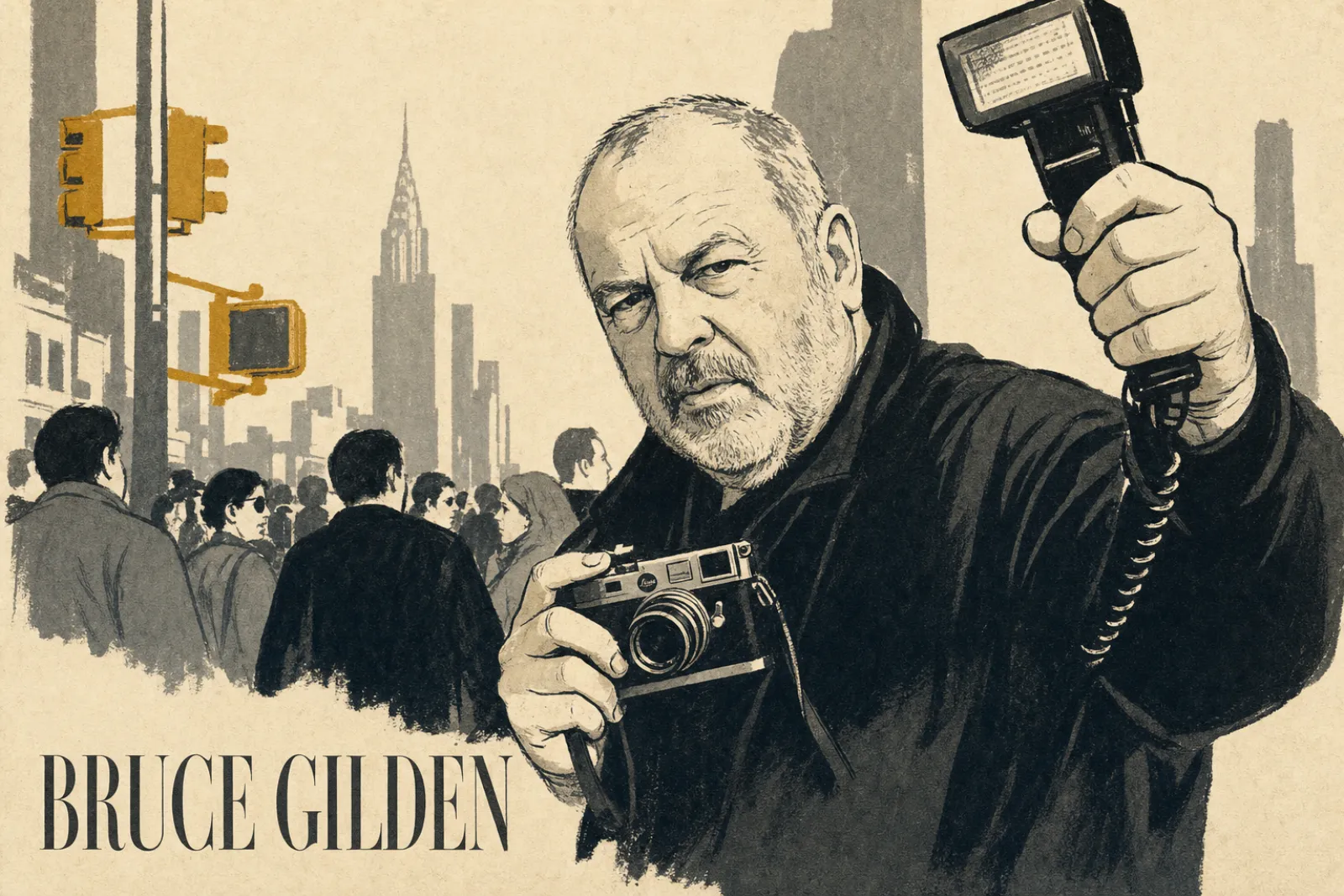
Bruce Gilden, born in Brooklyn, New York, in 1946, is an American street photographer who joined Magnum Photos in 1998. From the late 1960s he photographed people on the sidewalks of New York, and later in Haiti, Japan, Ireland and across the United States. He is known for one method above all: stepping very close to a stranger and firing a handheld flash, so that the face fills the frame in hard, sudden light.
Gilden came to photography from outside it. He studied sociology at Penn State University, lost interest and left. He considered acting. Then, in the late 1960s, he saw Michelangelo Antonioni’s film Blow-Up, whose main character is a photographer, and bought his first camera. He took evening classes at the School of Visual Arts in New York, but he is regarded as largely self-taught. His guiding idea was the one attributed to the war photographer Robert Capa, that a picture which is not good enough was not made from close enough. Gilden applied it to the street very literally, and photographers such as Joel Meyerowitz criticised the result as aggressive. That argument has followed the work ever since and is part of what a reader needs to know about it.
Coney Island, New Orleans and the sidewalks of Manhattan
His first long project was Coney Island, the beach and amusement district of Brooklyn. He began photographing there in 1969 and went back regularly until the middle of the 1980s. The pictures were published as a book, Coney Island, in 2002. From 1975 to 1982 he also photographed Mardi Gras in New Orleans.
From 1981 he worked on the streets of New York City itself. This is the work most people picture when they hear his name: candid close-ups of people on crowded pavements, in black and white, lit by flash. It was gathered in Facing New York (1992) and continued in a second New York book, A Beautiful Catastrophe.
New to photographing strangers at all? Street photography covers the gentler, more common ways of working in public, including where to stand and how to stay ready.
Haiti, Japan and Ireland
Gilden first landed in Port-au-Prince in 1984. He returned to Haiti for eleven years, and the book Haiti (1996) won the European Publishers Award for Photography. He went back again after the earthquake of 2010. His Magnum colleague Alex Webb was working in the same country in the same years in saturated color, and the two bodies of work show how differently one place can be seen.
From 1994 he photographed in Japan, supported in 1999 by a Japan Foundation artist fellowship. The book Go (2000) looks at a side of the country that visitors rarely meet, including members of yakuza crime groups and people living on the street. A project on rural Ireland and its horse racing became the book After the Off. He also worked in Russia, Romania, India, France and Portugal.
Between 2008 and 2011 he photographed the effects of home foreclosures in Florida, Detroit, Fresno and Nevada, published as Foreclosures in 2013. In the same year he received a Guggenheim Fellowship. Earlier support included fellowships from the National Endowment for the Arts in 1980, 1984 and 1992 and grants from the New York Foundation for the Arts. Gilden became a full member of Magnum in 2002. His prints entered the collections of the Museum of Modern Art in New York, the Victoria and Albert Museum in London, the Tokyo Metropolitan Museum of Photography and the J. Paul Getty Museum in Los Angeles.
From candid street pictures to portraits in color
For most of his career Gilden worked in black and white. He turned to color and to digital cameras when he was introduced to the Leica S camera during Postcards From America, a group project by Magnum photographers.
The change of tool came with a change of method. The book Face, published by Dewi Lewis in 2015, is a set of very tight color portraits: a face alone, or a figure from the waist up, always with flash. Unlike the New York street pictures, these were made with permission. Gilden talked to people first, sometimes at length, and sometimes asked them to move to a better background. Portraits made this way include people he met at state fairs in the United States and in the English West Midlands. Farm Boys and Farm Girls (2017) used the same approach with young people at state fairs. Only God Can Judge Me, published in 2018, portrayed people living in very hard circumstances. The subject matter is hard, and the photographs do not soften it.
What changes when the stranger has agreed to be photographed? Street portraits explains how to ask, what to say and how to direct someone in under a minute.
How distance and flash build a Gilden picture
Almost everything distinctive about these photographs comes from two decisions, and both can be understood without copying his manners.
- Distance. Gilden worked at arm’s length. At that range a face fills the frame, the background shrinks to fragments, and features nearest the lens look larger than those behind. The picture feels like an encounter, not an observation. He was selective, too: describing a day at a fair attended by 200,000 people, Magnum reported that he made five portraits.
- Flash off the camera. He held the flash in one hand and the camera in the other. Light that comes from somewhere other than the camera position puts shadows on the face and gives it shape. The guide to off-camera flash shows how the angle of the light changes a face.
- Flash in daylight. A flash lights a near subject far more strongly than the street behind, so the person is lifted out of the scene. This is the opposite of gentle fill flash, which is balanced to pass unnoticed. Gilden wanted the flash to show.
- Frozen gesture. A flash lasts a tiny fraction of a second, so a startled expression, a raised hand or a turning head is recorded sharply even when both people are moving. Flash photography for beginners explains why flash freezes motion.
- Preset focus. At arm’s length there is no time to focus. Working at one known distance, with focus set in advance, is the practical answer. Zone focusing describes the technique.
- Choice of person. Gilden said he looked for faces with strong features and intense eyes. The method is a kind of casting. He photographed few of the people he passed.
The cost of the method is plain. A flash fired at close range without warning startles people, and many viewers and photographers find that unacceptable. Others argue that the pictures are honest about city life in a way that polite distance is not. Both views are widely held. It is worth noting that Gilden’s own later practice moved toward asking first.
Where is the line between candid and intrusive? Photography etiquette and ethics sets out the questions about consent, dignity and photographing strangers.
Books and series to look for
- Coney Island (photographed from 1969, published 2002). The first long project. Ask of each picture how far the camera was from the person, and whether a flash was used.
- Facing New York (1992). The first New York book. Notice how the flash separates each figure from the crowd, and what the speed of the encounter does to the framing.
- Haiti (1996). Eleven years of visits. Compare how the same close, flash-lit approach reads in a place where he was a visitor instead of a native.
- Go (2000). Japan seen through people at its margins. Ask of each picture whether the person knew the camera was there, and how that changes the way the picture reads.
- Face (2015). Tight color portraits made with consent. Study how little there is in each frame besides skin, eyes and light, and how much the flash reveals.
Try this: the same face, three kinds of light
This takes 15 minutes and a willing friend or family member. Do not try it on strangers.
- Stand outdoors in open shade. Frame the person’s face so that it fills the picture from chin to hairline. On a phone, move closer instead of zooming.
- Take one frame with no flash.
- Take a second with the flash on, pointing straight from the camera.
- For the third, light the face from the side. Use a flash held off the camera if one is available. If not, have a second person hold a phone torch at arm’s length to one side and slightly below the face.
- Repeat all three from twice the distance.
- Compare the six frames. Note which light makes the face look flattest, which shows the most texture, and how the feeling of the picture changes when the camera backs away.
Questions people ask about Bruce Gilden
How did Bruce Gilden take his street photographs?
He walked crowded sidewalks with the camera in one hand and a flash in the other, stepped close to a person who interested him and fired both. The flash and the short distance account for the hard light and the startled expressions.
Did Bruce Gilden ask permission?
Not for the New York street pictures, which were candid. The later color portraits, including those in Face, were made with the agreement of the people in them, usually after a conversation.
Why is Bruce Gilden’s work controversial?
Critics, among them the photographer Joel Meyerowitz, have called the close flash method aggressive toward the people photographed. Defenders see a direct and unsentimental record of faces that are usually ignored. The disagreement is about method and consent more than about the quality of the pictures.
When did Bruce Gilden join Magnum?
He joined Magnum Photos in 1998 and became a full member in 2002.
For other approaches to the street, from quiet to confrontational, see the A to Z of photographers.