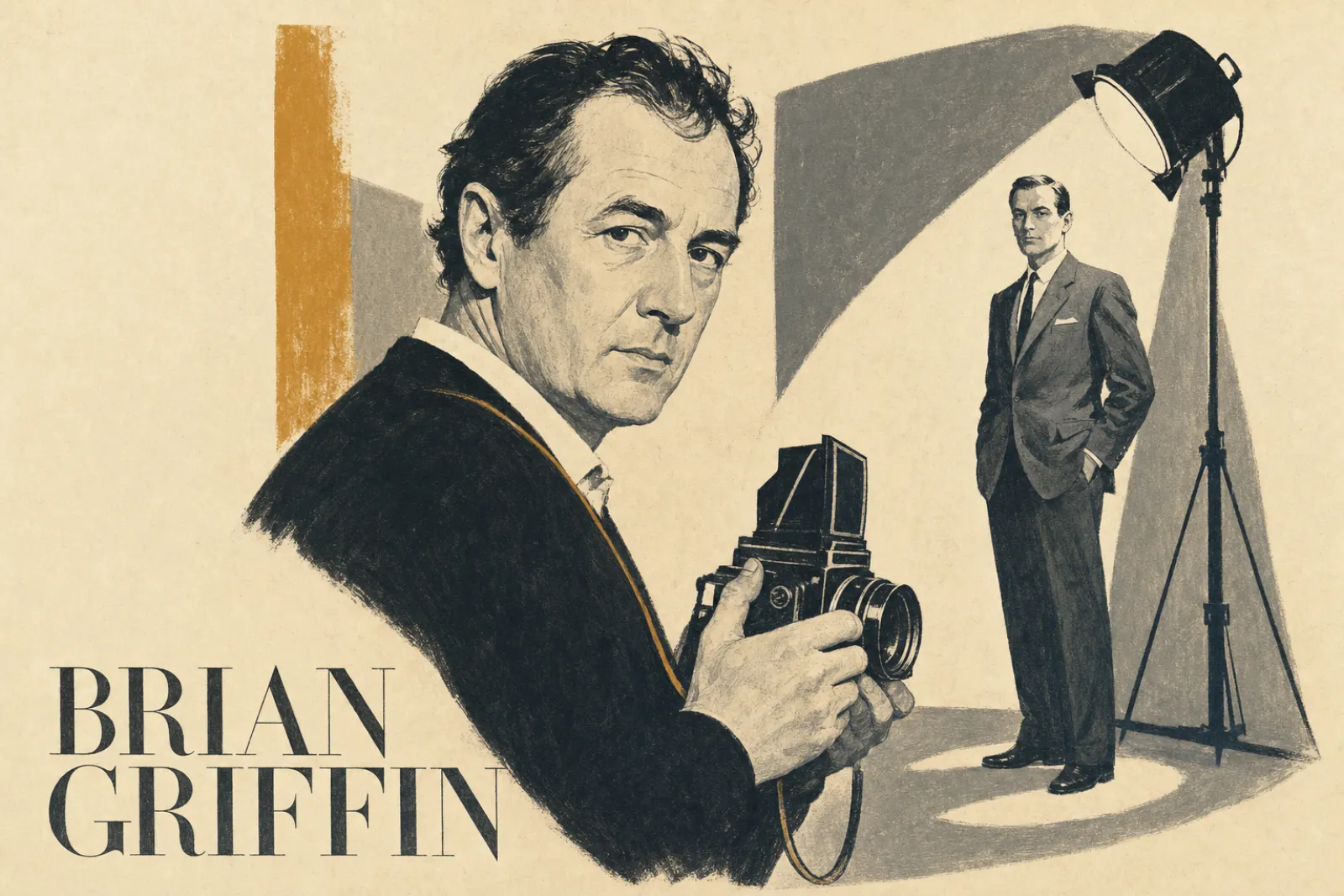
Brian Griffin (1948 to 2024) was a British portrait photographer from the industrial Midlands who worked in London from 1972. He photographed businessmen for trade magazines, musicians for record sleeves and building workers for a property developer, and he lit and staged all of them like scenes from a strange film. He is known for the cover of Depeche Mode’s album A Broken Frame and for making corporate portraiture odd and memorable.
Griffin studied photography in Manchester in the same group as Martin Parr and Daniel Meadows, and they took very different roads. Parr went toward colour documentary. Griffin went toward the lighting rig and the staged idea. His sources lay outside the photography of his day: Renaissance painting, Symbolism, German Expressionist cinema and the Surrealism that photographers such as Man Ray had brought into the medium. His executive portraits can be compared with those of Arnold Newman, who also photographed powerful people in their own settings. The comparison shows the difference: Griffin made the scene slightly absurd.
From the factory floor to Management Today
Griffin was born in Birmingham on 13 April 1948, the only child of two factory workers, and grew up in Lye in the Black Country in a small house among factories. He went to Halesowen Technical School and started factory work at 16. In 1965 a foreman suggested he join the local camera club. He then worked for British Steel as an estimator for engineering pipework. At 21 he left to study photography in Manchester, and he graduated in 1972.
He moved to London in 1972 as a freelance photographer. His first major commission came that year from the business magazine Management Today. The job was to photograph executives. Griffin made black and white portraits that were playfully subversive, turning businessmen into figures in a drama. He went on to work for Accountancy Age, Computing and Marketing. His 1974 picture of the rush hour on London Bridge is in the collection of the Victoria and Albert Museum.
In 1978 he published a small book of his own with drawings by Barney Bubbles. Power: British Management in Focus followed in 1981, the year of his first solo exhibition in London. By then he was the recognised specialist in commercial photography for the business world, and his manner had a name, Capitalist Realism.
How do you make a portrait at someone’s workplace say something about them? Environmental portrait photography covers the relationship between a person and their setting and how to direct people in their own space.
Record sleeves, Broadgate and after
Griffin also began to photograph musicians, at first for Stiff Records, where he photographed Elvis Costello and Ian Dury. In 1980 he moved his studio to Rotherhithe in south London. Over the next decade he photographed The Jam, Kate Bush, Iggy Pop, Siouxsie Sioux, Ultravox and many others. He made the cover of Joe Jackson’s Look Sharp! and the first four album covers for Echo and the Bunnymen.
He made the cover of Depeche Mode’s first album, Speak & Spell, and in 1982 the cover of A Broken Frame. The band did not appear on the front. Griffin drew on Soviet socialist realist art and on German Romanticism. The picture won a D&AD award in 1984, and in 1990 Life magazine used it on the cover of its collection of the best photographs of 1980 to 1990.
In the mid 1980s the developers of Broadgate, a large office scheme in the City of London, commissioned him to photograph any part of the project he chose. He chose the men who built it. He was mourning his father, whose death he linked to industrial pollution, and he photographed the workers as if they were knights lying in state in a cathedral. These portraits, made in 1986, became the core of the book Work, and he presented the work at the National Portrait Gallery in London in 1988. In 1989 The Guardian named him photographer of the decade, and in 1991 Work was judged the best photography book in the world at the Primavera Fotografica in Barcelona.
Around 1990 Griffin turned to directing television commercials, music videos and films, and he came back to still photography in the early 2000s. Later commissions included the teams who built the high speed rail link to St Pancras station, a series made in Iceland for an energy company, and the National Portrait Gallery’s Road to 2012 project before the London Olympics. Late books include The Black Kingdom in 2013 and Pop, his collected music photographs, in 2017. In 2015 he made Himmelstrasse, a study of the railway lines that led to Nazi death camps. He received the Centenary Medal of the Royal Photographic Society in 2013. He published more than 20 books. Griffin died in London in January 2024, aged 75.
How Griffin’s pictures are made to work
He started from the ordinary and twisted it. His subjects were mundane: managers, scientists, factory hands, builders. He kept the plain facts of the person and the job and pushed them toward comedy or toward grandeur. A construction worker became a knight. An executive became an actor in a thriller.
He lit like a film maker. Lighting was the centre of his craft. An assistant from his later years recalled that he used grids to channel light exactly where it was needed, which left a retoucher very little to do. The practical lesson is control: a narrow, directed source with shadow around it. Studio lighting setup explains lights and modifiers, direction of light shows what each angle does, and high key and low key photography covers the dark tonal range that this kind of picture depends on.
He staged openly. Nothing in a Griffin portrait pretends to be caught. People hold a position they were given, and the result is closer to a painting than to a snapshot. The portrait posing guide covers how to direct people who are not models, which is what nearly all his sitters were.
He made effects in the camera. Griffin had trained in engineering, and he said this made him exact with the arithmetic of exposure in the days of film. He used that skill to build multiple exposures in the studio. Double exposure photography explains how layered exposures are planned, and medium format photography describes the larger film that much studio portrait work of that period was made on.
He managed the sitter. The same assistant described his first skill as psychological: he got exactly what he wanted out of the person in front of him.
Where does a single hard light go to get this kind of drama? How to use off-camera flash covers positions, modifiers and one light setups.
Which art movements shaped photographers like Griffin? Photography movements and the ideas behind them explains Surrealism, the New Vision and what each one changed.
Photographs to look for
- Rush Hour, London Bridge, 1974. Commuters on the bridge, made in his first years of work for business magazines. Look at how a crowd of individuals reads as one mass.
- George Cooper, Head of Thames TV, London, 1974. One of the early executive portraits. Compare it with a conventional company portrait and list what he changed.
- A Broken Frame, 1982. The Depeche Mode cover, made without the band. Look for the two influences he named, Soviet realist art and German Romanticism.
- Carpenter, Broadgate, City of London, 1986. From the series that became Work. A building worker is given the pose and the light of a monument.
Try this: one worker, one object, one light
This takes 20 minutes, one person and one lamp.
- Ask someone to bring the one object they use most in their work: a wrench, a laptop, a whisk, a stethoscope.
- Darken the room. Use a single desk lamp, torch or flash, and narrow it with a tube of black card so it lights only a small area.
- Place the light to one side and slightly above the face. Let the far side fall into shadow.
- Give one clear instruction for a pose that is formal and still, such as holding the object across the chest. Do not ask for a smile.
- Make five frames. Between frames move only the light, a hand’s width at a time, and watch the shadows change.
- Choose the frame where the object and the face are both lit and nothing else is.
The constraint is one light and one held pose. It forces the two decisions that define a Griffin portrait: where the light falls and what the person is doing.
Questions people ask about Brian Griffin
Which album covers did Brian Griffin photograph?
His best known cover is Depeche Mode’s A Broken Frame from 1982. He also photographed the first four Echo and the Bunnymen albums and Joe Jackson’s Look Sharp!, and worked with Ultravox, Kate Bush, Iggy Pop, Elvis Costello and Siouxsie Sioux.
What is Capitalist Realism in Brian Griffin’s photography?
It is the name given to the style he developed photographing British managers and executives in the 1970s and 1980s. He used dramatic light and staged poses so that routine corporate portraits read as slightly surreal.
What is Brian Griffin’s book Work about?
Work is built around his 1986 portraits of the construction workers of the Broadgate development in London. He presented the work at the National Portrait Gallery in 1988, and the book was named best photography book in the world in Barcelona in 1991.
For more photographers to study alongside Griffin, see the A to Z of photographers.