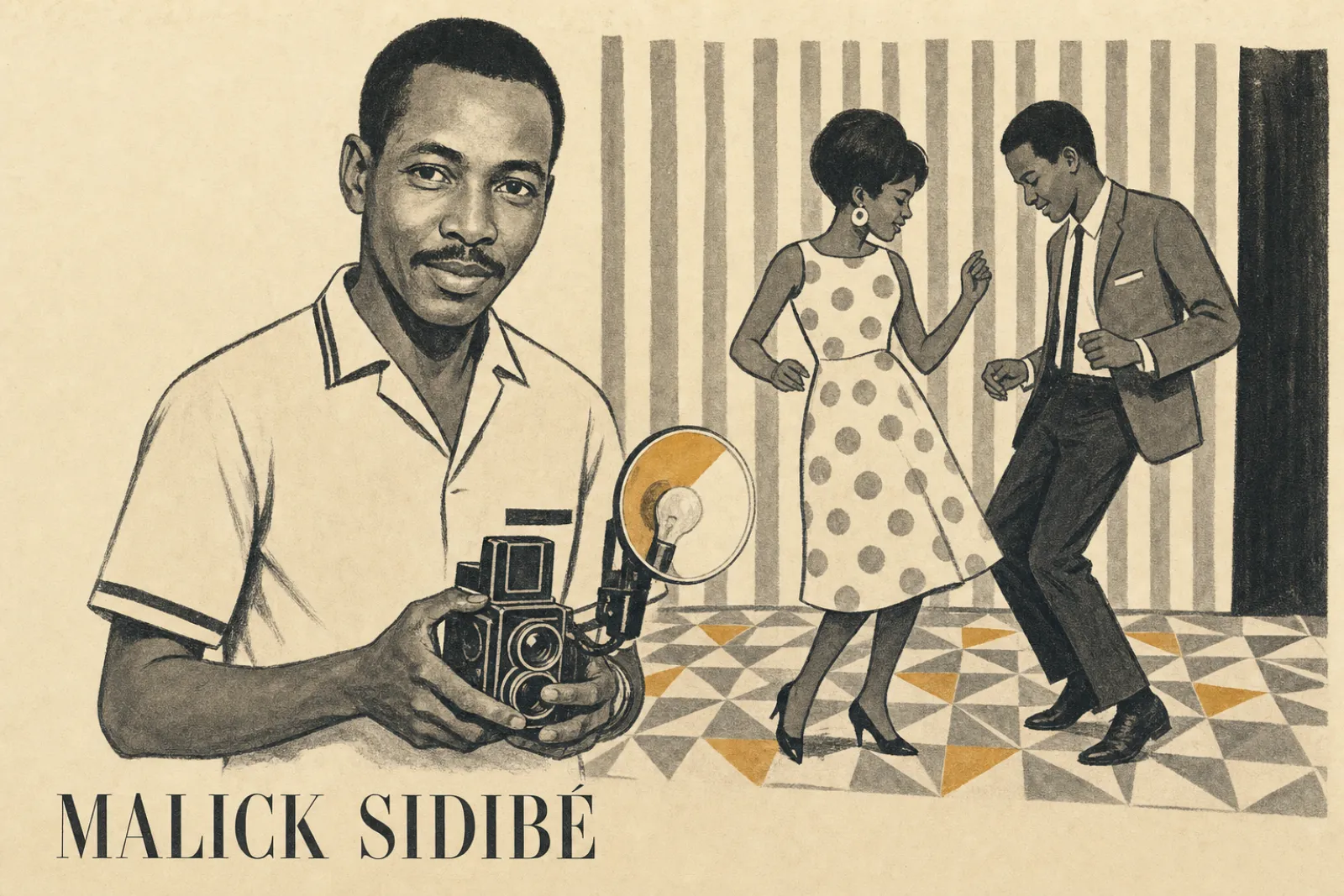
Malick Sidibé was a Malian photographer who worked in Bamako from the 1950s until his death in 2016. He photographed the city’s young people at dance parties, on the banks of the Niger and in his own small portrait studio, always in black and white. He is known for showing a generation enjoying itself in the years around Mali’s independence from France in 1960, and for doing it from inside the party.
Sidibé learned the trade as an apprentice to a French studio owner, Gérard Guillat, and then built a business of his own serving Malian customers. His pictures were made for local customers, which sets them apart from most of what was photographed in West Africa under colonial rule. It is useful to look at him beside August Sander, who also built a portrait of a society one sitter at a time, and beside Weegee, another photographer who worked at night with a flash on the camera. Sidibé’s tone is different from both. His sitters are his neighbours, and they are having a good time.
From a village school to a Bamako darkroom
Sidibé was born in 1935 or 1936 (sources differ) in Soloba, a village in what was then French Sudan. He was the first child in his family to go to school, and his talent for drawing won him a place at the School of Sudanese Craftsmen in Bamako, where he trained in jewellery making and graduated in 1955.
Soon afterwards Guillat hired him to decorate his studio and shop. Sidibé stayed on as an apprentice, learned to develop film and make prints, and gradually took over the studio’s reportage work. In 1956 he bought his first camera of his own, a Kodak Brownie Flash. Flash mattered to the work that followed, because the parties were after dark.
Wondering what a small flash can and cannot do in a dark room? Flash photography for beginners explains when to use one and how to control it.
The only photographer at the party
By 1957 Sidibé was covering events, celebrations and surprise parties all over Bamako. The city’s young people had formed social clubs, and their Saturday night gatherings ran until dawn, with new dances from Europe and Cuba and clothes to match. On Sundays the parties carried on beside the Niger, and Sidibé went with them.
He opened Studio Malick in the Bagadadji neighbourhood of Bamako. Sources give the year as 1958 or 1962. He kept the studio there for the rest of his life, and it served both the portrait customers and the party work.
For candid work he used a Foca Sport, a 35mm camera, and for weddings and formal occasions a 6×6 Agfa with bellows. He used flash on location and tungsten lamps in the studio, and he worked only in black and white. He also took commissions for weddings and baptisms and photographed Malian musicians.
He gave up the party reportage in the later 1970s. Sources give 1976 or 1978. After that the work was studio portraits, identity photographs and camera repair.
Discovery abroad and the Venice Golden Lion
For decades the pictures were known only to the people in them. In the 1990s the French curator André Magnin and Western collectors began to show them outside Mali. The Fondation Cartier in Paris held a solo exhibition, Malick Sidibé: Bamako 1962 to 1976, in 1995.
Recognition followed quickly. Sidibé received the Hasselblad Award in 2003. In 2007 he was given the Golden Lion for Lifetime Achievement at the Venice Biennale, the first photographer and the first African artist to receive it. The International Center of Photography in New York gave him its Infinity Award for Lifetime Achievement in 2008. He died in Bamako on 14 April 2016. In 2017 the Fondation Cartier mounted a large retrospective, Mali Twist.
How a Sidibé picture is put together
The first choice is distance. Sidibé stood close enough to be part of the circle of dancers, and his subjects knew him. This is the opposite of working unseen. People perform for the camera, and the performance is the subject. The pictures sit somewhere between candid photography and posed portraiture, and that mix is what a good event photographer still aims for.
The second choice is light. A flash on the camera throws flat, direct light. It lights the people in front and lets the night behind them fall dark, so that the figures stand out cleanly against the background. Sidibé accepted that look and used it. The square 6×6 frame helped too, because a couple dancing fills a square with very little wasted space. That is a lesson in filling the frame with the subject.
The third is timing. Dance photography depends on choosing the point in a movement when bodies make a clear shape. Sidibé waited for the lean, the bent knee, the moment two dancers mirrored each other.
How do you light people with a flash and still keep some of the room? Balancing flash and ambient light shows how the two exposures combine.
In the studio his background in drawing showed. He positioned his sitters himself, so that the portrait looked alive and not stiff. His sitters came dressed in the clothes they wanted to be seen in, and the portraits are as much about style as about faces. The same thinking drives environmental portraits, where what surrounds a person helps say who they are.
Last, he worked only in black and white. With no colour to lean on, the pictures depend on shape, pattern and the difference between light clothes and dark backgrounds.
Photographing a group of friends and not sure where to put everyone? How to photograph groups covers arrangement, spacing and lens choice.
Photographs and series to look for
- Nuit de Noël, Happy Club (1963). A smiling couple dance together, the man in a suit and the woman in a Western party dress. She is barefoot. Notice the contrast between the formal clothes and the bare feet, and how at ease both dancers are in front of the camera.
- Regardez-moi! (1962). The title means “look at me”, and it sums up the party pictures. Look at how much the subject is performing for the camera and how willingly the photographer goes along with it.
- The Niger riverbank pictures. The Saturday parties carried on into Sunday on the banks of the Niger, and Sidibé photographed there too. Compare these with the night pictures to see how the same photographer handles sun in place of flash.
- The studio portraits. Young people came to Studio Malick to be photographed, and from the later 1970s the studio was his main work. Study how each sitter is positioned. Very little is left to chance.
Try this: one flash, one friend, twelve frames
Give yourself 15 minutes, in the evening, indoors or out. Ask a friend to put on music they like and move to it. Use a camera or phone with the flash switched on, and set a square crop if you can. Stand close enough that your friend fills the frame from head to feet. Make only twelve pictures. Before each one, wait for a clear shape: a bent knee, a raised arm, a turn of the head. Afterwards pick the frame where the body makes the strongest outline against the background, and ask your friend which one they would buy. Sidibé worked for his customers, and the exercise is not complete until yours has chosen.
Want the feeling of a moment to come through in the picture? How to capture emotion in photos looks at gesture, expression and timing.
Questions people ask about Malick Sidibé
What is Malick Sidibé known for?
He is known for black and white photographs of young people in Bamako in the 1960s and 1970s, made at parties, by the Niger and in his studio. They record the mood of the years around Mali’s independence. He was sometimes called the Eye of Bamako.
What camera did Malick Sidibé use?
His first camera of his own was a Kodak Brownie Flash, bought in 1956. He later used a 35mm Foca Sport for candid work and a 6×6 Agfa with bellows for weddings and formal events. He used flash on location and tungsten light in the studio.
What awards did Malick Sidibé win?
He received the Hasselblad Award in 2003, the Golden Lion for Lifetime Achievement at the Venice Biennale in 2007 and the International Center of Photography’s Infinity Award for Lifetime Achievement in 2008. He also won a World Press Photo first prize in the Arts and Entertainment category in 2010.
Where can his photographs be seen?
His prints are held by the Museum of Modern Art and the Metropolitan Museum of Art in New York, the J. Paul Getty Museum in Los Angeles, the Art Institute of Chicago and the San Francisco Museum of Modern Art, among others.
For more photographers and what each one can teach, see the A to Z of photographers.