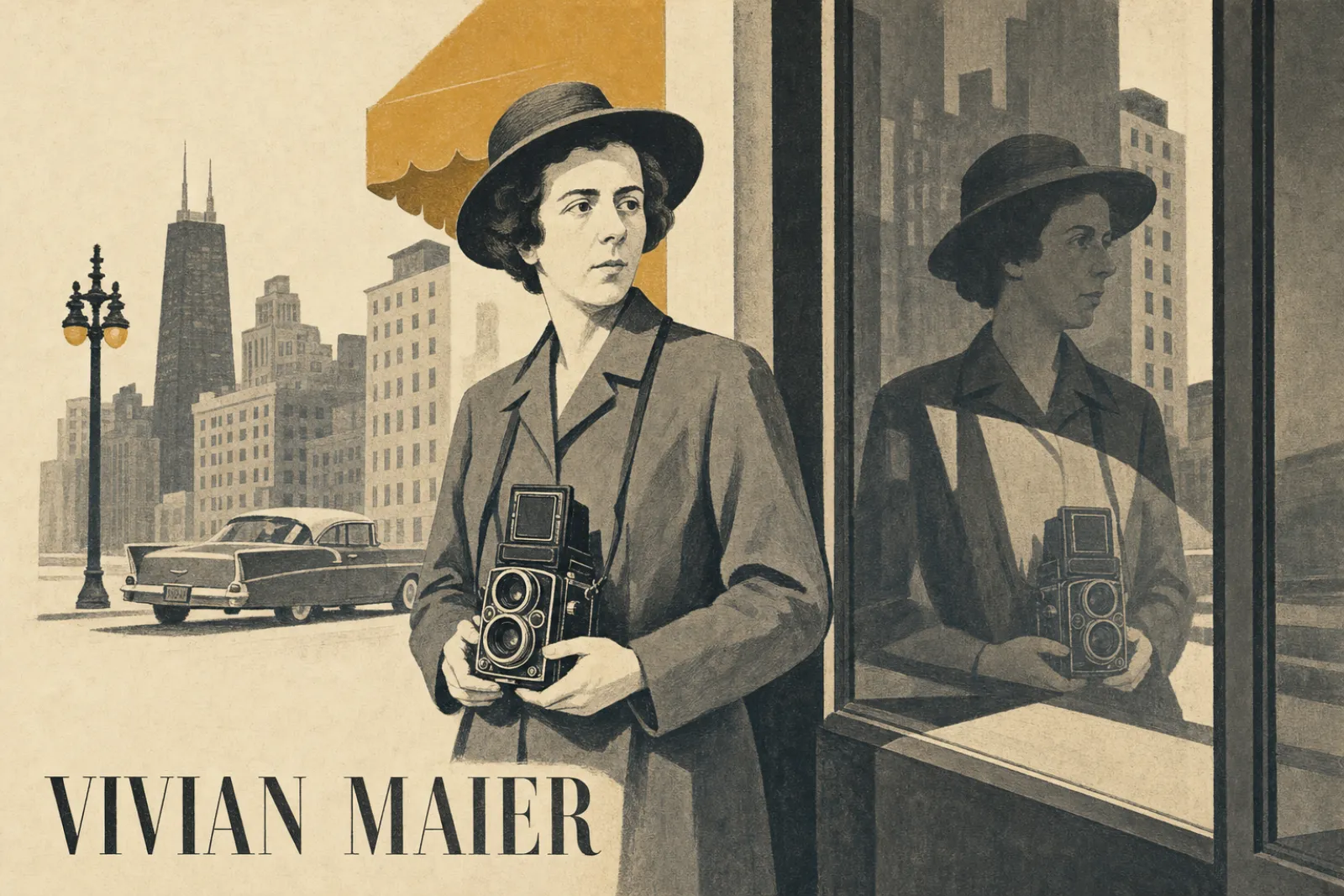
Vivian Maier (1926 to 2009) was an American street photographer who earned her living as a nanny, first in New York and then for decades in and around Chicago. On her days off she photographed the streets with a Rolleiflex and left more than 100,000 negatives, almost none of which anyone else saw. She is known for the fact that her work was found in a storage locker sold at auction two years before she died.
Maier had no teacher that the record can name, no gallery and no editor. She never exhibited. Because the pictures surfaced without a career around them, critics have placed her by comparison: with Helen Levitt, Robert Frank and Garry Winogrand, who photographed American streets in the same decades, and with Diane Arbus, who also used a Rolleiflex. Those photographers had exhibitions, books and magazine pages. Maier kept her pictures to herself.
New York, the French Alps and a box camera
Maier was born in New York City on February 1, 1926, to a French mother and an Austrian father. She spent much of her childhood in France, partly in the village of Saint-Bonnet-en-Champsaur, and moved between the two countries more than once. The 1930 census recorded mother and daughter living in the Bronx in the household of Jeanne Bertrand, a photographer.
Her first photographs date from about 1949, made in France with a Kodak Brownie box camera, a simple camera with few controls. Those early pictures were portraits and landscapes. She returned to the United States in 1951, worked for a time in a sweatshop, and that year began work as a nanny in Southampton, New York. Caring for other people’s children remained her job for the rest of her working life.
A Rolleiflex on the streets of New York and Chicago
In 1952 Maier bought a Rolleiflex, a twin lens reflex camera that makes square negatives on medium format film. Her photographs changed with it. She turned from controlled portraits and landscapes to spontaneous pictures of people in the street. One critic pointed out that because she used a Rolleiflex and not a 35mm camera, her pictures hold more detail than those of most street photographers.
In 1956 she moved to the North Shore suburbs of Chicago to work for the Gensburg family, who had three boys. She stayed with them until the early 1970s. The house gave her a private bathroom that she used as a darkroom, so she could develop her own black and white film. On her days off she walked Chicago with the camera. Her subjects included children, elderly people, domestic workers, homeless people and showily dressed older women. She also photographed old buildings being demolished. In 1959 and 1960 she travelled alone through Asia, the Middle East and Europe, photographing as she went.
How do you photograph people in public without stopping what they are doing? Candid photography covers how people stop noticing a camera and the settings that let you react in under a second.
Colour, unopened rolls and the storage locker
In the early 1970s, once the Gensburg boys had grown up, Maier moved from family to family. She stopped developing her own film, and exposed rolls began to pile up. Through the 1970s she moved to colour, using a Leica IIIc and several German single lens reflex cameras loaded with 35mm Kodak Ektachrome slide film. By the late 1970s she had put the Rolleiflex away. Her later pictures turn from people towards found objects, newspapers and graffiti. She also made home movies and audio recordings.
Money grew short in the 1980s and the film went unprocessed. She stopped photographing at some point between the late 1990s and the early 2000s. The Gensburg brothers, whom she had looked after as children, later helped arrange an apartment for her. In 2007 the contents of a storage locker she had been renting were auctioned in Chicago because the rent had not been paid. The buyers included John Maloof, Ron Slattery and Randy Prow. Maier fell on ice in Chicago in 2008, moved to a nursing home and died on April 21, 2009, aged 83.
Maloof posted a selection of the photographs online in October 2009, and they spread quickly. His collection came to hold between 100,000 and 150,000 negatives, more than 3,000 prints and hundreds of undeveloped rolls. The Chicago Cultural Center held the exhibition Finding Vivian Maier: Chicago Street Photographer in 2011, and the first book, Vivian Maier: Street Photographer, was published the same year. A documentary film, Finding Vivian Maier, directed by Maloof and Charlie Siskel, was released in 2013 and nominated for an Academy Award. Because it was unclear who Maier’s legal heir was, the right to publish the work was disputed. Cook County, Illinois, set up an estate for her in 2014, and the estate reached a settlement with Maloof in 2016.
How a Maier street photograph is made to work
Maier never published or taught, so the lessons have to be read from the pictures and from the equipment she is known to have used.
- Carry the camera every time. By the account of the archive that holds her work, she had a camera around her neck whenever she left the house. The volume of her work came from habit, not from special trips. The guide to street photography starts from the same point.
- Use a square frame. The Rolleiflex gave her a square negative, which has no built in direction. A face or a figure can sit in the middle and hold it. The page on aspect ratio shows what each frame shape does to a composition.
- Stay spontaneous. After 1952 her work moved from arranged portraits to pictures taken as things happened. Both kinds have their place. The difference between a candid and a street portrait, and when to ask first, is worth settling before you raise the camera.
- Put yourself in the picture. Maier made thousands of self portraits. She used her shadow, mirrors, shop windows and polished metal to place herself in the scene she was photographing. The technique is covered in reflection photography.
- Watch the edges of prosperity. She was drawn again and again to people at the margins of a rich country. That choice of subject, more than any technique, gives the archive its character.
- Know how you want the print to look. She wrote detailed notes for photo labs about paper, finish and cropping. The picture was not finished for her when the shutter closed.
Want to use your own shadow as she did? Shadow photography explains when shadows are longest and how to expose so the shape stays solid.
Photographs to look for
Most of Maier’s photographs carry only a place and a date, so they are easiest to find by group.
- Early pictures from France (about 1949 to 1951). Portraits and landscapes made with the box camera in a wider, rectangular format. Compare their stillness with the street pictures that came after the Rolleiflex.
- New York street photographs (1951 to 1956). Her first years with the square camera. For each picture, ask whether the person knew they were being photographed, and what tells you.
- Self portraits (1950s to 1980s). Maier appears in shop windows, in mirrors, in chrome, and as a shadow whose hat and large coat make it recognisable. Sometimes only a fragment of her shows, and sometimes several reflections appear at once.
- Chicago street photographs (1956 to the late 1960s). The best known part of the archive. Children, workers, the elderly and the homeless appear beside the well dressed. Look at who she chose to photograph on a crowded street.
- The journey of 1959 and 1960. Pictures made while travelling alone through Asia, the Middle East and Europe. Abroad, as at home, she was drawn to people who had little.
- The colour work (1970s onward). 35mm slides, published in the book Vivian Maier: The Color Work, which has a foreword by Joel Meyerowitz. People give way to found objects, newspapers and graffiti. The guide to color in photography explains how colour can direct attention in a frame.
How do you build a picture when you cannot arrange anything in it? Composition in street photography looks at frames, layers and light on the street.
Try this: six reflections of yourself
This takes fifteen to twenty minutes on any street with shops or parked cars.
- Set your camera or phone to a square (1:1) frame.
- Walk until you find a surface that shows your reflection: a shop window, a car window, a mirror, a puddle or a sheet of polished metal.
- Make one photograph in which you and the camera are both visible in the reflection, and in which something else is going on as well: a person passing, a display behind the glass, the street behind you.
- Do not photograph your face directly and do not turn the phone around. Only reflections and shadows count.
- Find six different surfaces and make one picture at each. For the last one, use your shadow instead.
- Look at the six together. Pick the frame in which you are part of the scene and not the whole of it.
Questions people ask about Vivian Maier
How was Vivian Maier’s work discovered?
In 2007 the contents of a storage locker she rented in Chicago were auctioned over unpaid rent. John Maloof and two other buyers acquired boxes of her negatives and prints, and Maloof began posting the photographs online in October 2009, six months after her death.
What camera did Vivian Maier use?
She began with a Kodak Brownie box camera in about 1949 and bought her first Rolleiflex in 1952. She used the Rolleiflex for her black and white work, and later a Leica IIIc and 35mm single lens reflex cameras for colour.
How many photographs did Vivian Maier take?
She left more than 100,000 negatives, and some estimates put her total output above 150,000 images. Hundreds of rolls of film were still undeveloped when the archive was found.
Did Vivian Maier ever show her photographs?
No. She did not exhibit or publish during her lifetime and kept the work to herself. The Chicago Cultural Center exhibited her photographs in 2011, two years after she died.
For photographers who were working the same streets in the same years, see the A to Z of photographers.