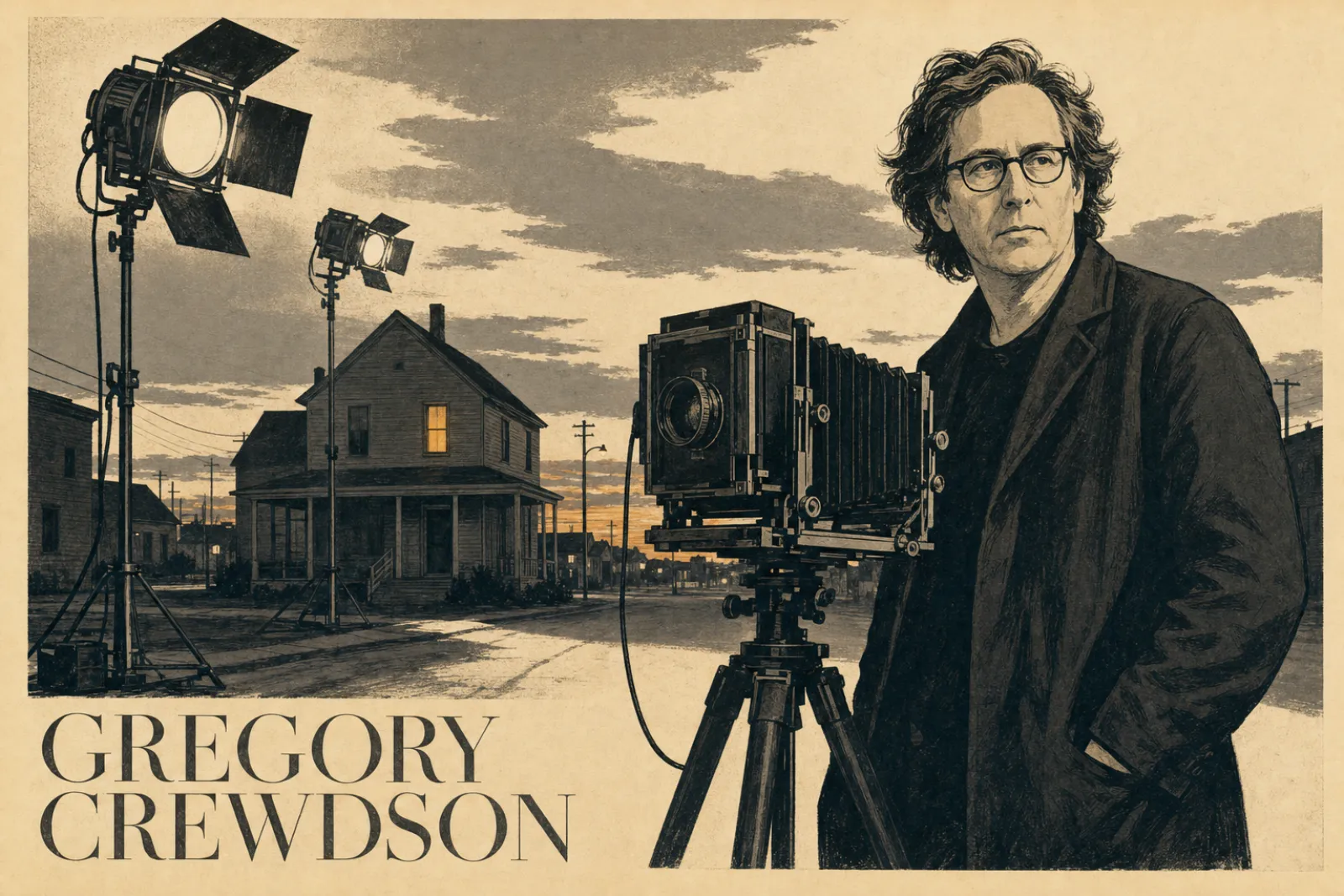
Gregory Crewdson is an American photographer, born in Brooklyn, New York, in 1962. He made large colour photographs of houses, streets and woods in small towns in western Massachusetts, each one staged and lit like a scene from a feature film. He is known for the series Twilight and Beneath the Roses, in which ordinary suburban settings at dusk hold a single unexplained event.
Crewdson studied photography at the State University of New York at Purchase, where his teachers were Laurie Simmons and Jan Groover, and graduated in 1985. He took a master’s degree at the Yale School of Art in 1988 and later taught there, serving as director of graduate studies in photography. He belongs to a generation that turned from finding pictures to building them. The sources named for his work are a mix of painting, film and photography. He has cited the painter Edward Hopper, the photographer Diane Arbus and films by Alfred Hitchcock and David Lynch. Galleries that show him also compare the pictures with the photographs of Walker Evans and the films of Douglas Sirk and Terrence Malick. Set his pictures beside Evans and the shared ground is the plain American house and street. Set them beside Arbus and it is the sense that something is off in an ordinary scene. What he set aside was the idea that a photograph must be taken from life as it happens.
From Brooklyn to the Berkshires
Crewdson grew up in the Park Slope neighbourhood of Brooklyn. As a teenager he played in a power pop band called the Speedies, whose song “Let Me Take Your Photo” was later used in an advertisement. He spent childhood summers in Massachusetts, and he kept returning to the state to photograph.
An early series, Natural Wonder, occupied him from 1992 to 1997. With Twilight (1998 to 2002) the productions grew to the scale of film sets. The forty pictures were made in and around the town of Lee, Massachusetts, with a production team, at dusk, with artificial light added to the fading daylight.
Beneath the Roses (2003 to 2008) pushed the method further. Crewdson worked with a full production crew on location in New England towns and on studio soundstages, where sets were built. Twenty of the pictures were shown in 2005 at galleries in London, New York and Beverly Hills. Later series include Sanctuary, photographed at the Cinecittà film studios in Rome; Cathedral of the Pines (2013 to 2014), photographed in the town of Becket, Massachusetts; An Eclipse of Moths (2018 to 2019); and Eveningside (2021 to 2022). A documentary film about him, Gregory Crewdson: Brief Encounters, directed by Ben Shapiro, was released in 2012.
What makes a still photograph look like a frame from a film? Cinematic photography covers the light, colour and framing choices behind that look.
A film crew for a single frame
A Crewdson picture is planned for weeks or months and involves dozens of people. For about 25 years he worked with the same director of photography, Richard Sands. The crews were of the kind used on feature films. They built sets on soundstages and lit streets and houses on location, and on Beneath the Roses more than 100 cast and crew took part.
The camera for Twilight was an 8×10 view camera. A sheet of film that size records fine detail across a very large print, which matters because the finished pictures are big: one print from Beneath the Roses in the Victoria and Albert Museum measures roughly 145 by 224 centimetres. Large format photography explains what such a camera does and what it costs in time.
One exposure was not the end of it. Crewdson made a number of photographs of each scene, and the final image was assembled from them in digital post production over a period of months. That allowed each part of the scene to be taken from the frame where it was best. It is the same principle as exposure blending, carried out on the scale of a street.
How the pictures are made to feel uneasy
- Dusk as the base exposure. The pictures are set in the short period when the sky still holds some light and lamps are already on. Daylight and artificial light are balanced so that neither wins. Blue hour photography covers that window and how short it is.
- Light with no honest source. Film lamps, including tungsten, fluorescent and HMI units, are arranged in layers. Light can fall where no everyday lamp would put it. The eye accepts it at first, then starts to doubt it.
- Mixed sources. Lamps of different kinds are combined with the last daylight, and the mix of colour is deliberate. White balance explains why different light sources record as different colours.
- Weather on demand. Artificial rain and dry ice fog are added, sometimes to strengthen a real dusk and sometimes to create one from nothing.
- Detail everywhere. The large negative and the composite method keep detail across the frame, so the viewer can search all of it for clues. The depth of field page explains how aperture and distance control this.
- Thresholds. Windows and doorways recur as the line between private and public space, and the suburb itself sits between town and woods. Windows and doors also act as frames inside the frame. See framing in photography.
- A stopped person. The people do not act. They stand or sit, looking at nothing in particular, as if paused in the middle of something. The picture gives the before and after to the viewer to invent.
Crewdson has described his subject as the uncanny: an ordinary situation in which something strange or mysterious shows through.
Want to tell a story in one picture or a short series? Visual storytelling in photography sets out the elements a narrative image needs.
Series and pictures to look for
- Beneath the Roses (2003 to 2008). Desolate streets, forest clearings and ordinary bedrooms, made on location and on soundstages. In each one, find the single thing that is out of place, then count how many lights you think were needed to show it to you.
- Untitled, from Twilight (1998 to 2002). A boy in a bathroom reaches down toward the drain, and the constructed set shows the dark space under the floor. Light streams through the window. Notice that the room is a stage built for one viewpoint.
- Twilight as a whole (1998 to 2002). Forty pictures made around Lee, Massachusetts. Compare several and find the repeated elements: the beam of light from above, the lit window, the figure who has stopped.
- Untitled, from Beneath the Roses (2006). A snowy suburban backyard with a solitary figure in a distant doorway. See how far away the person is, and how the doorway becomes the place the eye keeps returning to.
- Cathedral of the Pines (2013 to 2014). Photographed in Becket, Massachusetts. Compare these pictures with Twilight and ask what the change of setting does to the mood.
- Eveningside (2021 to 2022). A later series. Compare it with Twilight and list what stayed the same in twenty years and what was removed.
Is this documentary, or art, or something else? Fine art photography describes work that starts from an idea instead of an event.
Try this: one room at dusk, two kinds of light
Allow 20 minutes, starting about ten minutes after sunset. You need a room with a window, one lamp and a tripod or a steady shelf.
- Turn off the ceiling light. Leave on one warm lamp, or the light of a television or an open fridge.
- Set the camera so the frame includes both the lamp lit area and the window with blue sky in it. Do not move the camera again.
- Ask one person to stand or sit in the frame and to stop halfway through an ordinary action: a hand on a door, a coat half on. They look away from the camera.
- Make one frame every two minutes for 16 minutes, keeping the pose. Use daylight white balance so the lamp stays orange and the window stays blue.
- Compare the eight frames. Find the one where the window and the lamp are equally bright. That balance point is the whole exercise.
Questions people ask about Gregory Crewdson
How does Gregory Crewdson make his photographs?
He planned each picture like a film scene, with a director of photography, a lighting crew, set builders and cast. The scene was photographed a number of times with a large view camera, and the final image was assembled from those exposures in digital post production.
Where were Crewdson’s photographs taken?
Many were made in small towns in Massachusetts. Twilight was photographed in and around Lee, Beneath the Roses in New England towns and on soundstages, and Cathedral of the Pines in Becket. Sanctuary is the exception: it was made at the Cinecittà studios in Rome.
Are Gregory Crewdson’s photographs real or digital?
Both. The sets, lights, rain, fog and people were physically present in front of the camera. The finished picture is a digital composite of many exposures of that real scene, made so that every part of the frame is as the photographer wanted it.
Who influenced Gregory Crewdson?
He has pointed to the painter Edward Hopper, to film directors including Alfred Hitchcock and David Lynch, and to the photographer Diane Arbus. Galleries have also compared his work with the photographs of Walker Evans. His teachers at Purchase were Laurie Simmons and Jan Groover.
Crewdson is one of the photographers in the A to Z of photographers, and he is quoted on the photography quotes page.