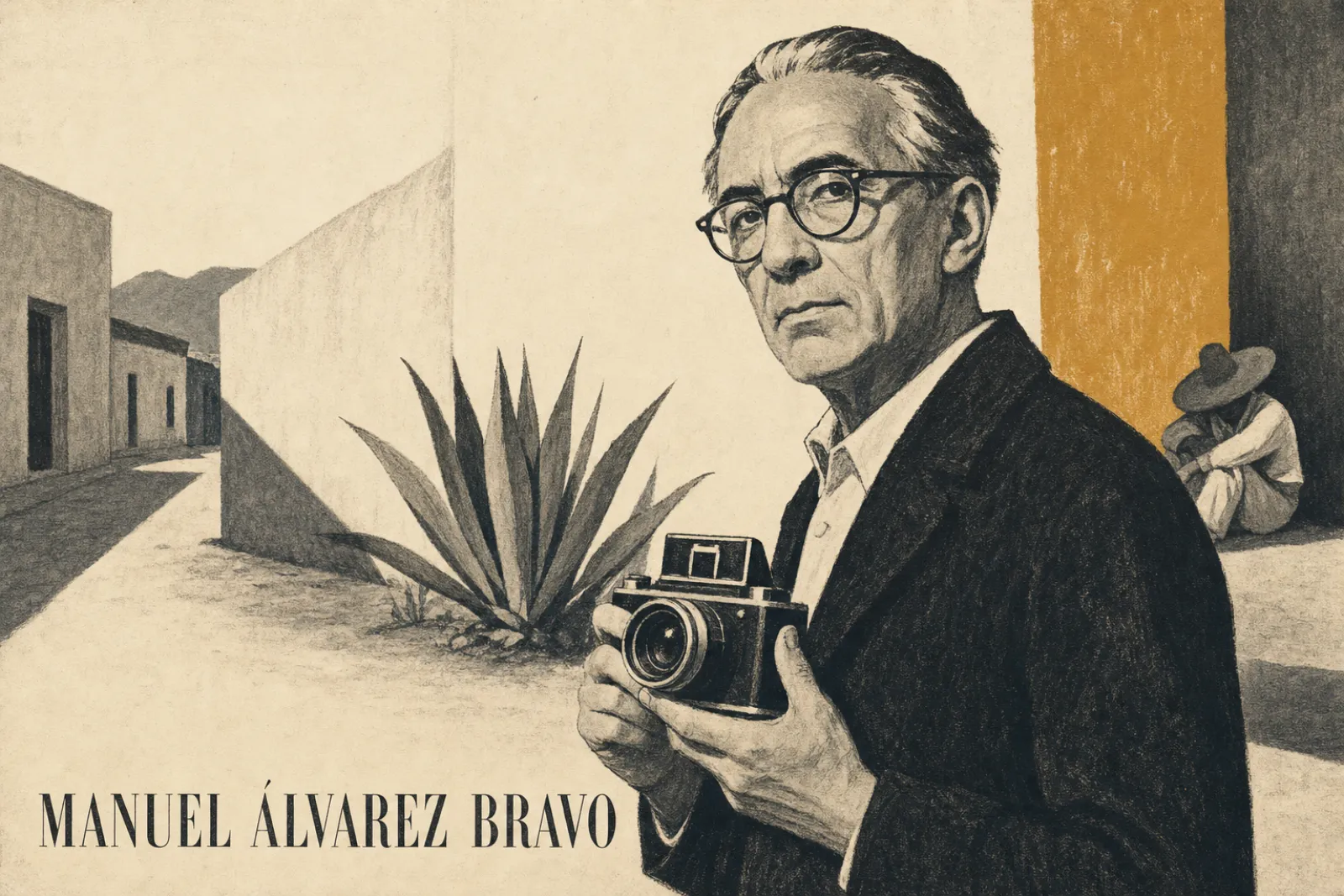
Manuel Álvarez Bravo was a Mexican photographer who was born in Mexico City in 1902 and died there in 2002, at the age of 100. Over about eight decades he photographed streets, shop windows, walls, sleepers, workers, nudes and rural customs, mostly in black and white. He is known for quiet pictures of everyday Mexico that carry a second, stranger meaning, often pointed to by the title.
He taught himself, with advice from the German photographer Hugo Brehme and from photography magazines. In 1927 he met Tina Modotti, who introduced him to artists and intellectuals in Mexico City, among them the painter Diego Rivera, and Edward Weston encouraged him to keep going. After Modotti left Mexico he photographed the work of the muralists Rivera, David Alfaro Siqueiros and José Clemente Orozco. His contemporaries in the 1930s included Paul Strand and Walker Evans, and one of his later students was Graciela Iturbide.
A Treasury clerk with a camera
Álvarez Bravo was born on 4 February 1902. He went to work as a clerk in his early teens, and for years he held a post at the Mexican Treasury Department. He also took art classes at the Academia Nacional de Bellas Artes. He bought his first camera in the 1920s and learned by doing.
He grew up during the Mexican Revolution and came of age in the years after it, when artists and writers in Mexico City were looking again at the country’s indigenous past and its folk culture. That setting shaped his subject matter for life.
When Modotti was deported from Mexico in 1930, he took over her work as photographer for the magazine Mexican Folkways, recording customs, festivals and country life. It was documentary photography in the service of a magazine about Mexican culture. In 1931 he won first prize in a competition run by the cement company La Tolteca, with Rivera on the jury, and he gave up his government job to photograph full time. His first solo exhibition was at the Galería Posada in Mexico City in 1932.
Curious how photography moved from soft, painterly pictures to sharp, direct ones? The history of photography traces the main turns from the daguerreotype to digital.
The 1930s: Mexico City streets and Surrealist attention
The pictures that made his name come from the early and middle 1930s. He photographed what he found in Mexico City and beyond it: a girl at a window, people at a lunch counter, a dead striker.
In 1933 he met Strand on the set of the film Redes. In the mid 1930s he exhibited with Henri Cartier-Bresson at the Palacio de Bellas Artes in Mexico City, and in 1935 the two of them showed with Walker Evans at the Julien Levy Gallery in New York, in an exhibition called Documentary and Anti-Graphic Photographs.
In 1938 the French poet André Breton, leader of the Surrealists, came to Mexico, admired the photographs and promoted them in France. Breton asked him for a picture for a Surrealist exhibition catalogue. The result was La buena fama durmiendo, a nude that the Mexican censors would not allow to be used. Álvarez Bravo was never a member of the Surrealist movement. His pictures stay closer to the ground than that. The odd thing is found in the street, not invented.
Film sets, teaching and late recognition
From 1943 to 1959 he earned his living in the Mexican film industry. In 1955 Edward Steichen chose three of his photographs for The Family of Man at the Museum of Modern Art. In 1959 he helped found a publishing house for books on Mexican art, the Fondo Editorial de la Plástica Mexicana. In the 1960s he taught at the university film school in Mexico City.
The large museum exhibitions came late. The Pasadena Art Museum showed his work in 1971 and the exhibition travelled to the Museum of Modern Art in New York. He received a Guggenheim Fellowship in 1975 and the Hasselblad Award in 1984. The Museum of Modern Art held a retrospective of 175 photographs in 1997, and the J. Paul Getty Museum opened Manuel Álvarez Bravo: Optical Parables in November 2001, a few months before his hundredth birthday. He died in Mexico City on 19 October 2002.
He made platinum and palladium prints as well as gelatin silver prints, and in the 1960s and 1970s he also experimented with colour.
How an Álvarez Bravo picture works on the viewer
The title is part of the photograph. He gave plain scenes titles that point somewhere else: The Good Reputation Sleeping, Optical Parable, The Daughter of the Dancers. The words do not explain the picture. They open a second reading and leave the viewer to finish it. This is a teachable habit. A caption that describes closes a picture down, and a title that suggests keeps it open.
The subject is often looking, or being looked at. A girl peers through a window. A picture is titled Optical Parable. Looking is a recurring theme, and it makes the viewer aware of their own looking.
Something is hidden. Figures are wrapped in cloth, lying down or turned towards something the viewer cannot see. What is held back gives the picture its pull. A composition that withholds the face is a strong form of framing, and it works because the mind fills in what the camera leaves out.
Reflections can confuse the space on purpose. A shop window piles up glass, signs and reflections until it is hard to say what is in front of what, and a picture about sight can use that. The guide to reflection photography covers the mechanics of working with glass and mirrors.
Two things that do not belong together share a frame. Old and new, sacred and ordinary, a soft body and sharp cactus. This kind of difference in meaning is discussed, with the visual kinds, in the guide to contrast in photography.
He did not hurry. Iturbide remembered him teaching that there is always time for the picture you want. The pictures look found, and they were, but he waited for them. That patience is a large part of learning how to see like a photographer.
Do your own pictures need a clearer idea behind them? Fine art photography looks at how to build work around a personal point of view.
Photographs to look for
- Parábola óptica (Optical Parable), 1931. The picture that gave the Getty exhibition of 2001 its name. Ask what the title adds: a parable is a story with a second meaning, and here the subject is sight itself.
- La hija de los danzantes (The Daughter of the Dancers), 1933. A girl is seen from behind as she peers through a window. The viewer cannot tell what she sees. The picture is about the act of looking.
- Obrero en huelga, asesinado (Striking Worker, Assassinated), 1934. A young man killed during a strike lies dead. It is a direct picture of political violence, and it has also been read as an image of sacrifice with roots in Mexico’s older cultures.
- La buena fama durmiendo (The Good Reputation Sleeping), 1938. A nude woman, partly wrapped in gauze, lies with pieces of cactus around her. It was made for Breton and refused by the censors. Look at how softness and threat are placed side by side.
- Los agachados (The Crouched Ones), 1934. A group of people eating at a lunch counter, made in the same year as the picture of the striking worker and very different in mood. Look for how much of each figure is given and how much is kept back.
Want to put several pictures together so they say more than one alone? How to create a photo story or series explains how to choose and order them.
Try this: title first, photograph second
Set aside 20 minutes on any street with shops. Before you take a picture, write down three short titles that describe an idea and not an object, for example “The Patient One”, “What the Window Knows” or “Rest”. Then walk until you find one ordinary scene for each title: a shop window, a doorway, a person waiting, something covered or wrapped. Make no more than five frames per title, and keep faces out of at least one of them. At home, put each title under its picture and see whether the words change what you notice.
Questions people ask about Manuel Álvarez Bravo
What is Manuel Álvarez Bravo known for?
He is regarded as the leading Mexican photographer of the twentieth century. He is known for black and white photographs of daily life in Mexico made from the late 1920s onward, with poetic titles and a sense of mystery.
Was Manuel Álvarez Bravo a Surrealist?
Not as a member of the movement. André Breton admired and promoted his work from 1938 and included it in a Surrealist exhibition, and the pictures are often associated with Surrealism, but Álvarez Bravo never belonged to the group.
How long did he live and work?
He was born on 4 February 1902 and died on 19 October 2002. His photographs span about eight decades, and his work appeared in more than 300 exhibitions in his lifetime.
Where can his photographs be seen?
His prints are in the Museum of Modern Art and the Metropolitan Museum of Art in New York, and the J. Paul Getty Museum in Los Angeles, among others. In Oaxaca, the Centro Fotográfico Álvarez Bravo, founded in 1996, is named after him.
For more photographers and what each one can teach, see the A to Z of photographers.