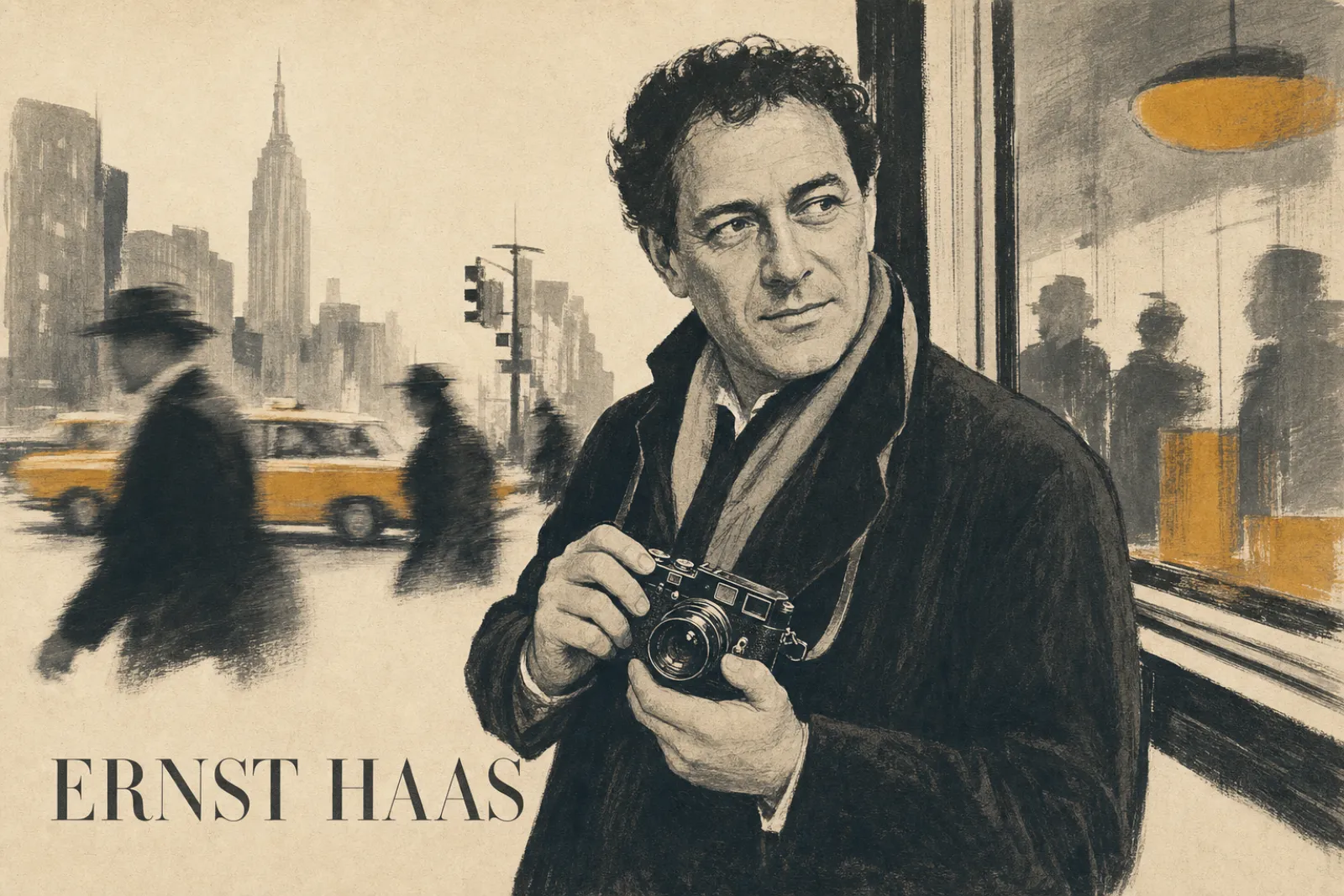
Ernst Haas (1921 to 1986) was an Austrian photographer who began as a black and white photojournalist in postwar Vienna and moved to New York in the early 1950s. There he turned to colour film at a time when serious photographers were expected to avoid it. He is known for showing that colour, blur and reflection could carry a picture on their own, and for the first solo exhibition of colour photography at the Museum of Modern Art, in 1962.
Haas was largely self taught. While teaching photography at the American Red Cross in Vienna at the end of the war, he came across the work of Edward Weston, which changed his idea of what a photograph could be. Robert Capa brought him into the Magnum agency, where he worked closely with Capa, Henri Cartier-Bresson and Werner Bischof. He admired their reporting but grew restless with assignments. He wanted pictures that worked like poems, not like news.
Vienna, a black market Rolleiflex and the returning prisoners
Haas was born in Vienna on March 2, 1921. He tried to study medicine but was barred because of his Jewish ancestry. In 1946 he got his first camera, a Rolleiflex, on the black market. With it he photographed a ruined city, and above all the Austrian prisoners of war coming home and the families searching among them for missing relatives.
His work was shown in a group exhibition at the American Red Cross headquarters in Vienna in 1947, where an editor of the magazine Heute saw it. Heute and then Life published the homecoming story in 1949. Life offered Haas a staff job. He turned it down to keep his independence and joined Magnum at Capa’s invitation. In the same year he bought a Leica, a small 35mm rangefinder, and started to experiment with colour film.
How does a set of pictures become a story a magazine can run? The photo essay guide covers planning, shooting and ordering one.
New York in Kodachrome
Haas first came to the United States in 1951 and became the vice president in charge of Magnum’s American operations. In 1952 he hitchhiked across New Mexico and photographed the desert in colour for a Life story titled “Land of Enchantment”. He then spent two months walking New York with Kodachrome film in the Leica.
Life published the result in 1953 as “Images of a Magic City”. It ran to 24 pages across two issues and was the first long colour essay the magazine had printed. It did not show landmarks in the usual way. Haas photographed the city as it looked to someone on foot: buildings mirrored in glass and water, the Brooklyn Bridge at dusk, an oil spot on the road. Colour photography then was thought of as a commercial tool for advertising. These pictures made the case that it could be personal.
More colour essays followed, on Paris in 1955 and Venice in 1956. Haas also worked as a stills photographer on film sets, including The Misfits, and was elected president of Magnum in 1959.
What makes colour the subject of a picture and not just a property of it? Color in photography covers using colour on purpose.
Motion, the museum and The Creation
In the mid 1950s Haas photographed bullfights in Spain with slow shutter speeds, letting the bull and the cape smear across the film. Life ran the story in 1957 under the title “Beauty in a Brutal Art”. In 1958 the magazine published “The Magic of Color in Motion”, in which he applied the same method to other moving subjects. Blur had been treated as a fault. Haas used it to show what movement feels like.
In 1962 the Museum of Modern Art presented “Ernst Haas: Color Photography”, about 80 prints from ten years of work. Edward Steichen, who had included Haas in the 1955 exhibition “The Family of Man”, championed him. In the same year Haas wrote and presented a television series called The Art of Seeing.
He worked as a second unit director on John Huston’s film The Bible, shooting the creation sequence, and that led to a long project of his own. He photographed volcanoes, seas, deserts and animals in the Galapagos, Iceland and Kenya. The book The Creation came out in 1971 and sold hundreds of thousands of copies. In America followed in 1975 and Himalayan Pilgrimage in 1978. From the 1970s he taught workshops, including the Yosemite workshop that carried the name of Ansel Adams, and built slide shows set to music. He died in New York on September 12, 1986.
How Haas made colour and movement do the work
- He chose a slow shutter on purpose. A moving subject photographed at a slow speed spreads into streaks, and the colours of the subject and background mix on the film. The page on shutter speed explains the control he was using.
- He moved with the subject. In the bullfight pictures the camera follows the action, so part of the subject holds together while everything else flows. That is the technique covered in panning photography.
- He looked at surfaces, not at things. Glass and water gave him a second picture laid over the first. The guide to reflection photography covers finding and framing these.
- He cut out context. An oil spot on a road, framed tightly, stops being a stain and becomes colour and shape. See abstract photography for the same way of seeing.
- He used shadow as a solid. In the New York pictures large black areas hold small patches of bright colour in place, in the way that a dark mount sets off a print.
- He cared about the print. Haas preferred the dye transfer process for his colour prints, and issued portfolios of them. It was slow and costly and gave him rich, stable colour.
Want to try blur on a moving subject without losing the whole picture? How to photograph moving subjects compares freezing, blurring and panning.
Photographs and essays to look for
- Homecoming, Vienna (late 1940s). Black and white, made with the Rolleiflex. The pictures show returning prisoners of war and the people searching for lost relatives among them. Look at how often hope and grief share one frame.
- “Land of Enchantment” (1952). The New Mexico essay for Life. Notice how early he let the colour of earth and sky, more than any event, hold the frame.
- “Images of a Magic City” (1953). The New York essay. Look for reflections that stack two views into one and for small areas of strong colour inside large areas of dark.
- La Suerte de Capa, Pamplona (1956). A bullfighter and bull in mid pass, blurred into sweeping bands. The shapes are still readable. The blur shows the path of the movement.
- The Creation (1971). A book length sequence in colour that follows the Genesis story through the elements, the seasons and living creatures. Pay attention to the order of the pictures as much as to any single one.
- Ernst Haas in Black and White (1992). A book published after his death that shows how strong the early monochrome work was.
Try this: fifteen minutes at one slow shutter speed
Find a place where things move across your view: a road with cyclists, a path with runners, a playground.
- Set the camera to shutter priority and choose 1/15 second. On a phone, use an app or mode that lets you set the shutter speed, or work at dusk so the phone picks a slow speed by itself.
- For five minutes, hold the camera still and let subjects blur through the frame.
- For five minutes, swing the camera smoothly with each subject and press the shutter in the middle of the swing.
- For the last five minutes, look for the most strongly coloured moving thing you can find, such as a red jacket or a yellow bus, and repeat both methods.
- Pick the one frame where the blur describes the movement best. It will rarely be the sharpest.
Questions people ask about Ernst Haas
Why is Ernst Haas important in colour photography?
He used colour for personal, expressive work in the early 1950s, when it was mostly reserved for advertising. His 24 page New York essay in Life in 1953 and his 1962 exhibition at the Museum of Modern Art brought that work to a very large audience.
What camera and film did Ernst Haas use?
His first camera was a Rolleiflex, obtained in Vienna in 1946. Around 1949 he changed to a Leica 35mm rangefinder, and his colour work of the 1950s was made on Kodachrome film. He preferred dye transfer for colour prints.
Was Ernst Haas a member of Magnum?
Yes. Robert Capa invited him to join after seeing his pictures of returning prisoners of war. Haas ran the agency’s American operations from 1951, joined the board in 1954 and was elected president in 1959.
What is The Creation by Ernst Haas?
It is a book of colour photographs of the natural world, first published in 1971 and revised in 1983, arranged to follow the biblical account of creation. It grew out of his work on the opening of the film The Bible.
Haas is one of the names in the A to Z of photographers, and he is quoted on the photography quotes page.