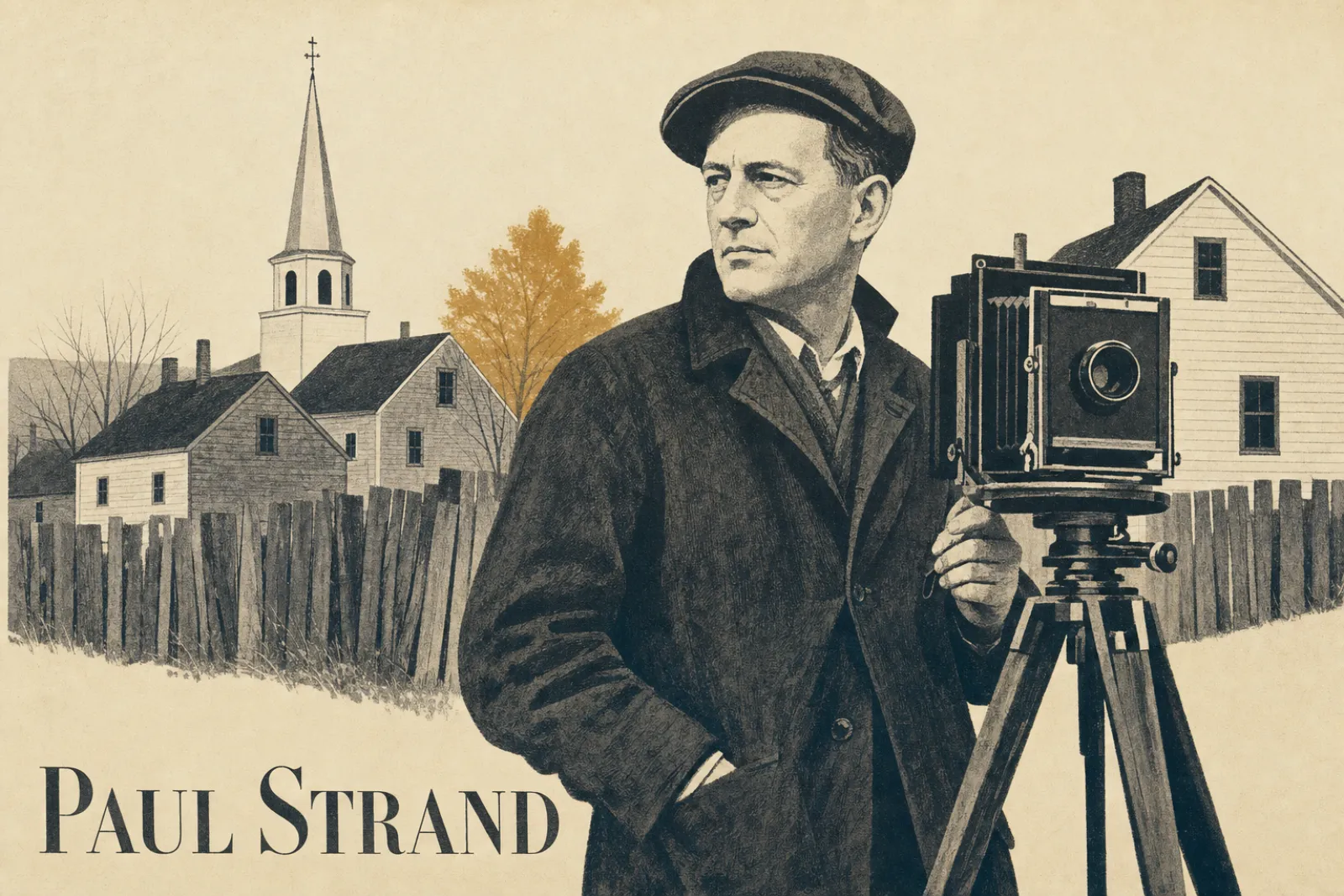
Paul Strand (1890 to 1976) was an American photographer and filmmaker who worked in New York, Mexico, New England, Italy, Scotland, Egypt and Ghana, and spent his last decades in France. He photographed city streets, strangers, machines, plants and village communities with a clarity that was new in the 1910s. He is known above all for helping to turn art photography away from soft focus and toward the sharp, unmanipulated picture.
Strand learned photography as a teenager at the Ethical Culture School in New York, where his teacher was the documentary photographer Lewis Hine. A class trip took him to 291, the gallery run by Alfred Stieglitz and Edward Steichen, and that visit decided him on photography as an art. His first pictures were in the soft, painterly manner then in fashion. Stieglitz criticised them, Strand changed course, and Stieglitz went on to show his work at 291 and print it in the journal Camera Work. What Strand reacted against was Pictorialism, the school that used haze and blur to make photographs resemble paintings.
Wondering where Pictorialism and straight photography sit among the other schools? Photography movements and the ideas behind them sets out what each group believed and what its pictures looked like.
New York, 1915 to 1917: the pictures that ended Camera Work
The work that made Strand’s name was done in about two years. He photographed people hurrying to work on Wall Street, the patterns that shadows made on a porch, a group of bowls, a white fence, and a run of close portraits of people on the streets of New York who did not know they were being photographed. These were early examples of what became street photography and of abstract photography, made by the same person in the same months.
Camera Work first carried his photographs in issue 48, in October 1916. The final issue, a double number dated June 1917, was given over almost entirely to Strand. The journal had spent years promoting the Pictorialists. By ending with photographs that found their beauty in the clear lines and shapes of ordinary things, it closed its own chapter.
Strand’s prints from these years were platinum or platinum and palladium prints. He made large prints from small negatives and left them with their natural matte surface, which gave the image richness without gloss.
Machines, film cameras and Mexico
After serving as an X-ray technician in the Army Medical Corps, Strand turned to moving pictures. In 1921 he and the painter Charles Sheeler made Manhatta, a ten minute silent film of 65 shots that begins with the Staten Island ferry approaching Manhattan and ends with a sunset seen from a skyscraper. The camera hardly moves, and the titles between shots are taken from Walt Whitman. It is often described as the first American avant-garde film.
From 1923 to 1929 Strand earned his living as a freelance cinematographer. His still photographs of the period include a study of an Akeley motion picture camera, and tightly cropped portraits of his first wife, the painter Rebecca Salsbury, whom he married in 1922. In the late 1920s and early 1930s he photographed in Maine, Colorado, New Mexico and Canada.
In the early 1930s he went to Mexico, where he served as chief of photography and cinematography for the Department of Fine Arts and supervised the film Redes, released in the United States as The Wave. In 1935 he travelled to Moscow with the Group Theatre and met the director Sergei Eisenstein. He worked as a cameraman on Pare Lorentz’s film The Plow That Broke the Plains, and in 1942 he and Leo Hurwitz directed Native Land, a film in support of labour unions and against fascism. In 1936 he was one of the founders of the Photo League, alongside Berenice Abbott.
Want to know how photographs are used to argue for change? The intersection of photography and social movements looks at that history.
Portraits of places: the books made after 1949
From 1933 to 1952 Strand had no darkroom of his own and printed in other people’s. He left the United States in June 1949 to present Native Land at a film festival in Czechoslovakia and did not move back. He settled in Orgeval, France, and lived there for the rest of his life. Asked why he had gone, he pointed to the spread of McCarthyism in America.
In these years he worked almost entirely toward books, each one a study of a single place and the people who lived there, with a writer supplying the text. Time in New England (1950) was edited by Nancy Newhall and set his photographs beside New England writings from the seventeenth century onward. La France de Profil (1952) was made with Claude Roy. Un Paese (1955), made with the writer Cesare Zavattini, describes the village of Luzzara in the Po valley in Italy. Tir a’Mhurain (1962) is about the Outer Hebrides in Scotland. Living Egypt (1969) had a text by James Aldridge, and Ghana: An African Portrait (1976) a commentary by Basil Davidson. During the 1950s he insisted that his books be printed in Leipzig.
Thinking about telling the story of one place in pictures? How to create a photo essay covers choosing, ordering and captioning a set, and photo book design covers putting it on pages.
How a Strand photograph is built
Strand’s pictures rest on a small number of decisions that can be studied and copied.
- Sharpness as the starting point. Straight photography means showing the subject in clear focus and detail, using what a camera does well instead of imitating paint. Strand rejected blur and symbolism and looked for form in real things.
- Shape before subject. In the 1916 abstractions, a table or a set of bowls stops being furniture and becomes an arrangement of light and dark areas, and the pattern matters more than the thing. The page on shape in composition explains why this works, and shadow photography covers making the shadow itself the subject.
- Scale. In the Wall Street picture the people are small and the dark openings of the bank are huge. The difference in size carries the meaning. See scale in photography.
- People who are not posing. For the 1916 street portraits Strand fitted a false brass lens to the side of his camera and pointed that at something else, while the working lens, hidden under his arm, faced the person. The result is a face with no performance in it, which is the aim of all candid photography. The method raises questions of consent that photographers still argue about.
- The print as part of the picture. Platinum and palladium give a matte surface and a long range of greys. The page on alternative photography processes describes how such prints are made.
- Staying in one place. The later books came from long stays. He spent two months photographing the village of Luzzara for Un Paese.
Strand’s example mattered to the photographers who followed. From the 1930s the sharp, direct approach of straight photography was taken up on the West Coast by the photographers of Group f/64, among them Edward Weston and Ansel Adams.
Curious how a matte black and white print gets its tones? Black and white printing covers neutral tones, paper and proofing for prints made at home.
Photographs to look for
- Wall Street (1915). Workers walk past the J.P. Morgan building at 23 Wall Street in Manhattan. The figures are faceless and small, and the tall dark recesses of the building stand over them. It is read as a picture about the power of financial institutions and the anonymity of the people who pass them.
- Abstraction, Porch Shadows (1916). An ordinary table and the shadows falling across it are turned into a flat pattern. It is one of the early abstract photographs.
- Blind Woman, New York (1916). A street vendor with a hand-painted sign reading BLIND around her neck and a numbered licence badge pinned above it, photographed without her knowledge using the false lens. Look at how close the framing is and how little surrounds her.
- Akeley Motion Picture Camera (1922). One of the machine studies made while he was working in film. A print of it brought the highest price paid at auction for a Strand photograph when it was sold in 2013.
- The Family, Luzzara, Italy (1953). A mother and five of her eight sons, all of them veterans of the Second World War, from Un Paese. Zavattini’s prose gives the pictures in the book their social and political meaning, and the picture and the words are meant to be read together.
- Anna Attinga Frafra (1964). A student in Ghana carrying her textbooks on her head, from the book on Ghana, which was photographed in 1963 and 1964.
Try this: fifteen minutes with one table
This practises what Strand did with the porch and the bowls.
- Find a table, chair or railing in direct sun or under one lamp, so the shadows have hard edges.
- Set the camera or phone to black and white if it has that option.
- Make ten frames. In each one, move closer or tilt the view until no one could name the object from the picture alone.
- The constraint: no frame may show the whole object, and at least half of every frame must be shadow.
- Pick the frame in which the light and dark areas balance best, turn it upside down, and check that it still holds together as a pattern.
Questions people ask about Paul Strand
What is Paul Strand best known for?
He is known for the photographs he made in New York between 1915 and 1917, including Wall Street and the street portrait of a blind woman, and for his part in establishing straight photography. Stieglitz gave nearly all of the last issue of Camera Work to his pictures in 1917.
What is straight photography?
It is photography that shows a subject in sharp focus and full detail and relies on the qualities that separate a photograph from a painting. The term was in use by 1904. It was defined against Pictorialism, which softened the image on purpose.
How did Paul Strand photograph strangers without being noticed?
He mounted a dummy brass lens on the side of his camera and aimed it away from his subject. The real lens, hidden under his arm, pointed at the person he wanted, who believed he was photographing something else.
Why did Paul Strand live in France?
He left the United States in 1949 and settled in Orgeval, where he lived until his death on March 31, 1976. He said that McCarthyism was spreading in America at the time. He had been a founder of the Photo League, which was placed on a government list of subversive organisations in December 1947.
Paul Strand is one of the photographers listed in the A to Z of photographers, and he is quoted on the photography quotes page.