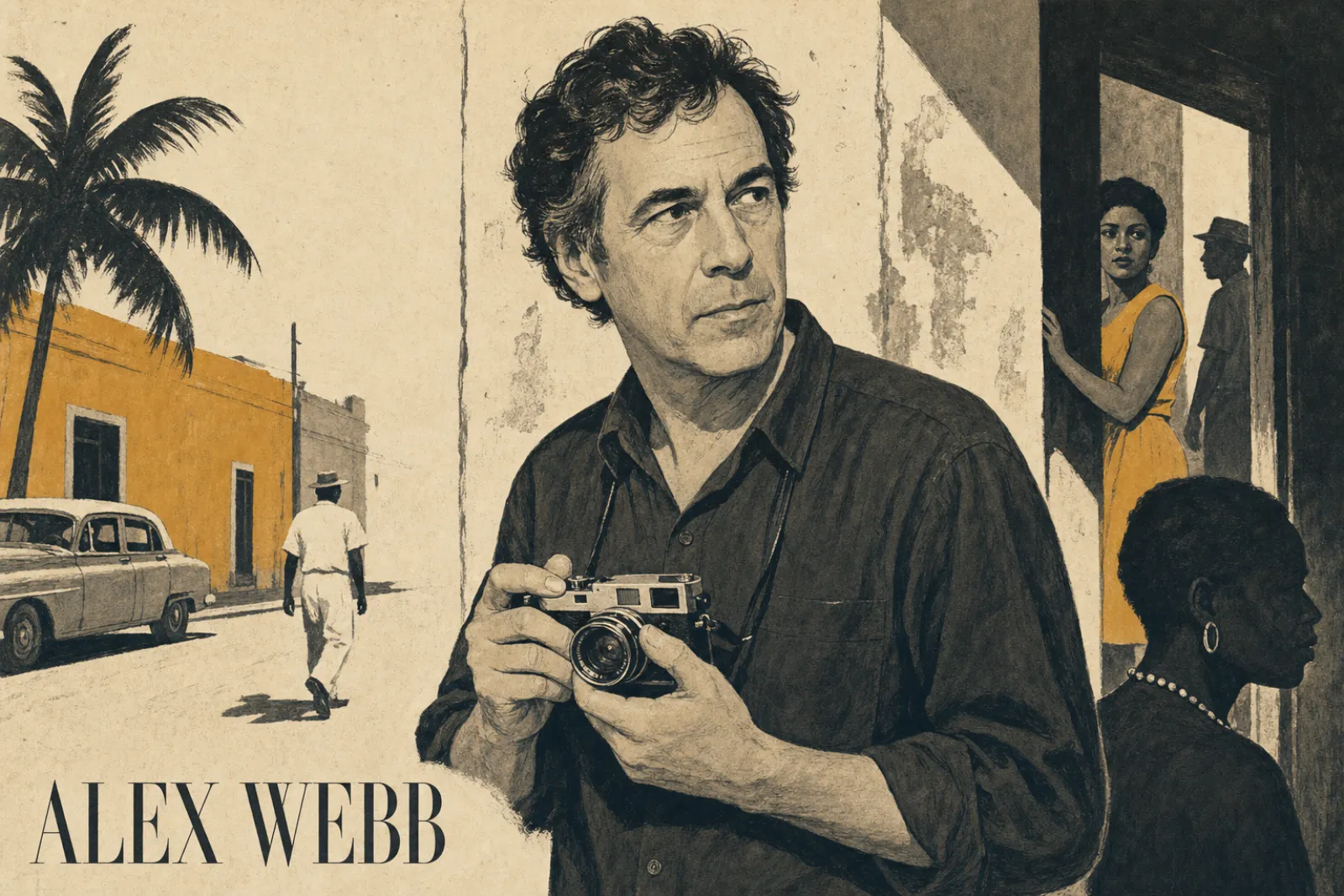
Alex Webb, born in San Francisco in 1952, is an American photographer who became a full member of Magnum Photos in 1979. From the late 1970s he photographed the streets of Haiti, Mexico, the border between Mexico and the United States, Cuba, Istanbul and American cities in intense color and hard light. He is known for crowded, layered frames in which several unrelated things happen at once and still hold together as one picture.
Webb grew up in New England and became interested in photography as a student at the Putney School. In 1972 he attended the Apeiron Workshops in Millerton, New York, where he met the Magnum photographers Bruce Davidson and Charles Harbutt. He studied history and literature at Harvard University, took photography at the Carpenter Center for the Visual Arts, and graduated in 1974. That year he began working as a photojournalist and was accepted by Magnum as a nominee. He became an associate in 1976 and a full member in 1979. He described himself as a street photographer, not as a documentary photographer or a photojournalist, and that distinction explains a good deal about the pictures.
From gray New England to Port-au-Prince
Webb’s first work was in black and white. In the mid 1970s he photographed small towns in the American South and the American social landscape: parking lots, children in car seats, dogs on empty streets. By 1975 he felt that this work had reached a dead end.
The way out came from a book. Webb read Graham Greene’s novel The Comedians, which is set in Haiti under the Duvalier dictatorship, and within months he flew to Port-au-Prince. That first trip lasted three weeks. He later wrote that it changed him as a photographer and as a person.
For three more years he kept working in black and white, in the Caribbean and along the Mexican border. Then he concluded that something was missing from the pictures. The light and the color of these places seemed to him part of the culture itself, and black and white film left them out. In the late 1970s he changed to color, and he worked mainly in color from then on.
What does color add that black and white leaves out? Color in photography covers mood, harmony and how a single hue pulls the eye, while black and white photography explains what a picture needs when color is removed.
Borders, islands and thirty years of books
Webb chose his places with a consistent logic. He was drawn to borders, islands and the edges of societies, places of cultural and political uncertainty. The list includes Haiti, Cuba, Mexico, the border between Mexico and the United States, Florida and Istanbul.
Some of this work was made on assignment. Webb photographed for the New York Times Magazine, Geo, Life and National Geographic, among other magazines. But the form he cared about most was the book. Hot Light/Half-Made Worlds appeared in 1986. It was followed by Under a Grudging Sun (1989), From the Sunshine State (1996), Amazon (1997), Crossings (2003), Istanbul (2007) and La Calle (2016). The Suffering of Light, published by Aperture in 2011, was the first survey of his whole career in one volume, and Dislocations followed from the same publisher in 2023.
He also made a series of books with the photographer Rebecca Norris Webb, his wife and creative partner. These include Violet Isle (2009), Memory City (2014), Slant Rhymes (2017), Brooklyn: The City Within (2019) and Waves (2022). The two also published Street Photography and the Poetic Image (2014).
Recognition followed the books. Webb received the Leopold Godowsky Jr. Color Photography Award in 1988, a National Endowment for the Arts fellowship in 1990, a Hasselblad Foundation grant in 1998, the Leica Medal of Excellence in 2000 and a Guggenheim Fellowship in 2007. His photographs were exhibited at the Whitney Museum of American Art, the Metropolitan Museum of Art, the High Museum of Art and the Walker Art Center.
How does a pile of single pictures become a book? Photo sequencing walks through cutting, pairing and pacing a body of work.
How a Webb frame holds so much
Most street photography advice says to simplify. Webb went the other way. His frames are full, and the skill lies in keeping every part readable. Several choices make that possible, and each can be practised.
- He walked. Webb wrote that everything in his work came first from the street. He wandered without a shot list and let the rhythm and life of the street guide him. The habit is the same one described in a photo walk: slow down, watch, and stay where something is building.
- He stacked the frame from front to back. A typical picture has a figure close to the lens, cut off by the edge, a second event a few metres behind, and a third against the far wall. Each occupies its own patch of the rectangle. This is the idea of depth and layers taken to its limit, and the section on it in the photography composition guide gives the basic version.
- He kept the layers from touching. The frame reads because heads do not overlap, limbs do not merge, and each figure sits against a plain piece of wall, sky or shadow. One step to the side is often the difference between a stack of separate events and a tangle.
- He used hard sun. Many photographers avoid midday light. Webb worked in it. Strong sun gives saturated color in the lit areas and near black in the shade, and the shadow shapes act as dividers between one part of the picture and the next. The section on harsh midday sun in the guide to natural light photography explains how that light behaves.
- He treated color as structure. A painted wall, a shirt, a car door: large flat areas of color anchor the corners of the frame and give the eye stopping points among the people.
- He waited. A layered frame cannot be arranged. The photographer finds the stage, a wall with good light and a doorway, and stays until people fill the empty parts at the same instant. Most attempts fail, and that is normal.
A wide or moderately wide lens suits this approach, because it keeps a near figure and a far wall inside one frame and holds both in focus at a middle aperture.
Which focal length keeps the near figure and the far wall together? Lenses for street photography compares the common choices, and zone focusing shows how to keep a band of distances sharp without refocusing.
Photographs and books to look for
- San Ysidro, California (1979). A picture from the border, showing Mexicans arrested while trying to cross into the United States. It dates from the first years of his color work. Look at how much of the frame is given to the place around the event, and at what that adds to the story.
- Hot Light/Half-Made Worlds (1986). The earliest of the color books listed above. Read it for the light: note where the sun is in each picture and how much detail is left in the shade.
- Istanbul (2007). A city on a geographic edge, which fits his lasting interest in places between cultures. Compare the color and light with the Caribbean pictures and see which habits of framing stay the same.
- The Suffering of Light (2011). The career survey. Because the pictures come from many countries, it is the best place to see the method apart from any single subject. Pick five frames and count the separate events in each.
- Brooklyn: The City Within (2019). Made with Rebecca Norris Webb. It shows the same way of seeing applied to an American city.
Try this: one wall, three layers
Allow 20 minutes in a place where people pass on foot.
- Find a wall, a shop front or a market stall in direct sun with a strong color on it. Stand so that it fills the back of the frame. Do not move from this spot.
- Set a moderately wide focal length, or the main camera on a phone, and do not zoom.
- Take a frame only when three things are true at once: someone is close to the camera at one side, someone is in the middle distance, and something is happening against the wall.
- Before each frame, check that no two figures overlap. If they do, shift half a step left or right and wait again.
- Stop after 20 minutes however few frames were taken. Later, pick the one frame where every layer is clear, and note what the failures have in common.
Not comfortable photographing strangers this openly? Photography etiquette and ethics covers consent and respect in public places.
Questions people ask about Alex Webb
Why did Alex Webb switch from black and white to color?
He began in black and white and first visited Haiti in the mid 1970s. After about three years of working in the Caribbean and along the Mexican border, he decided that the light and color of those places were part of what he was responding to and that black and white could not carry them. He changed to color in the late 1970s and stayed with it.
When did Alex Webb join Magnum Photos?
Magnum accepted him as a nominee in 1974, the year he graduated from Harvard. He became an associate member in 1976 and a full member in 1979.
What is The Suffering of Light?
It is a book published by Aperture in 2011, the first to survey Webb’s whole career in color. It includes work from Haiti, Mexico, Cuba, India, Turkey and other places, and is the usual starting point for his work.
Is Alex Webb a photojournalist or a street photographer?
He started as a professional photojournalist in 1974 and took magazine assignments for many years. He described himself, though, as a street photographer who worked by walking and responding to what he found. The difference between the two approaches is set out in the guide to photojournalism.
Other photographers who worked in Haiti in the same years include his Magnum colleague Bruce Gilden, whose close flash pictures make a sharp contrast with Webb’s layered color. More names are in the A to Z of photographers.