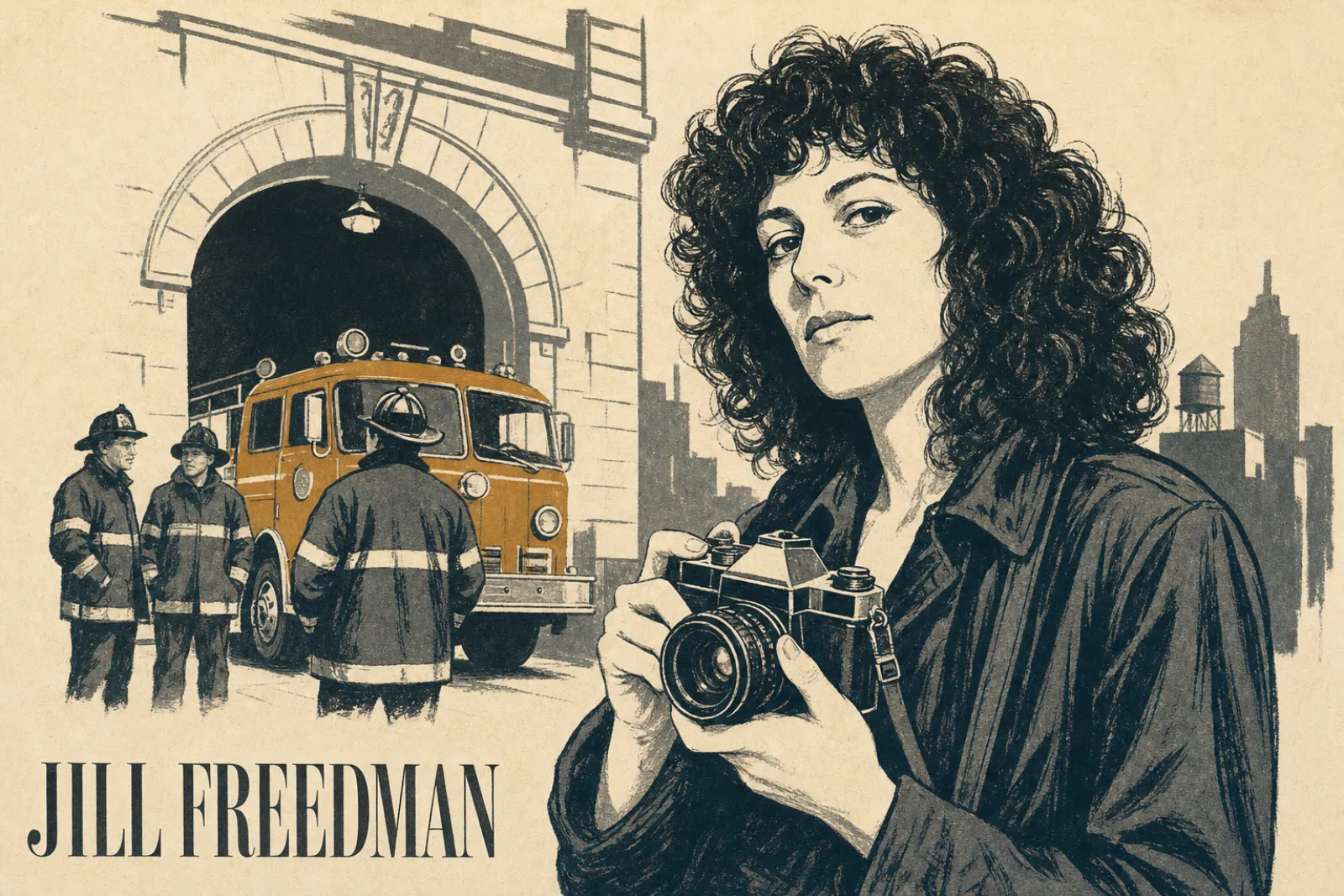
Jill Freedman (1939 to 2019) was an American documentary and street photographer based in New York City. From the late 1960s she made black and white books about groups she believed were misunderstood: the protesters of Resurrection City, circus performers, New York firefighters and street police officers. She is known for how she got her pictures. She moved in with her subjects and stayed for months, until the camera was no longer noticed.
Freedman taught herself. She had no photographic schooling, and the photographers she measured herself against were the photojournalists and street photographers of the generation before hers. She revered W. Eugene Smith above all, and her other influences included André Kertész, Henri Cartier-Bresson and Weegee. Her work is often described as belonging to their tradition of humane, close observation. In 1982 she received the Leica Medal of Excellence, shared with Mary Ellen Mark and Jill Krementz.
A borrowed camera and six weeks in Resurrection City
Freedman was born in Pittsburgh on October 19, 1939, and studied sociology at the University of Pittsburgh, graduating in 1961. She spent time in Israel, Paris and London and then settled in New York in 1964, where she worked as an advertising copywriter. She picked up photography as an adult, on a camera borrowed from a friend, and learned by doing.
The event that turned a pastime into a vocation was the assassination of Martin Luther King Jr. in 1968. Freedman quit her job and joined the Poor People’s Campaign. She travelled to Washington, D.C., and lived for the six weeks of the protest in Resurrection City, the encampment that the campaign built on the National Mall. She photographed it from the inside, as a resident.
Some of the pictures ran in Life magazine at the time. They were collected in her first book, Old News: Resurrection City, in 1970, and the work was reissued in 2018.
What separates this kind of work from news coverage? Documentary photography explains long projects, access and trust, and photojournalism covers the shorter, deadline-driven form.
The circus, the firehouse and the precinct
The pattern set in Washington held for the next decade. Freedman chose a closed world, got herself admitted, and stayed.
First came the circus. She travelled with the Clyde Beatty-Cole Brothers Circus for about two months, living in a Volkswagen van, and photographed the performers and the daily routine of the show. The book was Circus Days (1975).
Next she turned to the New York City Fire Department, working with companies in Harlem and the Bronx in the middle of the 1970s. She lived alongside the firefighters for two years, sleeping in the chief’s car and on the floor. The resulting book, Firehouse (1977), was made with the writer Dennis Smith. It shows fires, but it gives as much space to the hours between them: the life inside the firehouse and the bonds among the crew.
Then she photographed the police. Freedman had begun with a low opinion of the police and later said she came to see how foolish it was to dislike people she had never met. From 1978 to 1981 she accompanied officers in Manhattan, including in Alphabet City and around Times Square, and published Street Cops in 1982.
Alongside the planned projects she practised spontaneous street photography in New York, with no assignment and no theme beyond what turned up.
How do you turn weeks of pictures into a story with a beginning and an end? The photo essay guide covers planning, shot variety and editing, and photo sequencing deals with putting pictures in order for a book.
Ireland, dogs and the later years
Freedman made two books about Ireland, A Time That Was: Irish Moments (1987) and Ireland Ever (2004), and one about dogs, Jill’s Dogs (1993). In 1994 she received an Alicia Patterson Foundation fellowship for a project on the Holocaust fifty years on. Earlier support had come from the National Endowment for the Arts, which gave her a photography fellowship in 1973. The Royal Photographic Society made her an honorary fellow in 2001.
She died in Manhattan on October 9, 2019, ten days before her eightieth birthday. Her prints are in the collections of the Museum of Modern Art, the International Center of Photography, the George Eastman Museum, the Smithsonian American Art Museum, the New York Public Library and the Bibliothèque nationale de France.
Why the pictures look as if they were made from inside
Freedman’s method was simple to state and hard to do. Its parts can be listed.
- Time before pictures. She stayed for weeks or months. People who live beside a photographer stop performing. The unguarded moments in Firehouse and Street Cops exist because she was still there when they happened. The guide to candid photography describes the same effect on a small scale.
- Relationships, not access alone. She believed the strength of a photograph came from the bond between the people on either side of the camera. She did not stand apart as a neutral observer. She liked her subjects, and it shows.
- One moderate wide lens. Freedman preferred a 35mm lens. It is wide enough to show a person and the room or street around them, and it forces the photographer to stand within conversation distance. The comparison of 35mm, 50mm and 85mm lenses shows what each focal length does to distance and background.
- Available light. She preferred the light that was already there, whether in a firehouse, a patrol car or a circus tent. That keeps a photographer unobtrusive and keeps the mood of the place in the picture. See ambient light for how to read and expose for existing light.
- Fast black and white film. She used Kodak Tri-X, a film sensitive enough for dim interiors and night streets, and accepted its grain. The guides to film photography and black and white photography cover the materials and the way of seeing.
- Darkroom prints. She printed on Agfa Portriga Rapid paper. Later in life she worked digitally, without a darkroom.
- People shown whole. She showed her subjects with dignity and without turning them into heroes. Firefighters are tired as well as brave, and police officers are bored as well as tough. The pictures persuade because they include the ordinary parts.
Is it fair to photograph people at their most exposed? Photography etiquette and ethics sets out the questions of consent and dignity that long projects raise.
Books and series to look for
- Resurrection City (1968). The six weeks on the National Mall, published as Old News: Resurrection City in 1970. Ask where the photographer was standing for each picture, and whether it could have been taken by someone who visited for an afternoon.
- Circus Days (1975). Read it for what happens out of the ring. Ask how many of the pictures show the show itself and how many show waiting, travelling and work.
- Firehouse (1977). Compare the pictures at fires with the pictures in the firehouse. Notice how the quiet ones change the meaning of the dramatic ones when they sit together in a book.
- Street Cops (1982). The hardest material she handled. Study how she kept the people, both officers and members of the public, at the centre of frames that could have been only about incident.
- A Time That Was: Irish Moments (1987). A change of country and pace. See which habits carry over when the subject is a place instead of a group she lived with.
Try this: twenty minutes inside one small world
Pick a place where people you know are busy with something and will let you stay: a kitchen during cooking, a workshop, a sports practice, a market stall run by a friend.
- Ask first, and say you will be there for 20 minutes.
- Set a moderately wide focal length, or use the main camera on a phone, and do not zoom. Turn the flash off.
- For the first five minutes, take no pictures. Talk, help, and watch what repeats.
- For the next 15 minutes, photograph only when nobody is looking at the camera. Stay within two or three steps of the people.
- Take at least one frame of the main action, one of someone waiting or resting, and one of hands at work.
- Afterwards choose three frames that together tell what the place is like, and show them to the people in them.
Questions people ask about Jill Freedman
What is Jill Freedman known for?
She is known for black and white books made by living alongside her subjects: Old News: Resurrection City (1970), Circus Days (1975), Firehouse (1977) and Street Cops (1982). She also photographed the streets of New York throughout her career.
How did Jill Freedman learn photography?
She was self-taught. She studied sociology, worked as a copywriter in New York, and began photographing on a borrowed camera. Her first major project was Resurrection City in 1968.
What was Resurrection City?
It was the temporary encampment built on the National Mall in Washington, D.C., by the Poor People’s Campaign in 1968, after the death of Martin Luther King Jr. Freedman lived there for the six weeks it lasted and photographed it as a participant.
What camera and film did Jill Freedman use?
She worked with a 35mm lens and Kodak Tri-X black and white film in available light, and printed on Agfa Portriga Rapid paper. In later years she worked digitally.
Freedman is one of many photographers profiled in the A to Z of photographers.