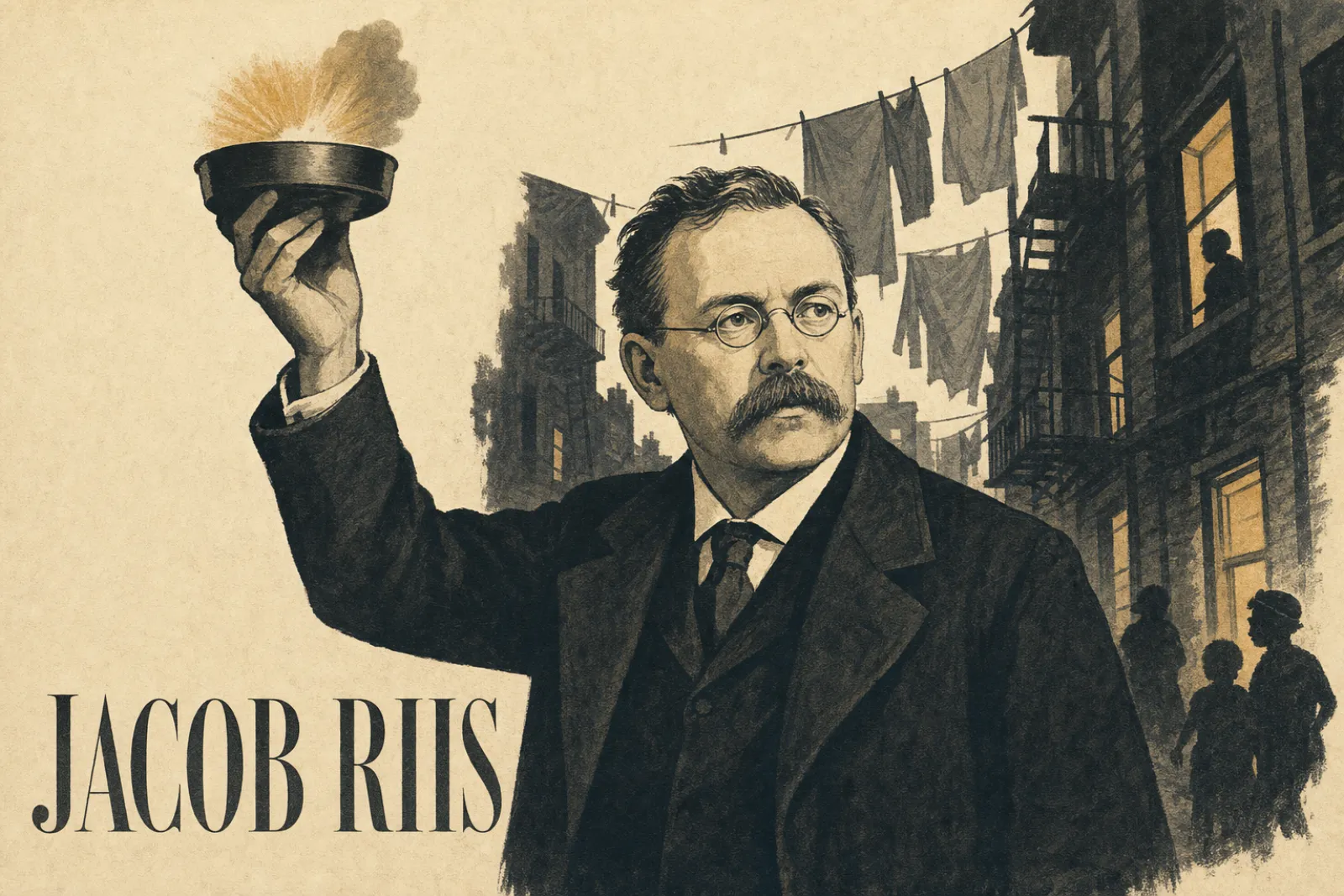
Jacob Riis (1849 to 1914) was a Danish-born American newspaper reporter who used photographs to show how the poor lived in the tenements of New York. Working mainly from 1887 to the middle of the 1890s, he was among the first in America to use flash powder to photograph dark rooms and alleys at night. He is known for the 1890 book How the Other Half Lives.
Riis did not think of himself as a photographer. He was a writer and reformer who wanted evidence, and he began by relying on others. His first flash pictures were made with two amateur photographers, Richard Hoe Lawrence and Dr Henry G. Piffard, before he bought a camera of his own. He and Lewis Hine, who photographed child labour from 1908, are named together as the pioneers of social documentary photography in America, the tradition that Dorothea Lange and other photographers carried on during the Depression of the 1930s.
From immigrant carpenter to police reporter
Riis was born on May 3, 1849, in Ribe, Denmark. He emigrated in 1870, at 21, and arrived in New York with very little money. For several years he was poor himself. He took work as a carpenter, in mines and in a brickyard, and he slept in police lodging houses, the bare rooms where the city put up the homeless.
He found his way into newspapers and became a police reporter for the New York Tribune, and from 1888 for the Evening Sun. His office was on Mulberry Street, across from police headquarters and close to the worst housing in the city. He worked that beat at night for years, following the police into overcrowded tenements, cellars and back alleys.
Words did not carry what he saw. Then, in 1887, he read that a magnesium flash powder had been developed in Germany that allowed photographs to be taken in the dark.
Flash powder in the tenements
Riis first went out with Lawrence, Piffard and a health official, John Nagle. They entered lodging houses and alleys at night, set up a camera and fired the powder. In January 1888 he bought his own equipment for 25 dollars and began photographing by himself. His method was simple and rough: take the cap off the lens, ignite the magnesium powder in a frying pan, put the cap back on. Commercial firms did his darkroom work.
The burst of light was sudden and very bright, and it reached into rooms that had never been photographed. It is the ancestor of every flash photograph made since. The light came from close to the camera and fell hard on whatever was nearest, so faces and walls close to the lens are bright and the back of the room drops into black.
Want to know why direct flash looks so hard, and how to soften it? Bounce flash explains how to get soft light from a ceiling or wall, and off-camera flash covers moving the light away from the lens.
Lantern slides, a magazine article and a book
The pictures reached the public first as a lecture. In January 1888 Riis spoke to a society of amateur photographers in New York, showing about 100 views as lantern slides projected on a screen. He went on to give the talk in churches around the city. He spoke without notes, to the pictures.
In 1889 Scribner’s Magazine published his article How the Other Half Lives, with the photographs redrawn as line illustrations. The book followed in 1890, with the subtitle Studies Among the Tenements of New York. It was one of the earliest books to reproduce photographs as halftones, alongside line drawings. More books came after it, among them Children of the Poor in 1892, The Making of an American in 1901 and The Battle with the Slum.
The work had results. Theodore Roosevelt, who became a police commissioner in New York in 1895, sought Riis out, went with him on night patrols and closed the police lodging houses. Mulberry Bend, a slum block Riis had photographed and written about, was cleared and replaced by a park in 1897. After 1895 Riis took very few photographs. He left police reporting in 1901 and made his living from lectures. He died in 1914 in Barre, Massachusetts.
His writing has been criticised for the way it stereotyped the immigrant groups he described. That criticism sits beside the reforms the work helped to bring about, and both belong in any honest account of him.
Thinking about how to photograph people who have less power than you do? Photography etiquette and ethics sets out the questions of consent and respect, and cultural sensitivity in photography looks at photographing communities that are not your own.
How Riis made pictures work as evidence
He photographed to prove a point, and each choice served that. He showed the whole room, not a detail: the ceiling, the floor, the bunks and how many people were in them. A wide view lets the viewer count. This is the plainest form of documentary photography, where the picture is a record first.
He went at the hour that mattered. A lodging house in daylight is an empty room. At night it was full. Deciding when a place tells the truth about itself is half the work.
He attached words to every image. The slides came with a spoken story and the book with a chapter. He named the street and often the price, and titles such as Five Cents a Spot told the viewer what a place to sleep cost. Strong captions turn a scene into a fact.
He showed the pictures as a set, about 100 slides in one talk, so that the case built from one image to the next. That is the method of the photo essay: a set of images arranged so that each one adds to the last.
The limits are worth noting too. The people in these rooms had little say in how they were shown, and the hard light of the flash is not kind. The pictures are direct, and they are sometimes harsh for the same reason.
Asking how a set of pictures becomes a story? How to make great stories with photos covers building a sequence with a beginning, a middle and an end.
Photographs to look for
- Bandits’ Roost, 59 1/2 Mulberry Street (1888). An alley in Mulberry Bend with men standing at its mouth, people leaning from windows and washing hung above. The photograph may have been taken by Piffard or Lawrence and not by Riis. Notice how the alley walls close the frame on both sides.
- Lodgers in a Crowded Bayard Street Tenement, Five Cents a Spot (about 1889). A tenement room crowded with lodgers, each paying five cents for a place to sleep. Look at how many people the one frame accounts for, and at how the title turns the scene into a price.
- Tramp in Mulberry Street Yard (1887 to 1888). One of the early flash pictures made with Lawrence and Piffard. It shows how the first experiments looked before Riis worked alone.
- The police lodging house photographs (1891 to 1892). Made for the newspaper articles of 1892 and 1893 in which he attacked the shelters he had once slept in. They are an example of pictures made for one specific reform.
- Yard in Jersey Street. A yard lined with sheds, published in The Battle with the Slum with a caption saying that it cost a dollar a month to sleep in them. It shows his habit of pairing a place with a price.
Try this: one room, one fact
Take 15 minutes in a room you know well: a kitchen, a workshop, a classroom after hours.
- Decide on one plain fact about the room that a stranger would not know. Write it down in a sentence.
- Stand in a corner and frame as much of the room as you can, floor to ceiling. Use your phone’s flash or the room’s own light.
- Make five frames from different corners. Do not tidy anything.
- Choose the frame that best proves your sentence and write a caption that gives the place and the fact, nothing more.
Questions people ask about Jacob Riis
Did Jacob Riis take all the photographs himself?
No. The earliest flash pictures of 1887 and 1888 were made with Richard Hoe Lawrence and Henry Piffard, and Riis began photographing alone after buying a camera in January 1888. Some well known images, including Bandits’ Roost, may be the work of his collaborators.
How did his flash work?
He used magnesium flash powder, which had been developed in Germany in 1887. He uncovered the lens, lit the powder in a frying pan and covered the lens again.
What did How the Other Half Lives change?
The book drew wide attention to tenement conditions in New York. Riis’s campaigning is linked to the closing of the police lodging houses under Theodore Roosevelt and to the clearing of Mulberry Bend for a park in 1897.
How were his photographs rediscovered?
In 1946 the photographer Alexander Alland tracked down Riis’s glass negatives and made new prints from them. The Museum of the City of New York showed those prints in 1947.
For more photographers from every period, see the A to Z of photographers.