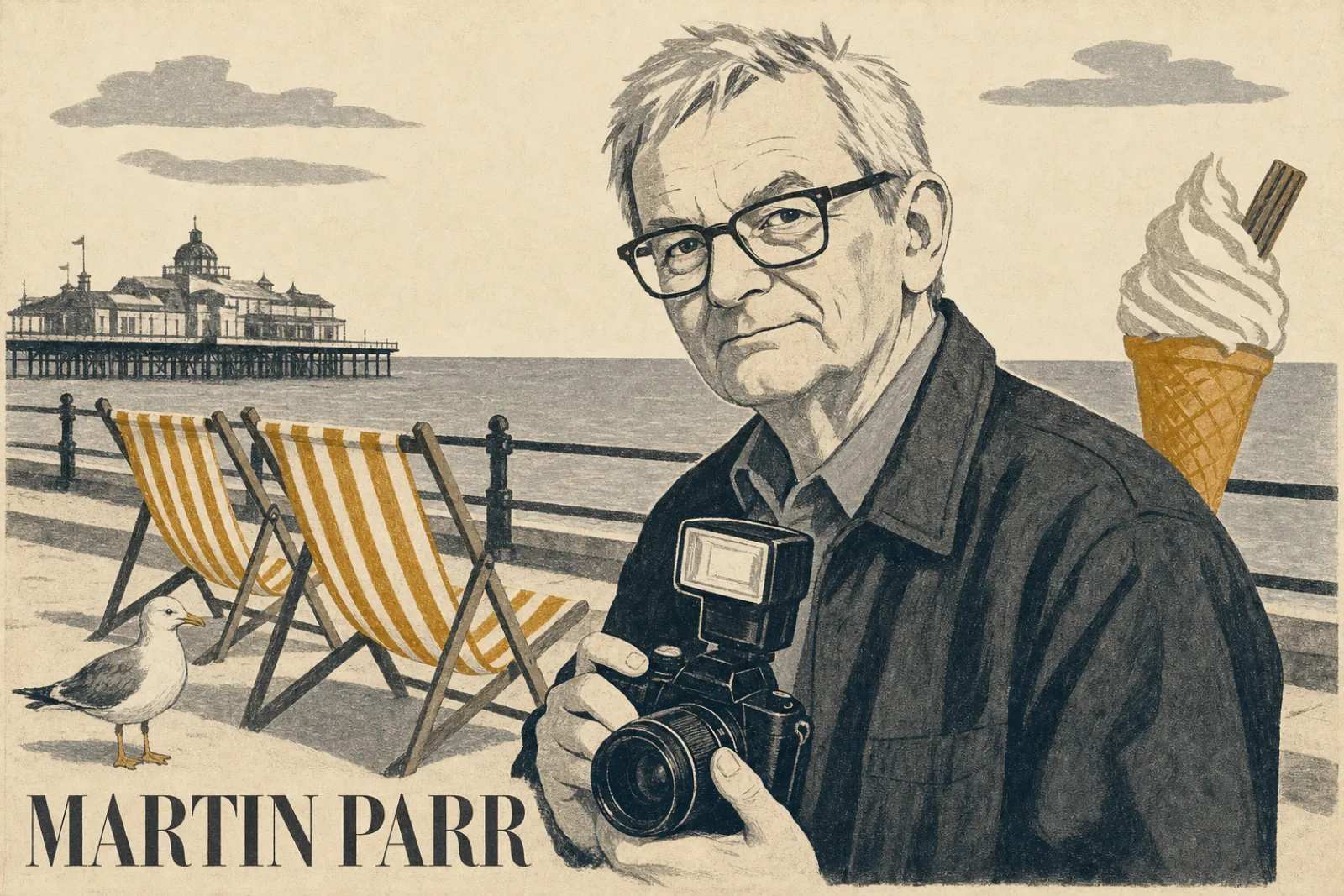
Martin Parr (1952 to 2025) was an English documentary photographer who spent five decades photographing how people in Britain, and later around the world, spend their free time and their money. He worked in saturated colour, close up, with flash in daylight. He is known above all for The Last Resort, a book of pictures made at the seaside resort of New Brighton in the mid 1980s that changed what British documentary photography could look like.
Parr was born in Epsom, Surrey, on 23 May 1952. His grandfather George Parr, a keen amateur photographer, encouraged him, and he studied photography at Manchester Polytechnic from 1970 to 1973, where Brian Griffin and Daniel Meadows were fellow students. He began in the black and white tradition of British documentary photography. What turned him was American colour work: the photographs of Joel Meyerowitz, William Eggleston and Stephen Shore, together with the bright picture postcards published by John Hinde, which he collected.
Black and white in Hebden Bridge
In 1975 Parr moved to Hebden Bridge in West Yorkshire and spent the next five years photographing the nonconformist chapel communities of the surrounding hills. The work was made in black and white with a 35mm Leica. It was not published as a book until 2013, as The Non-Conformists.
Bad Weather, photographed from 1978 to 1981, already shows his sense of humour and his interest in flash. He went out in the worst conditions with an underwater camera and a flashgun, a kit chosen because it could get wet. The subject was a British one, the weather and people putting up with it.
New Brighton and the move to colour
In 1982 Parr moved to Wallasey, near Liverpool, and changed to colour for good. He also changed camera, to a Plaubel Makina, a medium format camera that makes 6x7cm negatives through a fixed wide lens. The larger negative held far more detail than 35mm, and the page on medium format photography explains what that buys and costs.
Over the summers of 1983, 1984 and 1985 he photographed New Brighton, a run-down resort nearby. The pictures show day trippers in bright clothes, amusement arcades, and crowds spread out on concrete promenades. He used flash in bright sun, which lifted the shadows and made the colours jump. The Last Resort was published and shown at the Serpentine Gallery in London in 1986. Some critics called the pictures cruel and voyeuristic and accused him of mocking working class people. Others saw an honest picture of Britain in a period of economic decline. The argument made his name.
Where is the line between observing people and mocking them? Photography ethics covers photographing strangers, consent and what to publish.
Parr moved to Bristol in 1987 and turned the same eye on people closer to his own background. The Cost of Living, photographed from 1987 to 1989, looked at the comfortable middle class in and around Bristol and Bath.
Tourists, close-ups and Magnum
Small World, published in 1995 after years of travel, was about mass tourism. Parr went to the places everyone photographs and photographed the visitors instead. The gap between the place as advertised and the place as experienced was the subject.
For Common Sense, published in 1999, he changed tools again. He used a 35mm camera with a macro lens and a ring flash, loaded with highly saturated film, and went in very close on details: junk food, kitsch souvenirs, loud clothing and jewellery. The exhibition opened in 1999 in 41 venues in 17 countries at the same time. Later books include Think of England (2000) and Luxury (2009).
Parr became an associate of the Magnum Photos agency in 1988. His full membership in 1994 was opposed by some members and passed by a narrow vote. He went on to serve as Magnum’s president from 2013 to 2017. He was also a collector and historian of photography books, and wrote The Photobook: A History, in three volumes, with the critic Gerry Badger. The Martin Parr Foundation, founded in 2014, opened its premises in Bristol in 2017 to hold his archive and to collect and show photography made in Britain and Ireland. He was made a CBE in 2021 and died in Bristol on 6 December 2025, aged 73. He published more than 100 books.
Thinking of putting your own pictures into a book? Photo book design covers format, layout and sequence.
How a Parr picture works
Flash in daylight. Flash in full sun does two things. It fills the hard shadows that midday light leaves on faces, and it gives nearby colours a hard, even brightness that looks slightly unreal. The guide to fill flash explains how to balance it against daylight.
Saturated colour as the subject. Parr chose films and printing that pushed colour hard, and he looked for scenes that already had strong colour in them: plastic, packaging, swimwear, food. The page on colour in photography covers how colour directs attention and sets mood.
Getting close. A fixed wide lens meant that to make people large in the frame he had to stand near them. With the macro lens he came closer still, until a plate of food or a hand filled the frame. Both are versions of the same instruction, to fill the frame and leave out anything that does not add to the point. For the tools of the Common Sense pictures, see macro photography.
Jokes built from two things. Many of his pictures set one thing against another: the grand and the cheap, the famous view and the crowd standing in front of it. This is juxtaposition, and it depends on framing so that both halves are seen at once.
Series, not single pictures. Parr planned books. A single close-up of a plate of food is a curiosity. A hundred frames of food, souvenirs and clothing from many countries make an argument about consumer culture.
Want to make pictures that are funny without being unkind? Humour in photography breaks down how visual jokes work and how to laugh with people, not at them.
Books and series to look for
- The Non-Conformists (photographed 1975 to 1980, published 2013). Chapel life in the Yorkshire hills in black and white. Compare its tone and distance with the colour work that followed.
- Bad Weather (1978 to 1981). Pictures made with flash in foul weather. Notice that the weather, normally a reason to put the camera away, is the subject.
- The Last Resort (1983 to 1985). The New Brighton pictures. Notice the daylight flash, the crowded frames, and the hard colour of clothing against grey concrete.
- The Cost of Living (1987 to 1989). The same method pointed at the middle class. Ask whether the pictures feel different when the people in them are better off.
- Small World (1995). Tourists at famous sites. Look at how the place and the people visiting it are kept in one frame, so neither can be read without the other.
- Common Sense (1999). Close-ups with ring flash. Every picture is a detail, with no background and no horizon, and the meaning comes from seeing many together.
Try this
Take 20 minutes at a place where people eat and relax in public: a market, a fair, a beach cafe or your own kitchen table at a family lunch.
- Turn the flash on, even though it is daylight. On a phone, set the flash to on, not auto.
- Photograph only details, from as close as your camera will focus: a plate, a hand holding a cup, a pattern on a shirt, a souvenir. No whole people and no faces.
- Make 15 frames. Fill each one with a single thing.
- Lay the best nine out as a grid and look at them together.
The constraint is the lesson. One close-up says little. Nine from the same place describe it more sharply than a wide view would. If you move on to photographing people, read the guide to street photography first for approach and conduct.
Questions people ask about Martin Parr
What camera did Martin Parr use?
He used a 35mm Leica for his early black and white work. From 1982 he used a Plaubel Makina medium format camera with a wide lens and flash, the camera of The Last Resort. For the close-up work of the 1990s he used a 35mm camera with a macro lens and ring flash.
Why was The Last Resort controversial?
When the pictures were shown in London in 1986, some critics said Parr was sneering at working class families on holiday and exploiting them. Others argued that he was recording the state of a neglected resort without flattery. Parr went on to photograph the middle class and the wealthy in the same manner.
Was Martin Parr a member of Magnum?
Yes. He became an associate in 1988 and a full member in 1994 after a close and disputed vote. He was president of Magnum Photos from 2013 to 2017.
What is the Martin Parr Foundation?
It is a charity in Bristol that opened to the public in 2017. It holds Parr’s archive, collects photography made in Britain and Ireland, and runs a gallery and a programme of exhibitions and events.
More photographers, with the lessons each one teaches, are in the A to Z of photographers.