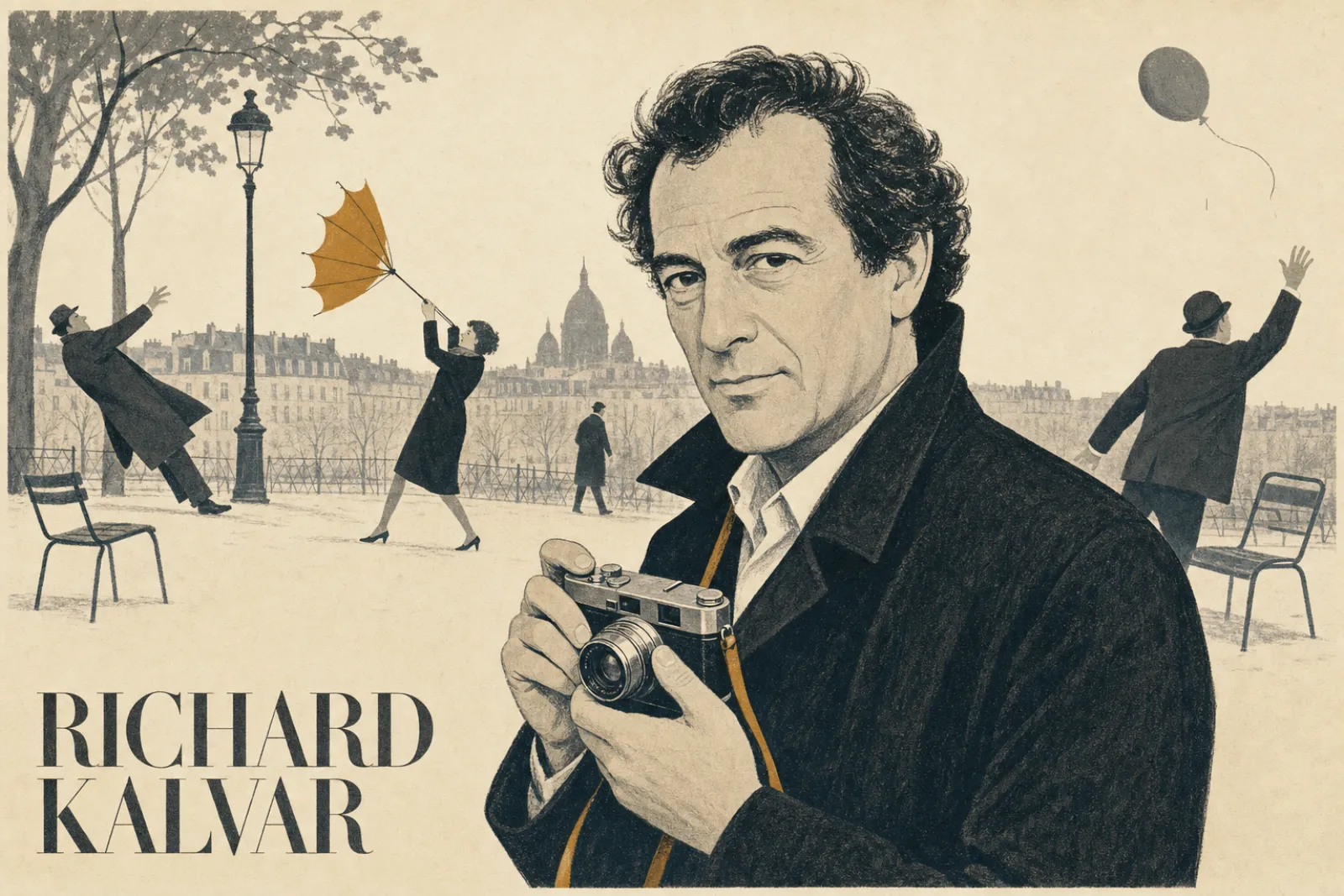
Richard Kalvar is an American photographer, born in Brooklyn in 1944, who made his career in Paris and joined Magnum Photos in the 1970s. He photographed ordinary people in public places in black and white, without posing anyone, and framed them so that a plain moment looks like a scene from a strange play. He is known for pictures that are funny and unexplained at the same time.
Kalvar belongs to the line of unposed street photography that also includes Garry Winogrand in New York, and at Magnum he worked alongside Elliott Erwitt, another photographer who found comedy in the street. The difference is in the tone. Erwitt’s jokes are usually clear at once. Kalvar’s pictures hold the joke back and leave a question in its place. He reacted against the idea that a photograph should explain an event. His personal work does the opposite: it removes the explanation.
From a borrowed trade to a camera of his own
Kalvar studied English and American literature at Cornell University from 1961 to 1965. He did not train as a photographer. Back in New York he worked as an assistant to the French fashion photographer Jérôme Ducrot, and that job was his introduction to the craft. Ducrot gave him a Pentax 35mm camera. In 1966 Kalvar took it on a long trip through Europe, and the pictures he made on that journey persuaded him that photography was what he wanted to do.
He returned to New York and took a job at the Modernage photo lab while he kept photographing. About two years later he moved to Paris, which became his base for the rest of his career. He joined the Vu photo agency, and in 1972 he helped to found the Viva agency. In 1975 he became an associate member of Magnum Photos, and in 1977 a full member. He later served the cooperative as vice-president and as president.
Two bodies of work, kept apart
Kalvar earned his living from assignments, and most of that professional work was in colour. His personal pictures were a separate thing and were made only in black and white. He photographed in France, Italy, England, Japan and the United States, and he carried on a long project in Rome over many years. Early books came out of French subjects: Familles en France in 1973, L’Usine in 1987 and Portrait de Conflans-Sainte-Honorine in 1993.
The personal work was shown slowly and in small numbers. He had a solo exhibition at the Agathe Gaillard gallery in Paris in 1980. The large statement came in 2007, when the Maison Européenne de la Photographie in Paris held a retrospective and the book Earthlings was published with it, under the French title Terriens. The title sets the tone: people are looked at as if by a visitor who does not know the local customs. Later books include Drôles de vie! in 2008, a volume in the Photo Poche series in 2018 and its English edition in the Thames and Hudson Photofile series in 2019. Damiani published a volume of his selected writings in 2023. In 2024 he received the International Award of Photography from the Centro di Ricerca e Archiviazione della Fotografia in Italy.
How do you photograph strangers without arranging them? Candid photography covers how people stop noticing a camera and the settings that let you react in under a second.
How Kalvar makes an ordinary moment look staged
Nothing in a Kalvar picture is set up. The people in his frames look like actors who do not know they are in a play. The effect of theatre comes from four choices that anyone can study.
Framing that removes the explanation. Kalvar has said that context is the enemy of his pictures. He frames tightly enough to cut out whatever would tell you what is really going on: the rest of the crowd, the thing people are looking at, the reason for a gesture. What stays inside the edges is a small group and a relationship between them that the viewer has to guess. The page on framing in photography deals with frames inside the picture, but the same question applies to the outer edge: what you leave out decides what the picture says.
Timing that catches the odd fraction. Most gestures look normal for most of their length. For a fraction of a second a hand, a look or a step can read as something else entirely. Kalvar waited for that fraction. This is the decisive moment used for a different purpose: the peak he wanted was the most ambiguous instant, the one where a movement can be misread.
Alignments between things that have nothing to do with each other. A fountain, a statue, a dog or a sign sits behind or beside a person, and from one exact position the two seem connected. This is juxtaposition, and it is also the basis of most humour in photography: the camera flattens depth and lets two separate things collide. Photographers are usually taught to avoid these overlaps. Kalvar looked for them. The guide to tangents and mergers explains the fault, and so explains how to cause it deliberately.
Black and white as a further step away from reality. Kalvar has explained that his pictures need to be abstracted from life while still looking like life. Selective framing is one abstraction and the frozen instant is another. Removing colour is a third. In black and white the viewer attends to shape, gesture and position, which is where his pictures do their work.
He also held back from captioning. A Kalvar caption gives the place and the year and little else. When Magnum asked him to explain his best known Rome picture, he gave a set of answers and then admitted that some of them were not accurate. That was the point. Once a viewer is told what was really happening, the viewer stops looking.
What should a caption say, and what can it leave out? How to write photo captions sets out what a caption has to answer in documentary work and how that differs in a portfolio or a book.
The method has a cost. Kalvar walked a great deal, watched how people behaved with one another, and made many frames that did not work. He edited hard. One exhibition drawn from his years of work held fewer than 90 photographs.
How long should you stay with one promising spot? Working the scene in street photography describes reading a location, making several passes and knowing when to leave.
Photographs to look for
- Piazza della Rotonda, Rome, 1980. Two men stand at the fountain in front of the Pantheon. Look at how the carved figures of the fountain and the two men share the frame, and at how little of the square is shown. Kalvar’s own account of the picture is deliberately unreliable, so the viewer is left to decide what is going on.
- New York City, 1969. A woman looks at herself in a shop window. It is an early example of his interest in a gesture that can be read two ways. Notice that the glass gives him a second figure without a second person.
- Paris, 1971. Men walk along with tables carried on their heads. Whatever the ordinary reason was, the frame does not give it. It holds only the strange shape the men and the tables make together.
- Rue de l’Ouest, Paris, 1974. A street picture from the 14th arrondissement, captioned with the street and the year and nothing more. Look at how little of the street is shown and how much is left for the viewer to work out.
- Château d’Asson, near Nantes, 1988. Two dogs looking at each other. Kalvar gave animals the same deadpan treatment as people. The picture shows that his method does not depend on city streets or on people at all, only on a relationship and an instant.
- Earthlings, 2007. The retrospective book that gathers the unposed black and white work. Read it as a sequence and watch how rarely a picture tells you where you are or what the occasion is.
Try this: cut out the reason
This takes 15 minutes in any place where people gather: a market, a square, a station, a bus stop.
- Set the camera or phone to black and white so the screen shows you shapes, not colours.
- Find two or three people who are reacting to something: looking up, pointing, laughing, waiting.
- Make one frame that includes the cause of the reaction.
- Move or step closer and make a second frame that leaves the cause outside the edges. Do not crop later. Do it with your feet.
- Repeat with four different groups. Do not ask anyone to do anything.
- Compare each pair. Pick the one pair where the second frame is the more interesting picture, and note what you removed.
The constraint is that the people must be reacting to something real that you then exclude. That is the whole of the technique in its simplest form.
Is it acceptable to photograph strangers this way? Photography etiquette and ethics covers consent, photographing strangers and the line between laughing with someone and laughing at them.
Questions people ask about Richard Kalvar
Is Richard Kalvar a member of Magnum Photos?
Yes. He became an associate member of Magnum in 1975 and a full member in 1977, and he served terms as vice-president and as president of the agency. Before Magnum he belonged to the Vu agency and was one of the founders of Viva in Paris in 1972.
Are Richard Kalvar’s photographs staged?
No. His personal work is unposed. The staged look comes from framing, timing and the removal of context, not from directing anyone.
Why did Richard Kalvar work in black and white?
His commissioned work was mostly in colour, but his personal pictures were always black and white. He has explained that the pictures depend on a degree of abstraction from reality, and that removing colour adds to the abstraction already made by the frame and the frozen moment.
What is Earthlings?
Earthlings, published in French as Terriens, is the 2007 book of Kalvar’s unposed black and white photographs. It accompanied his retrospective at the Maison Européenne de la Photographie in Paris.
For more photographers to study alongside Kalvar, see the A to Z of photographers.